Nakamichi CR-5: The Genesis of a Cassette Legend
In the early 1970s, as compact cassette technology began to emerge from its reputation as a medium for voice dictation and portable music, a handful of Japanese manufacturers sought to elevate the format to true high-fidelity status. Among them, Nakamichi stood out—not just for ambition, but for engineering excellence. The CR-5, introduced in 1973, was one of the company’s earliest high-end cassette decks and served as a critical stepping stone toward the legendary status Nakamichi would later achieve with models like the Dragon and ZX-7.
Though overshadowed by its more famous successors, the CR-5 was a bold statement of intent. It signaled Nakamichi’s commitment to precision mechanics, advanced tape head design, and audiophile-grade performance—values that would define the brand for decades. For collectors and vintage audio enthusiasts today, the CR-5 is a rare and historically significant machine, representing the dawn of the high-fidelity cassette era.
Technical Specifications
| Specification | Detail |
| Model | CR-5 |
| Manufacturer | Nakamichi Corporation, Japan |
| Year Introduced | 1973 |
| Type | 3-head, dual-motor cassette recorder |
| Tape Speed | 1⅞ ips (4.76 cm/s) |
| Heads | Separate record, playback, erase heads |
| Motor System | Dual direct-drive motors |
| Wow and Flutter | < 0.08% (measured) |
| Frequency Response | 30 Hz – 15 kHz (IEC Type I) |
| Signal-to-Noise Ratio | 58 dB (Dolby B capable) |
| Total Harmonic Distortion | < 1.5% |
| Input/Output | Line in/out (RCA), mic in (¼") |
| Power Requirement | 120V AC, 50/60 Hz |
| Dimensions | 440 mm (W) × 140 mm (H) × 330 mm (D) |
| Weight | 10.5 kg (23.1 lbs) |
| Accessories | Remote control (optional), calibration tape |
The CR-5 was built around a three-head configuration—a rarity at the time—featuring separate record, playback, and erase heads. This allowed for precise monitoring during recording, a feature typically found only in professional reel-to-reel decks. The dual direct-drive motor system ensured stable tape transport with minimal speed variation, contributing to its remarkably low wow and flutter.
Unlike later Nakamichi models, the CR-5 did not feature auto-reverse or Dolby C, but it was Dolby B noise reduction compatible, a cutting-edge feature in the early '70s that helped reduce tape hiss without overly complex circuitry. Its frequency response was impressive for the era, especially when using IEC Type I (ferric) tapes, and it could be calibrated for chrome tapes with manual bias and equalization adjustments.
Sound Characteristics and Performance
The CR-5 was engineered for accuracy and transparency, not coloration. Nakamichi’s philosophy from the outset was to reproduce the source signal as faithfully as possible, and the CR-5 delivered on that promise. Its separate playback head allowed for optimal alignment and minimized phase errors, resulting in tight bass, clear mids, and detailed highs.
When properly calibrated, the CR-5 could extract impressive dynamics and stereo imaging from even modest tapes. Its low distortion and wide frequency response made it a favorite among early audiophiles who were beginning to see cassette as a viable alternative to vinyl for portable and secondary listening.
While it lacked the azimuth correction and level optimization of later Nakamichi flagships, the CR-5’s manual calibration controls (bias, level, equalization) gave experienced users the tools to fine-tune performance for different tape formulations—a hallmark of professional-grade recorders.
Notable Features and Innovations
The CR-5 was packed with features that set it apart from consumer-grade cassette decks of the early 1970s:
- Three-head design: Enabled real-time monitoring during recording, a feature almost unheard of in cassettes at the time.
- Dual direct-drive motors: Provided precise capstan and take-up control, reducing reliance on pinch rollers and improving speed stability.
- Manual calibration dials: Allowed users to adjust bias, record level, and playback equalization for optimal performance with ferric, chrome, or metal tapes.
- High-precision tape transport: Built with heavy-duty chassis and rubber-isolated components to minimize vibration.
- Dolby B compatibility: One of the first cassette decks to integrate noise reduction as a standard feature.
These features positioned the CR-5 not as a consumer product, but as a semi-professional recorder—a tool for musicians, broadcasters, and serious hobbyists who demanded more from the cassette format.
Common Issues and Maintenance
As a 50-year-old machine, surviving CR-5 units require careful attention to restore and maintain. Common issues include:
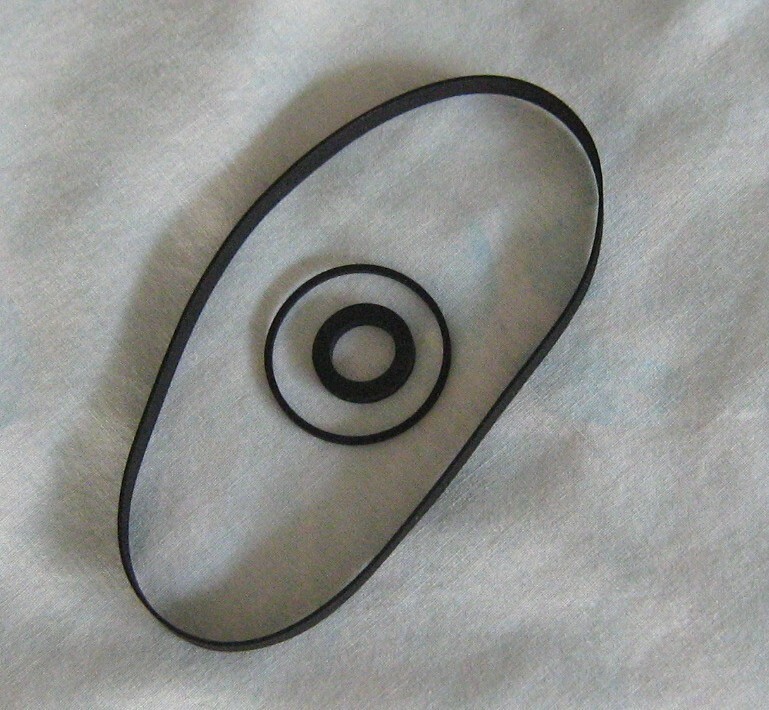
- Deteriorated rubber parts: The capstan tires, pinch rollers, and idler wheels are prone to hardening or crumbling. These must be replaced with modern equivalents.
- Worn belts: Though the CR-5 uses direct-drive motors, some internal mechanisms rely on small belts that degrade over time.
- Head wear and oxidation: Playback and record heads can become misaligned or corroded. Professional demagnetization and resurfacing are recommended.
- Capacitor aging: Electrolytic capacitors in the power supply and audio circuits may leak or lose capacitance, requiring replacement.
- Sticky pots and switches: The manual calibration controls can develop noise or intermittent contact due to dust and oxidation.
Restoration should be performed by a technician experienced with vintage tape equipment. Calibration using a reference tape and oscillator is essential to restore the CR-5 to its original performance standards.
Current Market Value and Collectibility
The Nakamichi CR-5 is rare on the vintage market, especially in working condition. Unlike later models such as the 700Z or Dragon, the CR-5 was produced in limited numbers and was never widely exported outside Japan and select Western markets.
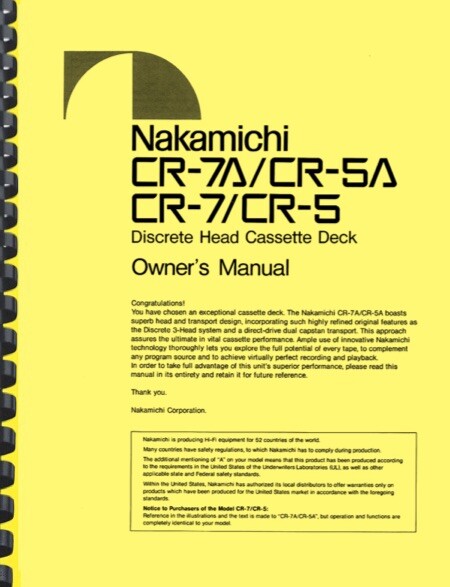
Today, a fully restored and calibrated CR-5 can command $400–$700, depending on condition, accessories, and provenance. Units with original packaging, manuals, and calibration tapes are particularly sought after by collectors of early high-end audio gear.
Its value lies not just in functionality, but in historical significance. The CR-5 represents the first major step in Nakamichi’s journey to becoming the undisputed leader in high-end cassette technology. For enthusiasts of analog tape, it’s a pioneer—a machine that helped prove cassette could be more than just convenience.
Conclusion and Legacy
The Nakamichi CR-5 may not have the fame of the Dragon or the ubiquity of the ZX-7, but it holds a special place in audio history. It was Nakamichi’s first serious foray into the high-fidelity cassette market, and it set the template for everything that followed: precision engineering, three-head design, manual calibration, and a relentless pursuit of sonic accuracy.
While later models would surpass it in automation and performance, the CR-5 laid the foundation. It was a machine built for those who cared about every detail—from the tension of the tape to the alignment of the heads. In an era when most cassettes sounded muffled and distorted, the CR-5 offered clarity, depth, and fidelity that stunned listeners.
Today, the CR-5 is more than a relic—it’s a testament to the belief that format limitations could be overcome with engineering excellence. For vintage audio collectors and tape enthusiasts, finding and restoring a CR-5 isn’t just about owning a piece of history—it’s about honoring the beginning of a legacy that redefined what cassette could be.
eBay Listings


As an eBay Partner, we earn from qualifying purchases. This helps support our independent vintage technology research.
Related Models
- Nakamichi 1000ZXL (1985)
- Nakamichi BX-150 (1983)
- Nakamichi CR-4 (1969)
- Nakamichi 1000-II (1974)
- Nakamichi 1000ZXL-LIMITED (1985)
- Sony TC-2050SD (1978)
- Aiwa AD-F990 (1993)
- Kenwood KX-3060 (1982)
- Sony TC-2130A (1974)
- Sony TC-2220 (1972)