Nakamichi CR-30 (1988–1989)
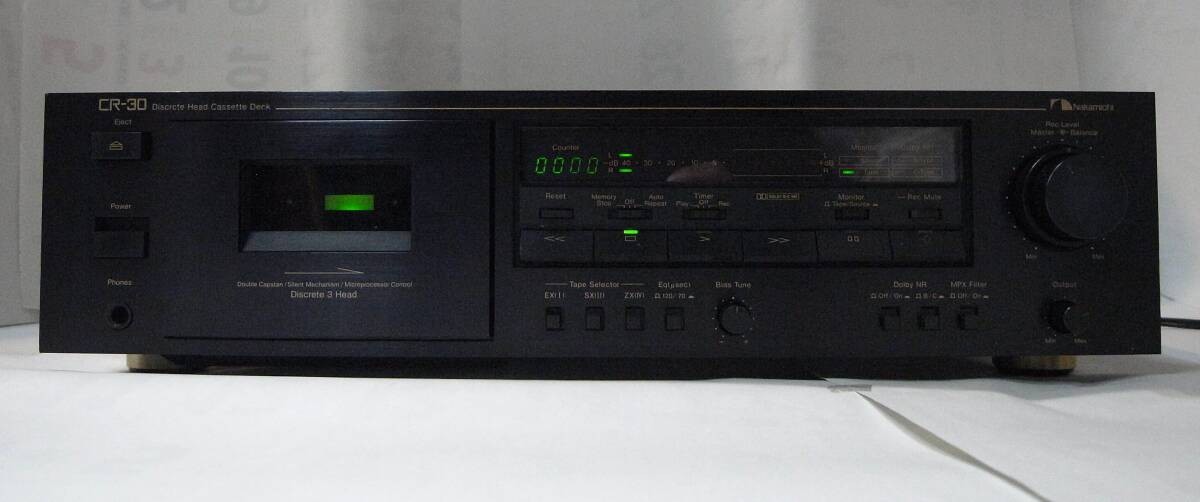
The Nakamichi CR-30 is a three-head cassette deck from the tail end of Nakamichi's analog era, built in Japan around 1988-1989. It was the last full-featured model in the CR series. Period Japanese sources give a list price of ¥100,000, though a U.S. figure of $795 has also been cited. The CR-30 shared its service manual with the CR-3, CR-3A, and CR-3E. The family resemblance is clear. This is a deck built on Nakamichi's traditional discrete three-head approach, not the auto-reversing complexity of some later models.
The headline feature is the fully independent discrete three-head system. Nakamichi argued it avoided the high-frequency loss caused by magnetic azimuth shift in combination heads. The record and playback heads are separate Crystalloy units with a self-polishing contour, which the company claimed kept like-new performance for over 10,000 hours. The transport uses a closed-loop dual capstan arrangement. Two capstans turn at slightly different speeds to hold tape tension without the tape pads or guides that could add modulation noise. Nakamichi also used a frequency-distributed transport design to avoid overlapping flutter periods, and the whole mechanism was built for silence.
The electronics follow the usual Nakamichi house approach: a multi-regulated power supply with high-speed discrete regulators, a dual-mono amplifier board configuration, and gold-plated input/output terminals. Dolby B and C noise reduction are on board, along with an independent equalizer switch, an output volume control, a tape slack prevention mechanism, and an acoustic insulator to cut external vibration. A system remote terminal and headphone jack are fitted. The RM-5 remote was sold separately for ¥6,000.
The period material makes the manufacturing discipline the most striking part of the CR-30. Nakamichi claimed roughly thirty internal adjustment points. That includes six bias trim pots for left and right channels across three tape positions, where a typical deck might have only one per channel. Every unit also got a 56-item characteristic measurement before shipment, and only decks that met every specification were released.
Rated performance: frequency response of 20 Hz to 20 kHz ±3 dB at -20 dB recording level across Type I, II, and IV tapes; wow and flutter of 0.035% or less Wrms; signal-to-noise of 72 dB or better with Dolby C on Type IV tape; and total harmonic distortion of 0.5% or less (EIAJ). The deck measures 430 × 100 × 265 mm and weighs approximately 5.8 kg.
Documentation on the CR-30's real-world reception is thin. No substantive period reviews have surfaced in the archive, and most contemporary references are sales listings and owner's manuals. The record does show a Nakamichi deck with the brand's usual heavy calibration, aimed at listeners who valued recording accuracy over convenience features.
eBay Listings
As an eBay Partner, we earn from qualifying purchases. This helps support our independent vintage technology research.
Related Models
- Nakamichi CR-7 (1971)
- Nakamichi 250
- Nakamichi 420
- Nakamichi 500
- Nakamichi 600II
- Akai CS-M40R (1983)
- Akai GX-7 (1970)
- Akai GX-8 (1975)
- Akai GX-F44R (1979)
- Akai GX-F71 (1982)