Nakamichi Amplifier 1 (c. 1990–1993)
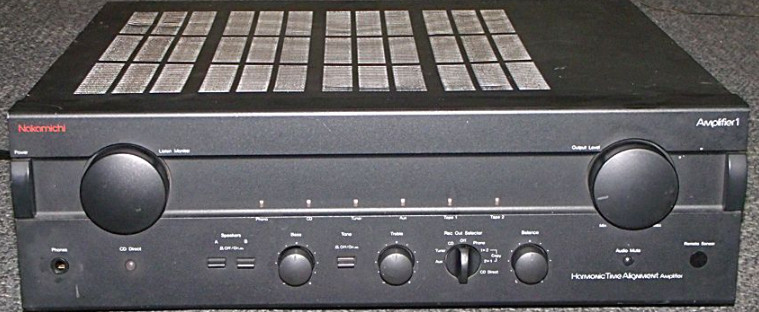
The Nakamichi Amplifier 1 is an integrated amplifier built around the company's Harmonic Time Alignment (HTA) theory, developed by Steve Kalison at Nakamichi's US Research Center. Most amplifiers use a single global negative feedback loop. HTA gives each stage its own regulated local loop instead, and the aim is to keep whatever residual distortion remains in phase with the original signal. Nakamichi had stopped licensing Nelson Pass's STASIS circuit by this point, and HTA was the in-house answer for setting its mid-priced amps apart from the Sony, Kenwood, and Yamaha crowd. The result was a wide-band, low-gain open-loop design used in both the preamp and power sections.
It's a big unit - 430 mm wide, 125 mm high, 360 mm deep, and roughly 15 kg. It's rated at 80W + 80W into 8Ω from 20 Hz to 20 kHz at 0.1% THD, with power bandwidth from 10 Hz to 50 kHz. The output stage uses eight transistors in a two-parallel push-pull arrangement capable of 28A peak per channel. A multi-regulated power supply gives the preamp, power amp, and control sections separate transformer windings, and the ground circuit uses Nakamichi's isolated-ground scheme. The line stage is built from discrete components, and the volume is a motor-driven four-gang potentiometer. A CD Direct input bypasses the selector and balance controls entirely and routes signal through that dedicated volume pot only.
The phono stage handles both MM and MC - 2.5 mV/47kΩ and 0.125 mV/100Ω respectively. RIAA accuracy is ±0.5 dB from 30 Hz to 20 kHz, and S/N is 82 dB (MM) and 70 dB (MC). The tone controls are modest at ±10 dB at 20 Hz and 20 kHz. The supplied infrared remote adjusts volume, switches inputs, and can also operate compatible Nakamichi CD players and decks. Optional system remote cables (SRC-2, SRC-3, and the RC-4 converter) linked it to Nakamichi's cassette decks and the 1000 series.
Dating the Amplifier 1 is a bit fuzzy. Sources place it anywhere from 1988 to 1993, with one reference giving "November 1990-1993" and another saying it was first sold in 1992 and discontinued a year later. The design shares its look with the CassetteDeck 1 and 2 of the same era, and a smaller sibling, the Amplifier 2, sat beneath it in the lineup. The Vintage Knob is blunt about it: the matte black finish and proportions were a good intention "which didn't help sales at all." Scarcity today seems to bear that out. It's a relatively rare find, and most discussion of it lives in a handful of forum threads and seller listings rather than in the period press. The sources give no original retail price.
What survives in the secondary market suggests owners value it. One Russian seller claimed it "will give a head start to Pioneers, Sonys, Technics, Marantz, Sansui." Another listing notes a unit took a blow to the face during shipping from Japan but survived. A service manual exists - 32 pages, available as a PDF download - which is more than many amplifiers of this vintage can claim.
Known specs at a glance:
- Rated output: 80W + 80W (8Ω, 20 Hz–20 kHz, 0.1% THD)
- Power bandwidth: 10 Hz–50 kHz
- Frequency response: 5 Hz–80 kHz (+0/–3 dB)
- S/N (IHF A-weighted, input short): 105 dB
- Maximum output current: 28A peak per channel
- Phono: MM 2.5 mV/47kΩ; MC 0.125 mV/100Ω
- Line inputs: CD, CD Direct, Tuner, Tape, Aux — 150 mV/20kΩ
- Dimensions: 430 × 125 × 360 mm; 15 kg
Little is documented about the Amplifier 1's market positioning or its reception in the contemporary hi-fi press. The record is built largely from the manufacturer's own spec sheet, a handful of enthusiast observations, and the occasional seller's description.
eBay Listings
As an eBay Partner, we earn from qualifying purchases. This helps support our independent vintage technology research.
Related Models
- Nakamichi 620
- Nakamichi Amplifier2
- Nakamichi AVP-1 (2014)
- Nakamichi CA-5
- Nakamichi CA-7
- Eico 3150 (1967)
- Fisher CUSTOM-ELECTRA-I (K-14/K-15) (1957)
- Fisher CUSTOM-ELECTRA IV (E33/E44) (1960)
- Akai AM-2400 (1978)
- Akai AM-2600 (1977)