Nakamichi 680ZX: The Pinnacle of High-End Cassette Engineering
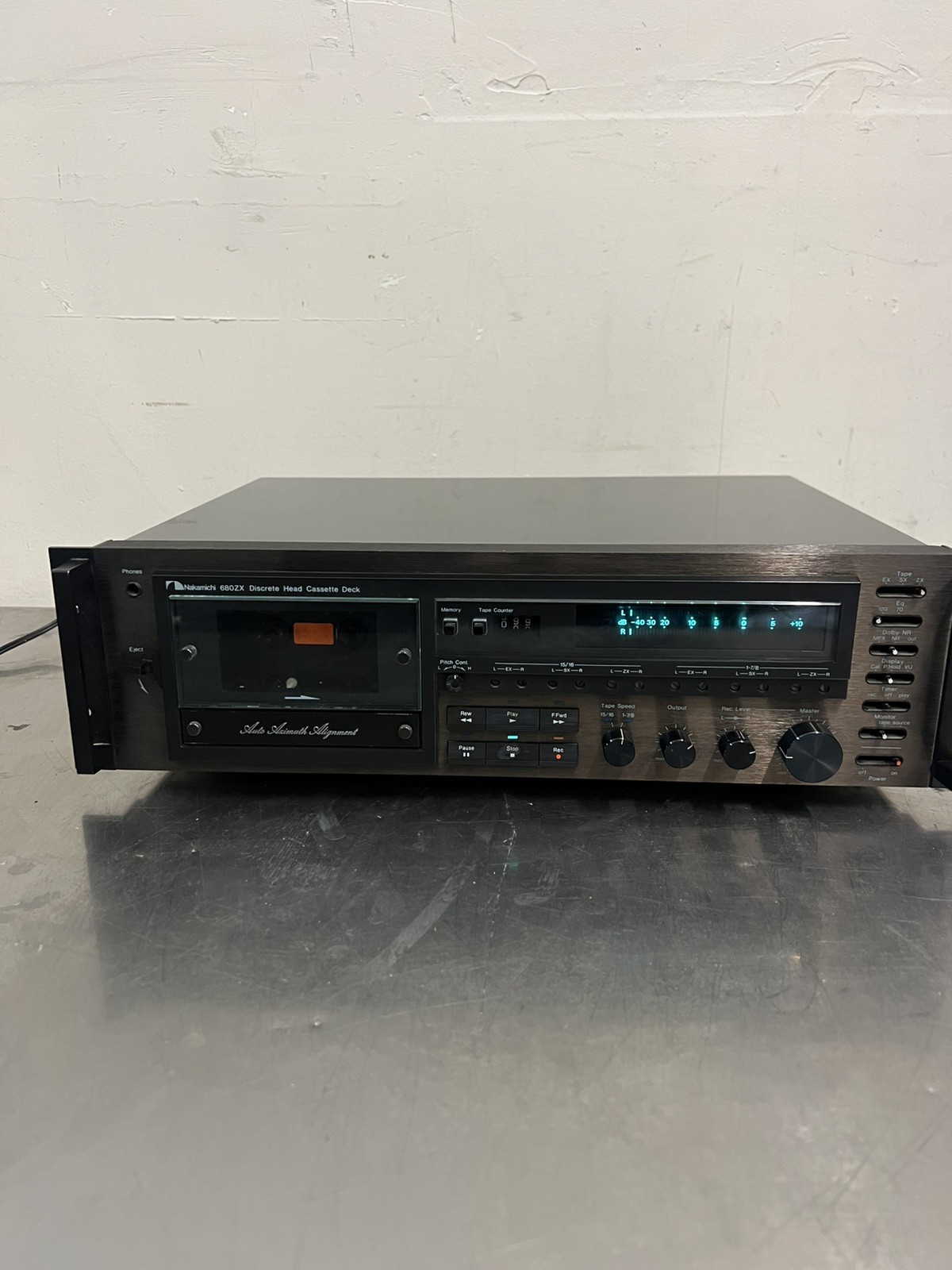
In the early 1980s, when audiophiles were beginning to question whether cassette tapes could truly rival reel-to-reel or vinyl in sound quality, Nakamichi answered with a resounding yes. The Nakamichi 680ZX, introduced in 1983, stood as one of the company’s most advanced cassette decks of its time—a technological tour de force that pushed the boundaries of what was possible in consumer analog tape reproduction. Though not as legendary as the auto-reversing CR-7 or the groundbreaking Dragon, the 680ZX occupies a respected place in Nakamichi’s lineage as a precision-engineered machine built for serious listeners who demanded near-reference playback performance.
Part of Nakamichi’s elite "ZX" series, the 680ZX was positioned just below the flagship 700ZX, sharing much of its advanced circuitry and mechanical design. It represented the culmination of years of refinement in tape head alignment, transport stability, and noise reduction integration. For those who sought the ultimate in cassette fidelity without stepping into the rarefied (and expensive) world of the Dragon, the 680ZX offered a compelling blend of performance, build quality, and innovation.
Technical Specifications
| Specification | Detail |
| Year Introduced | 1983 |
| Type | 3-Head, Full-Track Stereo Cassette Deck |
| Tape Speed | 1⅞ ips (4.76 cm/s) |
| Heads | Fujiya AVX (Record/Playback: Discrete, Fixed; Erase: Separate) |
| Motor System | Dual Direct-Drive Capstan Motors (One per direction) |
| Wow & Flutter | < 0.06% (WRMS) |
| Frequency Response | 20Hz – 20kHz (with CrO₂ tape, ±3dB) |
| Signal-to-Noise Ratio | 72 dB (Dolby C), 68 dB (Dolby B) |
| Dynamic Range | > 65 dB (with CrO₂ tape) |
| Azimuth Adjustment | Manual (via front-panel knob and test tape) |
| Noise Reduction | Dolby B, C, and HX Pro (Headroom Extension) |
| Inputs/Outputs | Line In (RCA), Line Out (RCA), 3.5mm Tape Monitor Jack |
| Recording Modes | Normal (IEC I), Chrome (IEC II), Metal (IEC IV) |
| Display | Dual VU Meters, LED indicators for mode and Dolby |
| Dimensions | 483 mm × 146 mm × 375 mm (W×H×D) |
| Weight | 13.6 kg (30 lbs) |
Sound Characteristics and Performance
The 680ZX was engineered for sonic transparency. Its three-head configuration—separate record, playback, and erase heads—allowed for independent optimization of each function, a hallmark of professional tape decks. The use of Fujiya AVX heads, known for their durability and high-frequency clarity, contributed to a clean, detailed sound with excellent transient response.
One of the 680ZX’s standout features was its dual direct-drive capstan motors, eliminating the need for belts or idler wheels. This design ensured exceptional speed stability and minimized mechanical wear, resulting in remarkably low wow and flutter—critical for maintaining pitch accuracy and rhythmic integrity. The deck’s rigid chassis, constructed from heavy-gauge steel and damped with bituminous material, further reduced vibration and external resonance.
With Dolby C and HX Pro support, the 680ZX could extract maximum fidelity from high-bias tapes. HX Pro, a non-noise-reduction technology, dynamically adjusted the bias during recording to prevent magnetic saturation, thereby extending high-frequency headroom—especially beneficial with metal tapes. The result was a wider dynamic range, reduced distortion, and a more open, natural soundstage.
Listeners often describe the 680ZX’s tonal balance as neutral and highly resolving, with tight bass, articulate mids, and extended, smooth highs. When paired with high-quality Type II or Type IV tapes and well-calibrated, it could produce results that rivaled early CD players in musicality and warmth.
Notable Features and Innovations
The 680ZX was packed with features that set it apart from even high-end contemporaries:
- Manual Azimuth Adjustment: Unlike most decks with fixed head alignment, the 680ZX allowed users to fine-tune the playback head’s azimuth using a front-panel knob and a calibration tape. This ensured optimal high-frequency response and channel balance, a feature typically reserved for professional studio equipment.
- Dual VU Meters: Large, centrally located VU meters provided real-time visual feedback during recording, allowing precise level setting and preventing overmodulation.
- Three-Head Configuration with Fixed Playback Head: The playback head did not move, ensuring consistent alignment and minimizing wear. The record head was only engaged during recording, preserving its life and accuracy.
- Direct-Drive Dual Capstan System: A rarity in consumer decks, this system provided bidirectional speed precision without the degradation associated with rubber belts.
- IEC Equalization Switching: Automatic or manual selection of 120μs (Normal), 70μs (Chrome), and 70μs with metal bias (Metal), ensuring correct replay equalization for all tape types.
- Tape Monitor Jack: A 3.5mm output allowed connection to headphones or external monitoring, useful for on-the-go recording checks.
Common Issues and Maintenance
As with all high-performance analog gear from the 1980s, the Nakamichi 680ZX requires careful maintenance to perform at its best. Common issues include:
- Dried-up Lubricants: The capstan and pinch roller mechanisms rely on precise lubrication. Over time, grease can harden, leading to speed instability or motor strain. A full mechanical service includes disassembly and relubrication of critical points.
- Pinch Roller Hardening: The rubber pinch roller can glaze or harden, causing tape slippage and speed fluctuations. Replacement or rejuvenation with specialized compounds is often necessary.
- Head Alignment Drift: While the fixed playback head is stable, the record head and tape path guides may shift over time. Professional alignment using calibration tapes is recommended for optimal performance.
- Capacitor Aging: Electrolytic capacitors in the power supply and audio circuits may degrade, leading to noise, hum, or channel imbalance. A recapping service is advisable for decks that haven’t been serviced in decades.
- Dust and Oxide Buildup: Regular cleaning of heads, capstans, and guides with isopropyl alcohol and lint-free swabs is essential to maintain signal clarity and prevent head clogging.
Due to its complexity, the 680ZX is not a beginner-friendly restoration project. Enthusiasts are encouraged to seek out technicians experienced with high-end Nakamichi decks.
Current Market Value and Collectibility
The Nakamichi 680ZX is a sought-after machine among cassette aficionados, though it trades below the stratospheric prices of the Dragon or CR-7. In working condition, a well-maintained 680ZX typically sells for $400–$700, depending on cosmetic condition, service history, and included accessories (such as calibration tapes or original packaging).
Fully restored units with documented alignment and fresh belts (where applicable) command premiums, especially in North America and Japan. While not as rare as some of its siblings, the 680ZX’s combination of advanced engineering, solid build, and excellent sound ensures steady demand.
Collectors value it not only for performance but also as a symbol of Nakamichi’s commitment to analog excellence during the cassette’s golden age. Its understated black chassis, brushed aluminum faceplate, and precision controls exude the no-nonsense elegance of 1980s high-end audio.
Conclusion and Legacy
The Nakamichi 680ZX may not have the fame of the Dragon, but it embodies the same philosophy: uncompromising engineering in service of musical truth. For audiophiles who appreciate the tactile experience of tape, the 680ZX offers a window into a time when manufacturers believed cassette could—and should—deliver reference-grade sound.
Today, it stands as a testament to analog innovation, a machine that treated the cassette not as a convenience format, but as a legitimate medium for high-fidelity reproduction. In an era of digital perfection, the 680ZX reminds us that warmth, soul, and precision can coexist—on a 1/8-inch strip of magnetic tape.
eBay Listings



As an eBay Partner, we earn from qualifying purchases. This helps support our independent vintage technology research.
Service Manuals & Schematics
- Service Manual — archive.org
Related Models
- Nakamichi 1000ZXL (1985)
- Nakamichi BX-150 (1983)
- Nakamichi CR-4 (1969)
- Nakamichi 1000-II (1974)
- Nakamichi 1000ZXL-LIMITED (1985)
- Sony TC-2050SD (1978)
- Aiwa AD-F990 (1993)
- Kenwood KX-3060 (1982)
- Sony TC-2130A (1974)
- Sony TC-2220 (1972)