Nakamichi 680 (c. 1980)
A two-speed cassette deck with half-speed recording that delivered near-full-speed fidelity.
Overview
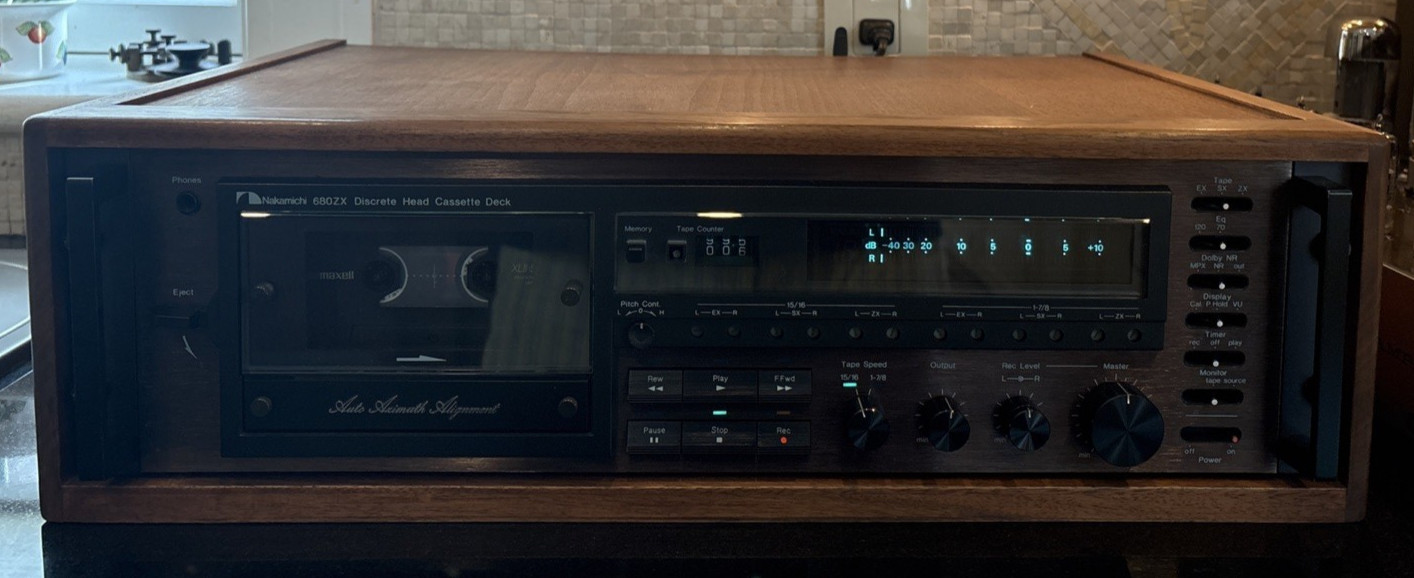
The 680 was the first consumer cassette deck to offer a 15/16 ips (2.4 cm/s) speed alongside the standard 1-7/8 ips, and for years it was the only one. At half-speed, a C-90 cassette became a three-hour tape. The performance held up, too. Stereo Review (August 1980) found "almost perfectly flat response out to 15 kHz" at half-speed, which few full-speed decks could match. At standard speed, High Fidelity (May 1980) called the 680 "simply superb… cannot be surpassed." It sold for ¥238,000 in Japan, and that bought a machine packed with innovations the competition spent years chasing.
The performance starts with a discrete three-head system. Nakamichi's crystalline P-8L playback head has a 0.6 micron gap, and the R-8L recording head has a 3.5 micron gap. Both were built from a crystallized material that resisted wear so well the company claimed no degradation after 10,000 hours. An E-8L double-gap erase head handled erasure to 60 dB or more. The transport used a frequency-distributed dual-capstan arrangement with two different-diameter capstans to avoid overlapping flutter peaks, plus a pad lifter that eliminated head pressure pads. The chassis was resonance-damping, aluminum alloy combined with resin-molded parts that killed vibration before it reached the tape path.
The 680 also had auto azimuth alignment, a feature normally reserved for studio machines. A built-in 400 Hz, 0 dB test tone was recorded, played back, and analyzed by a phase-discrimination circuit. That circuit adjusted the recording head's tilt angle through a motor-driven lever. The process repeated until the play button's indicator stopped blinking, so azimuth was locked for each tape. That removed the most common alignment headache for serious recordists. The recording amplifier also dropped the coupling capacitor to the head and used a direct-coupled DC design to reduce low-frequency phase shift, while a double negative-feedback circuit improved equalization accuracy.
The 680 also introduced RAMM (Random Access Music Memory), which let fast-forward or rewind skip up to 18 selections by counting the pauses between songs. A dedicated cueing mode crept through tape at one-third speed (or one-fifth with a continuous press), which made it easy to find exact start points. The pitch control varied playback speed by ±6%, and the front-panel FL display could switch between VU-style metering and peak indication with a hold function. A Dolby level-adjustment circuit was built in for calibration. The three-position tape selector handled EX (normal), SX (chrome equivalent), and ZX (metal) tapes, with separate 120 µs / 70 µs equalizer switching. Dolby B noise reduction circuits were dedicated to both record and playback, so off-tape monitoring worked during recording.
The deck’s wow and flutter figures were exceptional for the era: at standard speed, 0.04% WRMS (0.08% weighted peak); at half-speed, 0.08% WRMS (0.15% weighted peak). Frequency response at standard speed with ZX metal tape was ±3 dB from 10 Hz to 22 kHz, while at half-speed the range was ±3 dB from 10 Hz to 15 kHz — a limitation only noticeable on the most demanding program material. Signal-to-noise ratio with Dolby B engaged and 70 µs equalization measured 66 dB at standard speed (0 dB level, 3% THD). Distortion at 0 dB, 400 Hz, with ZX tape came in at 0.8% or less. These numbers meant the 680 could hold its own against open-reel decks aimed at the consumer market.
Every 680 came with a rack-mount adapter (19-inch panel, EIA-standard screw pitch) and the option of the RM-200 remote control. A dedicated power terminal for Nakamichi's Black Box series accessories was also included. The deck measured 3.5 inches high, 17.3 inches wide, and 14.5 inches deep. Owners report that the transport's C-MOS logic control made the buttons feel decidedly modern, with smooth cam-driven mechanisms for head base and pinch roller engagement.
Collectors prize the 680 for its rarity and for being the only half-speed deck that worked well enough to use daily. The belts and idlers are replaceable, and the heads have held up remarkably well even after decades. Second-hand prices have climbed steadily as the deck's reputation for unique capability has spread among tape fans. A working unit with original packaging can fetch well over the $2,000 mark in 2025.
eBay Listings



As an eBay Partner, we earn from qualifying purchases. This helps support our independent vintage technology research.
Related Models
- Nakamichi CR-7 (1971)
- Nakamichi 250
- Nakamichi 420
- Nakamichi 500
- Nakamichi 600II
- Akai CS-M40R (1983)
- Akai GX-7 (1970)
- Akai GX-8 (1975)
- Akai GX-F44R (1979)
- Akai GX-F71 (1982)