Nakamichi 481: The Precision Pioneer of Cassette Fidelity
In the late 1970s, as high-fidelity audio reached new heights, cassette tapes were still considered by many audiophiles to be a convenient but sonically compromised format—until Nakamichi changed the game. The Nakamichi 481, introduced in 1978, was one of the first cassette decks to challenge the notion that compact cassettes couldn’t deliver true high-end sound. Though it predates the legendary Nakamichi 1000 and the later CR-7A, the 481 laid crucial groundwork for the brand’s reputation as the gold standard in cassette reproduction.
While not as widely celebrated as its successors, the Nakamichi 481 was a technological marvel of its time, combining precision engineering, advanced tape transport mechanics, and innovative alignment systems. It marked a turning point in cassette deck design and established Nakamichi as a leader in the pursuit of tape-based audio perfection.
Technical Specifications
The Nakamichi 481 was engineered for accuracy, consistency, and long-term reliability. It featured a dual-capstan transport system, a hallmark of Nakamichi’s high-end decks, which minimized tape flutter and ensured stable tape-to-head contact. Its three-head configuration (record, playback, and erase) allowed for precise monitoring during recording—a feature previously reserved for professional reel-to-reel decks.
| Specification | Detail |
| Model | Nakamichi 481 |
| Year Introduced | 1978 |
| Type | 3-Head Stereo Cassette Deck |
| Tape Transport | Dual Capstan, Direct Drive |
| Heads | Three (Record, Playback, Erase) |
| Head Type | Discrete Permalloy (Record & Playback) |
| Azimuth Adjustment | Manual, User-Accessible |
| Tape Speed | 1⅞ ips (4.76 cm/s) |
| Frequency Response | 30 Hz – 18 kHz (Type IV), 35 Hz – 17 kHz (Type II) |
| Wow and Flutter | < 0.055% (weighted) |
| Signal-to-Noise Ratio | 66 dB (Dolby B), 72 dB (Dolby C) |
| Total Harmonic Distortion | < 1.5% |
| Input/Output | Line In/Out (RCA), Mic In (¼") |
| Recording Modes | Type I (Ferric), Type IV (Metal) |
| Dolby Noise Reduction | Dolby B and C (switchable) |
| Power Requirements | 120V AC, 60 Hz (or 220-240V via transformer) |
| Dimensions | 440 mm × 145 mm × 355 mm (W×H×D) |
| Weight | 14.5 kg (32 lbs) |
Sound Characteristics and Performance
The Nakamichi 481 was designed with one goal: to extract the maximum possible fidelity from the compact cassette format. Its three-head system allowed users to monitor recordings in real time with the playback head, ensuring that what you heard during recording was exactly what was being captured.
Sonically, the 481 delivered a remarkably neutral and transparent sound signature. Bass response was tight and well-controlled, thanks to precise tape speed regulation and minimal wow and flutter. Midrange clarity was excellent, making it ideal for vocal recordings and acoustic instruments. High frequencies were extended and detailed without being harsh—especially when using metal tapes with Dolby C noise reduction engaged.
One of the deck’s standout features was its ability to handle azimuth misalignment, a common issue in cassette playback. Unlike most decks of the era, the 481 allowed manual azimuth adjustment, enabling users to fine-tune the playback head angle to match the recording source. This was particularly valuable when playing tapes recorded on other machines, where head alignment might be off. For purists, this meant the difference between muffled highs and sparkling clarity.
Notable Features and Innovations
The Nakamichi 481 introduced several features that would become standard in high-end cassette decks:
- Dual Capstan Transport: Reduced tape slippage and improved speed stability, minimizing flutter and ensuring consistent contact between tape and heads.
- Three-Head Configuration: Enabled real-time monitoring with the playback head, a feature previously found only in professional studios.
- Manual Azimuth Adjustment: A rare and advanced feature that gave users control over high-frequency response by aligning the playback head precisely.
- Dolby B and C Compatibility: Offered effective noise reduction for both ferric and metal tapes, significantly improving signal-to-noise ratio.
- Discrete Head Design: Each head was optimized for its specific function (record, playback, erase), rather than using a combined record/play head, resulting in superior performance.
The front panel was clean and functional, with large VU meters for level monitoring, tactile buttons for transport control, and clear labeling for recording modes and noise reduction settings. The build quality was exceptional—thick steel chassis, precision-machined components, and high-grade potentiometers and switches—all contributing to its reputation for durability.
Common Issues and Maintenance
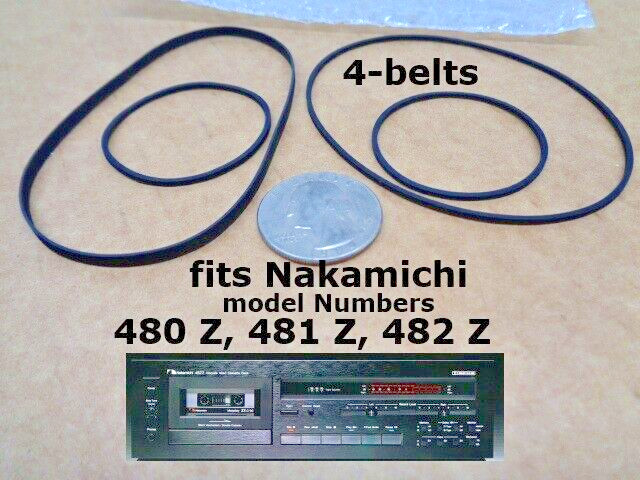
Like all vintage electronics, the Nakamichi 481 requires careful maintenance to perform at its best. Over time, the rubber drive belts and idler tires can harden or crack, leading to speed instability or transport failure. These should be replaced with high-quality modern equivalents.
The tape heads and capstans also require regular cleaning with isopropyl alcohol and a lint-free swab. Demagnetization is highly recommended every few months of use, especially if the deck is used frequently. A dedicated tape head demagnetizer with a plastic-coated tip should be used to avoid scratching the heads.
One potential issue with older Nakamichi decks is wear on the head lift mechanism, which raises and lowers the playback and record heads. If this mechanism becomes sluggish or noisy, it may require lubrication or adjustment by a qualified technician.
Due to its complex mechanical design, the 481 is not recommended for novice restorers. However, for those willing to invest in proper servicing, it remains a highly reliable machine even after decades of use.
Current Market Value and Collectibility
The Nakamichi 481 is not as commonly sought after as the later CR-7A or Dragon, but it holds a special place among cassette enthusiasts and vintage audio collectors. Its rarity, advanced features, and historical significance contribute to its growing appeal.
In today’s market, a fully functional and well-maintained Nakamichi 481 typically sells for $400 to $700, depending on condition, included accessories, and provenance. Units with original packaging, manuals, or service records may command higher prices, especially if they come from a smoke-free environment.
While it lacks the automatic calibration and servo-controlled azimuth of later Nakamichi models, the 481’s hands-on approach to tape alignment appeals to purists and DIY audio tinkerers. It’s also a favorite among those who appreciate the “golden era” of Japanese high-fidelity engineering.
Conclusion and Legacy
The Nakamichi 481 may not have the fame of its successors, but it was a critical step in Nakamichi’s journey to dominate the high-end cassette market. It combined professional-grade features with audiophile-level performance, proving that the compact cassette could be a serious medium for music reproduction.
More than just a tape deck, the 481 represented a philosophy: that precision, craftsmanship, and user control matter. It empowered listeners to take charge of their audio experience, from azimuth alignment to noise reduction settings.
Today, the Nakamichi 481 stands as a testament to an era when engineers pushed the limits of analog technology. For collectors, restorers, and analog enthusiasts, it remains a rewarding machine—one that continues to deliver stunning sound from a format once dismissed as obsolete. In the world of vintage audio, the 481 is not just a relic; it’s a reminder of what’s possible when passion meets precision.
eBay Listings



As an eBay Partner, we earn from qualifying purchases. This helps support our independent vintage technology research.
Related Models
- Nakamichi 1000ZXL (1985)
- Nakamichi BX-150 (1983)
- Nakamichi CR-4 (1969)
- Nakamichi 1000-II (1974)
- Nakamichi 1000ZXL-LIMITED (1985)
- Sony TC-2050SD (1978)
- Aiwa AD-F990 (1993)
- Kenwood KX-3060 (1982)
- Sony TC-2130A (1974)
- Sony TC-2220 (1972)