Nakamichi 1000ZXL Limited (1979–1984)
It didn’t just play tapes — it interrogated them, optimized them, and then played them again, perfectly.
Overview
The Nakamichi 1000ZXL Limited wasn’t merely a cassette deck; it was a declaration. When it arrived in 1979, it announced that analog tape could be governed by logic, precision, and computation — not just mechanics and magnetism. As Nakamichi’s first deck with microprocessor control, the 1000ZXL Limited rewrote the rules of what a consumer-format tape machine could do. This wasn’t incremental progress. It was a quantum leap wrapped in rosewood, gold plating, and enough servo motors to make a robotics lab jealous.
Produced from 1979 to 1984, the 1000ZXL Limited was positioned at the absolute apex of Nakamichi’s lineup — a statement piece engineered without compromise. At $6,000 in 1982 (a staggering sum, equivalent to a luxury car), it wasn’t for casual listeners. It was for engineers, broadcasters, and obsessive audiophiles who demanded not just high fidelity, but total control. And control is exactly what it delivered: through its dual microprocessors, discrete electronics, and self-calibrating intelligence, it turned cassette recording into a repeatable, scientific process.
While later models like the Dragon would capture more headlines, the 1000ZXL Limited was the pioneer — the first to embed a computer inside a cassette deck, the first to automate azimuth, bias, level, and equalization with the push of a button. It didn’t just respond to the tape; it analyzed it, adapted to it, and then optimized the entire signal path accordingly. That’s not hyperbole — that’s what ABLE, its onboard calibration system, was designed to do.
Specifications
| Manufacturer | Nakamichi |
| Model | 1000ZXL Limited |
| Production Years | 1979–1984 |
| Type | 3-head, single compact cassette deck |
| Track System | 4-track, 2-channel stereo |
| Tape Speed | 4.8 cm/s |
| Heads | 1 x record, 1 x playback, 1 x erase |
| Tape Type | Type I, CrO2, Metal |
| Noise Reduction | Dolby B |
| Frequency-response deviation | ±0.5 dB from 20 Hz to 20 kHz (at 20 dB below the 0-dB indication) |
| Frequency response (ABLE enabled) | 18 Hz – 25 kHz (± 3 dB) |
| Wow and Flutter | 0.04% (WRMS) |
| THD | < 0.8% (400 Hz ; 0 dB) |
| S/N ratio (Dolby C, 3% THD) | 74 dB |
| Erasure ratio | > 60 dB (100 Hz ; +10 dB) |
| Channel separation | > 37 dB (1 kHz ; 0 dB) |
| Bias frequency | 105 kHz |
| Fast-forward time for a C-60 cassette | 50 seconds |
| Rewind time for a C-60 cassette | 45 seconds |
| Line-level input sensitivity for 0-dB indication | 0.05 volt (50 millivolts) |
| Output level at 0-dB indication | 0.95 volt |
| Microphone sensitivity for 0-dB indication | 0.173 millivolt |
| Inputs | 2x line (50 mV / 50 kOhm), 2x MIC (0.2 mV / 10 kOhm), 2x NR (100 mV / 50 kOhm) |
| Outputs | 2x line (1 V / 400 Hz ; 0 dB ; max. output level), 1x headphones (45mW / 400 Hz), 2x NR (100 mV / 2.2 kOhm) |
| Power consumption | 60W |
| Dimensions | 52.7 x 25.8 x 32.2 cm |
| Weight | 19.5 kg |
| PITCH control range | ±6 per cent |
| Number of motors | 4 |
Key Features
ABLE: The Brains Behind the Operation
The heart of the 1000ZXL Limited’s intelligence was ABLE — Azimuth, Bias, Level, Equalization — a fully automated calibration sequence that redefined setup simplicity. At a time when most high-end decks required meticulous manual alignment with test tapes and oscilloscopes, the 1000ZXL Limited did it all by itself. Press the "Auto Cal" button, pop in a blank tape, and the deck would run a four-frequency calibration, adjusting bias, level, and equalization to match the specific tape formulation. It even optimized azimuth — not just for playback, but for recording, via a motor-driven cam that physically adjusted the record head’s angle.
ABLE wasn’t just convenient; it was transformative. It meant that users could switch between ferric, chrome, and metal tapes without touching a single knob or screwdriver. The microprocessor remembered the settings, and the system adapted in real time. This wasn’t guesswork — it was measurement, computation, and correction, all executed with clinical precision.
RAMM: Random Access Before It Was Cool
Long before digital playlists, the 1000ZXL Limited offered something eerily close: RAMM, or Random Access Music Memory. Using a 5 Hz / 20-bit digital code, the deck could tag up to fifteen selections on a tape. During playback, users could jump to any track, play them in reverse, or shuffle them randomly. It wasn’t MP3-level agility, but for 1980, it was revolutionary. The system worked by encoding the subsonic space below the audible range, leaving the music untouched while embedding a navigable index. For DJs, broadcasters, or anyone tired of fast-forwarding through side-long LP transfers, RAMM was a game-changer.
Discrete Electronics and Dual Capstans
The 1000ZXL Limited didn’t just think like a computer — it sounded like no other cassette deck. Its signal path was fully discrete, with no integrated circuits muddying the audio. Every stage, from preamp to output, used individual transistors and components, preserving transient detail and dynamic range. Combined with its dual-capstan, closed-loop drive system — featuring asymmetrical capstans (3 mm on supply, 2.5 mm on takeup) — the transport delivered tape speed stability that rivaled professional reel-to-reel machines. The quartz-locked direct-drive capstan motor ensured speed accuracy within 0.04% WRMS, making wow and flutter virtually inaudible.
Crystalloy Heads and Auto Azimuth
The playback head used a P-8L Crystalloy core with an ultra-narrow 0.6µ gap, optimized for high-frequency response and low distortion. The record head (R-8L) used a 3.5µ gap and was mechanically adjusted for azimuth via its own dedicated motor. The erase head (E-8L) featured dual gaps and high-saturation Sendust poletips, operating at a low 52.5 kHz frequency to minimize interference. Together, they formed a triad of precision — and the playback head even had a mechanism to push the cassette’s internal pressure pad out of the way, ensuring consistent tape-to-head contact.
Limited Edition Upgrades
The “Limited” in 1000ZXL Limited wasn’t marketing fluff. These units received extensive upgrades: front panel and transport components were gold-plated, solid brass flywheels replaced standard ones, and the chassis used corrosion-resistant sandwiched aluminum with black alumite. The enclosure was crafted from rosewood, and each unit came with an engraved personal nameplate mounted under the cassette window. Inside, hand-selected PCBs and added copper in power supply heatsinks further elevated build quality. It was a machine built to last — and to impress.
Historical Context
Launched between 1979 and 1984, the Nakamichi 1000ZXL Limited emerged at a time when high-fidelity cassette decks were pushing the limits of analog technology. It was the first Nakamichi deck to feature microprocessor control, marking a turning point in the company’s engineering philosophy. No longer were adjustments left to the user’s ears or a technician’s tools — now, the machine could self-optimize, adapting to tape variations with unprecedented consistency.
The transport was a heavily modified version of the one used in the earlier 1000/700ZXE models, but with significant enhancements: four servo-controlled DC motors replaced solenoids, enabling smoother, more precise control over capstan, reels, and head alignment. At $6,000 in 1982, it was among the most expensive consumer audio components ever made — a price that reflected not just parts, but ambition. It wasn’t trying to compete with other cassette decks. It was trying to outperform reel-to-reel.
eBay Listings

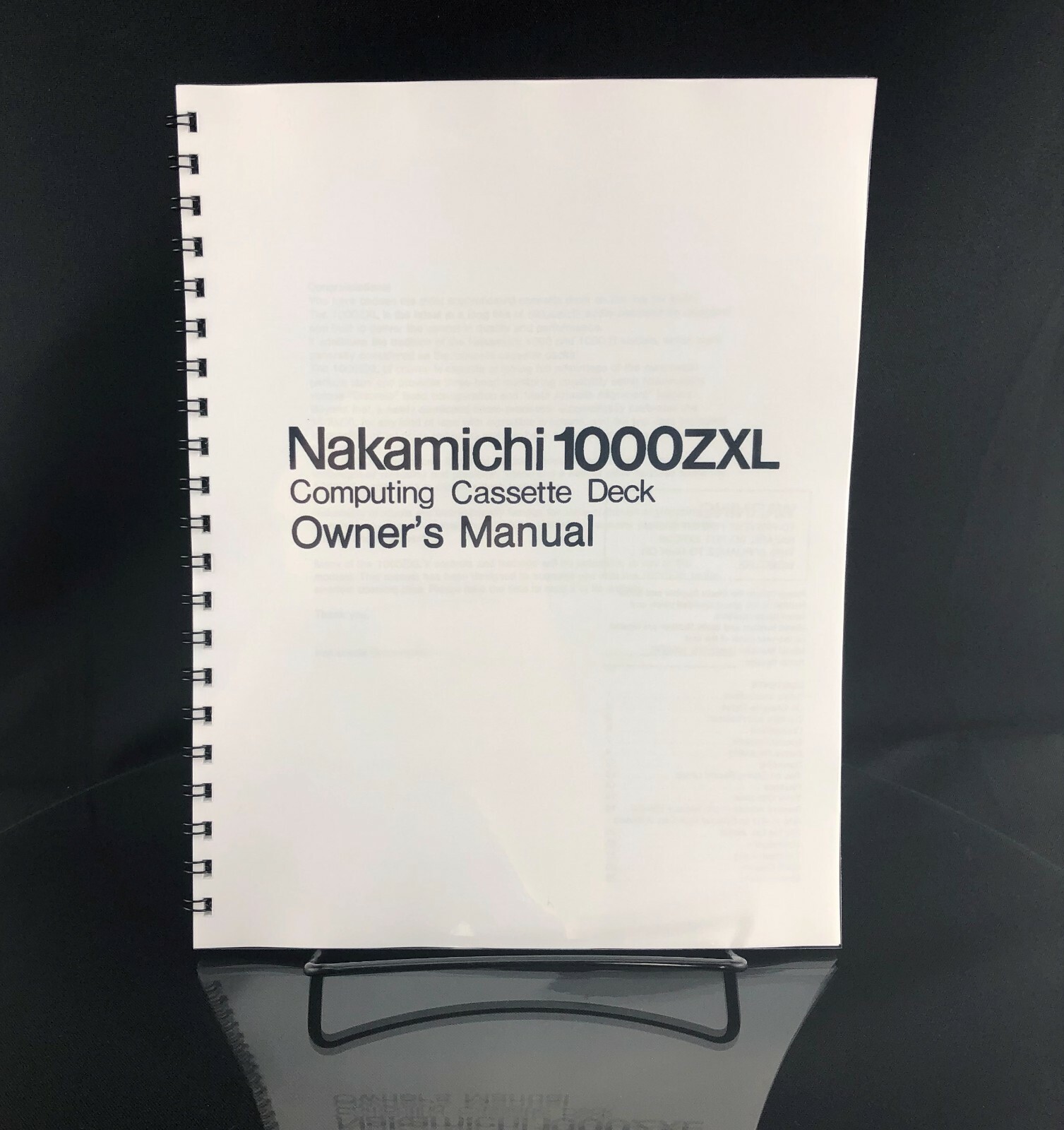


As an eBay Partner, we earn from qualifying purchases. This helps support our independent vintage technology research.
Related Models
- Nakamichi BX-150 (1983)
- Nakamichi CR-4 (1969)
- Nakamichi 1000-II (1974)
- Nakamichi 1000ZXL-LIMITED (1985)
- Nakamichi 480 (1975)
- Sony TC-2050SD (1978)
- Aiwa AD-F990 (1993)
- Kenwood KX-3060 (1982)
- Sony TC-2130A (1974)
- Sony TC-2220 (1972)