NAD T175
Three thousand dollars of AV preamp that NAD built around a single stubborn idea: movies are easy, music is hard.
Overview
The T175 is not a receiver. It's an AV tuner preamplifier - a preamp-tuner-processor, in NAD's own phrasing. It does the switching, decoding and volume control, and leaves the amplifying to outboard power amps, which in NAD's plan were the T955 or T975. It launched at $2999 USD. According to SoundStage! Xperience it sat at the top of NAD's line of standard home-theater components, the only separate surround processor in a range otherwise made up of MDC surround receivers. The receivers were where the volume was. The T175 was where the philosophy was.
The philosophy is "Music First," which NAD states plainly in its own literature. The company argues that most of the mass market conceives AV components overwhelmingly from a feature-content point of view, with sound quality well down the list. NAD's home-theater designs exist to close that gap. The T175's spec sheet backs up the intent. It ships with NAD's AM 200 Dual DSP audio module and the VM 200 video module, and the audio path is built around NAD's most advanced audio module of the period.
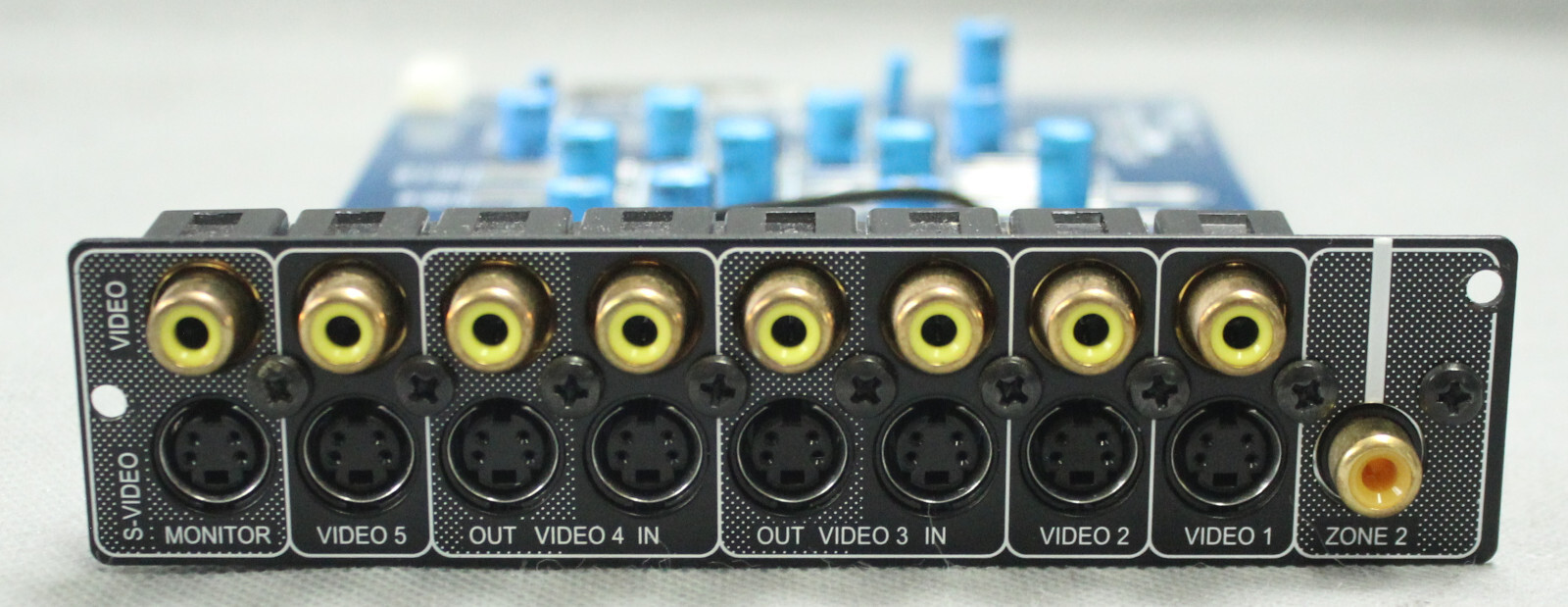
The rear panel tells you the era. There are four HDMI v1.3 inputs, specified with enough bandwidth to carry progressive-scan 1080p with unrestricted resolution. That was the whole ballgame in the mid-2000s, before HDMI 1.4 and 2.0. NAD's documentation for the family emphasizes HDMI switching supporting native resolutions up to and including 1080p, with the T175 adding audio processing and on-screen display on top of the basic switching. It also handles analogue video conversion, with composite, S-Video, component and HDMI monitor outputs all present on the platform.
Then there's the part collectors care about: Modular Design Construction. The input circuitry lives on plug-in cards. NAD sold this as a way to future-proof the investment, with easy upgrades, fast service and a cleaner internal layout for better sound and video performance. In practice it meant the T175 could be brought forward as HDMI standards moved, which is rare for a 2000s processor.
Key Features
Modular Design Construction (MDC)
The T175's input and processing circuitry sits on removable plug-in cards instead of being soldered into one big board. NAD's line is that this "future-proofs" the investment through easy upgrades, faster service and improved performance from the tidier internal layout. For a buyer in 2007 that was a promise about the future. For a buyer today it's the difference between a unit that can be serviced and one that becomes a doorstop the first time a card fails. The platform approach also means the T175 shares DNA with the wider MDC family of NAD receivers, though the T175 is the separate processor rather than a receiver.
AM 200 Dual DSP Audio Module
SoundStage! Xperience describes the AM 200 as NAD's most advanced audio module, a dual-DSP design. Surround decoding, bass management and the digital domain work all run through it. NAD built the T175's reputation on the claim that this audio path is where the money went, rather than into feature count.
VM 200 Video Module and Sigma Designs VXP Processing
The VM 200 module handles video. It carries Sigma Designs' VXP broadcast studio quality image processor. Per HighFidelityReview, that chip supports all standard formats up to 2048 x 2048 pixels. That's well beyond the 1080p displays the T175 was sold to drive, so NAD was buying headroom rather than chasing the current spec sheet. The VXP is the reason the T175's video processing still gets mentioned favorably in retrospectives.
Audyssey MultEQ XT Room Correction
The T175 carries Audyssey MultEQ XT, NAD's enhanced version of the room-correction system. The manual gives it real space under "Corrección de la Acústica de la Sala Audyssey Multeq Xt." A supplied calibration microphone measures each speaker's response and the room's acoustic reflections independently, then the system calculates a corrected response that minimizes the reflections' effects. NAD's documentation claims improved dialogue intelligibility, enhanced imaging and sound stage, and more accurate localization of instruments for musical balance. The company also notes that the digital technology required for this level of performance would have cost many thousands of dollars just a few years earlier. Audyssey Auto Calibration is also present as a separate setup routine.
EARS Surround Mode
NAD's EARS mode gets a brief but specific mention in the manual: "El ambiente natural del EARS produce un modo envolvente sutil aunque excepcionalmente eficaz, que mejora naturalmente la presentación espacial." Roughly, EARS produces a subtle but exceptionally effective surround ambience that naturally improves spatial presentation. It's a proprietary mode that reviewers either loved or ignored.
On-Screen Display Across All Video Outputs
The on-screen menu and display system is available on all video outputs. A single cable between the preamp and the display is enough to run setup. NAD positions this as an ease-of-use feature, and it is. The alternative in this era was crawling behind the rack to read a front-panel display the size of a postage stamp.
Four HDMI v1.3 Inputs
Four HDMI version 1.3 inputs, specified to route signals with sufficient bandwidth for progressive-scan 1080p at unrestricted resolution. For its moment that was the right number and the right spec. Today it's the T175's most obvious limitation, since HDMI 1.3 predates the audio return channel, 3D and 4K entirely. Anyone putting a T175 in a modern system should plan on external HDMI switching rather than relying on the internal board.
DAB, iPod, and the DB 1 Adaptor
The T175 is compatible only with NAD's DAB Adaptor DB 1 - not a generic DAB module, and not the later variants. The manual's wording on this is garbled in the Spanish source text, so anyone chasing DAB functionality should verify against the original English manual before buying an adaptor. The iPod path is more straightforward. The NAD IPD dock connects to Audio 5 / Video 5, and that input is assigned to iPod by default on the T175.
Tone Controls, Lip Sync Delay, and Picture Controls
The manual documents tone controls, a lip sync delay, and picture controls including brightness. The lip sync delay is the one worth noting. HDMI audio and video processing delays were a real, visible problem in this era, and NAD put a fix on the front panel.
RS-232 and USB Interfaces
Both an RS-232 control interface and a USB interface are documented in the manual as dedicated sections. The RS-232 port is the one that matters for anyone integrating the T175 into a control system. It's the difference between a processor you run from a Crestron or Control4 remote and one you run by walking over to it.
Historical Context
NAD introduced the T175 as part of a trio of new audio separates at CEDIA in Denver, alongside the T975 seven-channel and T955 five-channel power amplifiers. The T175 was the processor of the group, and SoundStage! Xperience frames it as the top of NAD's standard home-theater line - the only separate surround processor in a range otherwise built from MDC surround receivers. At $2999 USD it was priced as a serious component, not a value play, which put it in direct conversation with processors costing considerably more.
Period coverage confirms the price. HighFidelityReview lists $2,999 as the suggested price. SoundStage! Xperience's assessment lands on the same number. It notes that the T175 doesn't have the setup flexibility or transparency of a reference processor like the Anthem Statement D2, but neither does it carry the D2's much higher price.
Collectibility & Value
The T175 occupies an awkward spot in the used market. It's a 2000s AV processor, so its core competence - HDMI switching - has been thoroughly superseded, and its original $2999 price has not translated into collector premiums the way NAD's stereo gear has. Listings show units trading as used components with original box, packing, manual, remote and secondary remote included. That's the configuration to look for, since the accessories matter on a processor this dependent on its remote and OSD.
The known failure to check is the HDMI outputs. At least one used listing documents a unit with one HDMI out not working, and it appears in the seller's own description. Given the modular design, a failed board is in principle a replaceable board. Still, buyers should confirm the state of both HDMI outputs before committing, and should assume that parts for a 2000s HDMI 1.3 board are not going to get easier to find.
On sound, the period assessment is favorable. One published review concludes that the T175 may lack some features and flexibility but remains an excellent performer, with the latest VXP video processing and exceptional sound on both movie soundtracks and music at its $2999 price. A forum comparison against the Anthem D2 found the NAD tamed brightness in the paired speakers and softened the vocals and top end by the right amount. The caveat, as stated there, is that speaker synergy may have accounted for more of the result than outright superiority.
eBay Listings



As an eBay Partner, we earn from qualifying purchases. This helps support our independent vintage technology research.