NAD NAD 3020A: The Refined Classic of Compact Amplification
Introduction
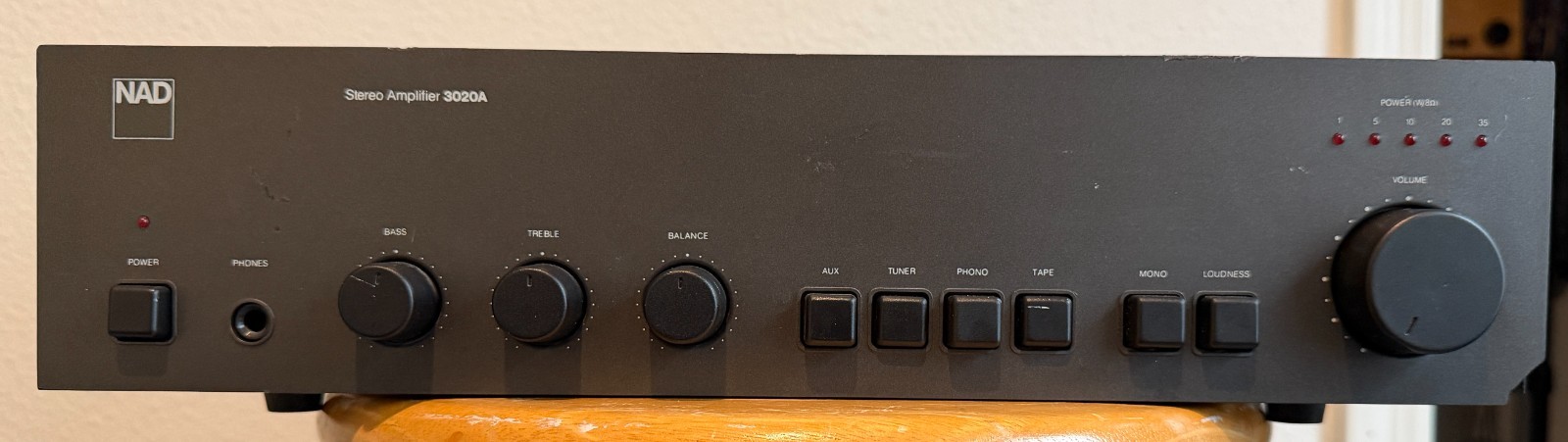
The NAD 3020A, produced from 1983 to 1987, stands as a refined evolution of one of the most iconic integrated amplifiers in hi-fi history—the original NAD 3020. Introduced just a few years after its legendary predecessor, the 3020A incorporated subtle but meaningful improvements while preserving the soul of what made the 3020 a benchmark in affordable high-fidelity audio. Positioned as a compact yet powerful amplifier for the discerning listener, the 3020A continued NAD’s philosophy of delivering exceptional sound quality without extravagant pricing. During its production run, it became a favorite among audiophiles and casual listeners alike, praised for its musicality, reliability, and ability to drive a wide range of speakers with authority. Its legacy endures today, with the 3020A frequently sought after in the vintage audio market as a quintessential example of 1980s British engineering at its most accessible and effective.
Technical Specifications
| Specification | Value |
| Model | NAD 3020A |
| Category | Amplifiers |
| Years Produced | 1983-1987 |
| Power Output | 20W per channel @ 8Ω (FTC), 35W @ 4Ω |
| Impedance | 8 ohms (minimum 4 ohms) |
| Frequency Response | 20Hz - 20kHz (+0, -0.5dB) |
| Total Harmonic Distortion | < 0.03% @ 1W, < 0.1% at full power |
| Signal-to-Noise Ratio | 86dB (A-weighted) |
| Dimensions | 17.1 x 5.9 x 13.8 inches (435 x 150 x 350 mm) |
| Weight | 17.6 lbs (8 kg) |
Design & Engineering
The NAD 3020A reflects a thoughtful refinement of the original 3020’s design, maintaining its compact form factor while enhancing internal components and circuit stability. One of the key engineering hallmarks of the 3020A is its dual-mono power supply architecture, which provides separate rectification and filtering for each channel, significantly improving channel separation and reducing crosstalk. This design choice, uncommon in amplifiers at this price point, contributes to a more spacious and accurate stereo image. The amplifier employs a discrete transistor output stage capable of high current delivery, allowing it to maintain control over difficult speaker loads—a trait that set it apart from many contemporaries.
A standout feature carried over from the original is NAD’s proprietary soft-clipping circuitry. This innovative design gently rounds off signal peaks when the amplifier approaches its limits, avoiding the harsh, grating distortion typical of clipped audio. As a result, the 3020A remains listenable and musical even at high volume levels, making it ideal for both background and critical listening. The front panel retains the minimalist aesthetic of the original: a large central volume knob, source selector, and basic tone controls with a defeat switch to ensure a pure signal path when desired. The blue power indicator light adds a touch of visual charm, now iconic among vintage audio enthusiasts.
Internally, the 3020A benefits from improved component quality and tighter tolerances compared to early 3020 units. The PCB layout is clean and service-friendly, with clearly labeled sections and accessible test points—making it a favorite among technicians and DIY restorers. The use of high-quality capacitors and robust power transistors contributes to long-term reliability, and many 3020A units remain fully functional decades later with minimal maintenance.
Sound Characteristics
The sonic signature of the NAD 3020A is warm, engaging, and remarkably detailed for its class. It delivers a smooth midrange that brings vocals and acoustic instruments to life, paired with a tight and well-controlled bass response that belies its 20-watt rating. The high frequencies are extended without being harsh, contributing to a balanced and natural tonal presentation. Its ability to remain composed under dynamic demands—thanks to the high current output—makes it particularly adept with genres like jazz, classical, and rock, where dynamic range and timing are crucial.
Compared to other integrated amplifiers of the era, such as the Yamaha B-201 or the Luxman L-200, the 3020A stands out for its musical coherence and lack of listener fatigue. While not as powerful on paper as some competitors, its real-world performance with efficient bookshelf speakers like the KEF Coda 1 or the Spendor BC1 is exceptional. Audiophiles often praise its ability to create a wide and deep soundstage, with precise imaging that enhances the listening experience even in modestly sized rooms.
Market & Collectibility
Today, the NAD 3020A occupies a cherished place in the vintage audio market. While not as rare as the earliest 3020 models, it is highly collectible due to its improved build and consistent performance. Units in good working condition typically sell between $250 and $450, with mint examples or those accompanied by original packaging and documentation commanding higher prices. When purchasing a 3020A, buyers should verify that the soft-clipping function is operational, check for any hum or channel imbalance, and ensure the input selector switches are clean and crackle-free.
Common restoration practices include recapping the power supply, cleaning potentiometers and switches with contact cleaner, and occasionally replacing aging output transistors to restore optimal performance. Due to the availability of service manuals and community support, the 3020A is considered a beginner-friendly project for those entering vintage audio restoration.
eBay Listings



As an eBay Partner, we earn from qualifying purchases. This helps support our independent vintage technology research.
Related Models
- NAD 3020 (1978-1983)
- Luxman L-530 (1975)
- Luxman R-404 (1975)
- Luxman RV-371 (1975)
- Luxman SQ-38U (1975)
- Luxman T-14 (1972)
- Luxman T-530 (1975)
- Luxman TX-101 (1975)
- Denon DRA-800 (1985)
- Denon PMA-350Z (1980)