NAD 3020: The Amplifier That Redefined Hi-Fi Value
Introduction
The NAD 3020 integrated amplifier, introduced in 1978 and produced until 1983, stands as one of the most influential and celebrated components in the history of high-fidelity audio. At a time when the market was dominated by either underpowered budget models or expensive high-end separates, the 3020 emerged as a revelation—offering exceptional sound quality, thoughtful engineering, and remarkable value. With its modest 20 watts per channel rating, it defied expectations by delivering a rich, dynamic, and engaging listening experience that belied its compact size and affordable price. The 3020 quickly became a benchmark for what a budget amplifier could achieve, earning critical acclaim and a loyal following that persists to this day. Its success helped establish NAD (NAD Electronics) as a major player in the global audio market and set a new standard for performance-per-dollar in consumer audio equipment.
Technical Specifications
| Specification | Value |
| Model | 3020 |
| Category | Amplifiers |
| Years Produced | 1978-1983 |
| Power Output | 20W per channel @ 8Ω |
| Impedance | 8 ohms (minimum) |
| Frequency Response | 20Hz - 20kHz |
| Total Harmonic Distortion | < 0.1% |
| Signal-to-Noise Ratio | 86dB |
| Dimensions | 430mm x 110mm x 310mm |
| Weight | 8.2 kg |
Design & Engineering
The NAD 3020 was engineered with a philosophy of "minimum necessary complexity"—a design ethos that prioritized sonic performance over feature bloat. Its circuitry was carefully optimized to deliver maximum musicality without unnecessary embellishments. One of its standout engineering features was its high-current power supply, which allowed the amplifier to maintain control over a wide range of speakers, even those with difficult impedance loads. This gave the 3020 an impressive sense of dynamic headroom, enabling it to handle musical transients with authority far beyond what its 20W rating might suggest.
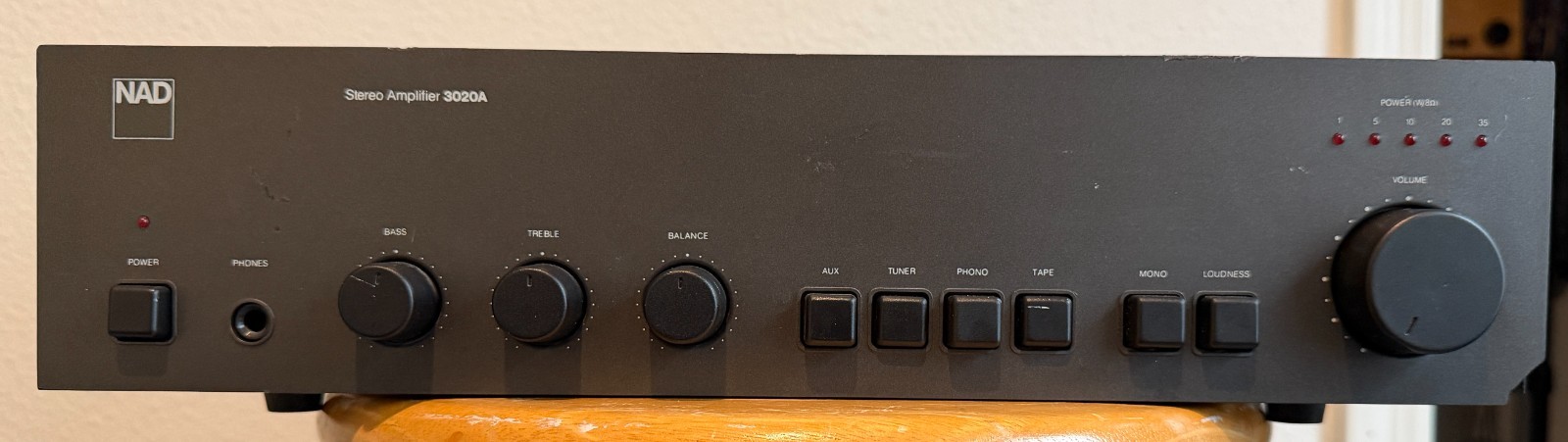
The front panel featured a clean, functional layout with a large central volume knob, source selector, and distinctive blue VU meters that provided a visual indication of output levels—a rare and welcome feature at its price point. The inclusion of a high-quality phono preamp with adjustable loading for moving magnet (MM) cartridges made it an ideal match for turntable-based systems, a common setup in the late 1970s and early 1980s. Tone controls were included but could be bypassed via dedicated switches, allowing users to enjoy a pure, uncolored signal path when desired.
Build quality was robust for its class, with a steel chassis, solid knobs, and a durable finish. The internal layout emphasized short signal paths and effective grounding to minimize noise and interference. NAD also employed a modular design approach, making servicing and repairs more straightforward—a practical consideration that has contributed to the 3020’s longevity.
Sound Characteristics
The sonic signature of the NAD 3020 is often described as warm, musical, and surprisingly spacious. Despite its modest power output, it delivered a full-bodied midrange, clear highs, and a tight, controlled bass response—especially when paired with efficient speakers. Its ability to render vocals and acoustic instruments with realism and emotional immediacy made it a favorite among music lovers.
Critics and listeners alike praised its dynamic expression and rhythmic drive, qualities that allowed it to excel with a wide range of genres—from jazz and classical to rock and folk. The 3020 had a way of drawing listeners into the music, creating an engaging and immersive experience that many more expensive amplifiers failed to match. Its phono stage, in particular, was lauded for its low noise and accurate RIAA equalization, making it a standout choice for vinyl enthusiasts.
While not as detailed or transparent as some high-end contemporaries, the 3020’s slight warmth was often seen as a virtue, softening the harshness of lower-resolution recordings and digital sources that were emerging at the time. It struck a near-perfect balance between accuracy and listenability—a hallmark of great amplifier design.
Market & Collectibility
Today, the NAD 3020 is a highly sought-after vintage component, celebrated not only for its sound but also for its historical significance. Well-maintained units typically sell for $200–$400 on the secondhand market, with fully restored or mint-condition models commanding higher prices. Its enduring popularity has made it a staple of vintage audio forums, restoration projects, and entry-level high-fidelity systems.
When purchasing a 3020, buyers should look for units with responsive controls, clean channel balance, and healthy VU meters. Over the years, common issues include worn potentiometers, degraded capacitors, and failing power supplies—all of which are generally repairable by experienced technicians. Many enthusiasts choose to recap the unit or upgrade the power supply to extend its life and improve performance, though purists often prefer to keep it in original condition.
The 3020’s legacy has also inspired modern reissues, including the NAD 3020i and later D 3020 digital amplifier, which pay homage to the original’s design and philosophy while incorporating contemporary technologies.
eBay Listings


As an eBay Partner, we earn from qualifying purchases. This helps support our independent vintage technology research.
Service Manuals & Schematics
- Owner's Manual — archive.org
- Owner's Manual — archive.org
- Service Manual — archive.org
- Owner's Manual — archive.org
- Owner's Manual — archive.org
Related Models
- NAD NAD 3020A (1983-1987)
- Luxman L-530 (1975)
- Luxman R-404 (1975)
- Luxman RV-371 (1975)
- Luxman SQ-38U (1975)
- Luxman T-14 (1972)
- Luxman T-530 (1975)
- Luxman TX-101 (1975)
- Denon DRA-800 (1985)
- Denon PMA-350Z (1980)