NAD 7020 (1979–1983)
Twenty conservative watts, three ceramic IF filters, and the 3020's amplifier section in a box with a tuner bolted on.
Overview
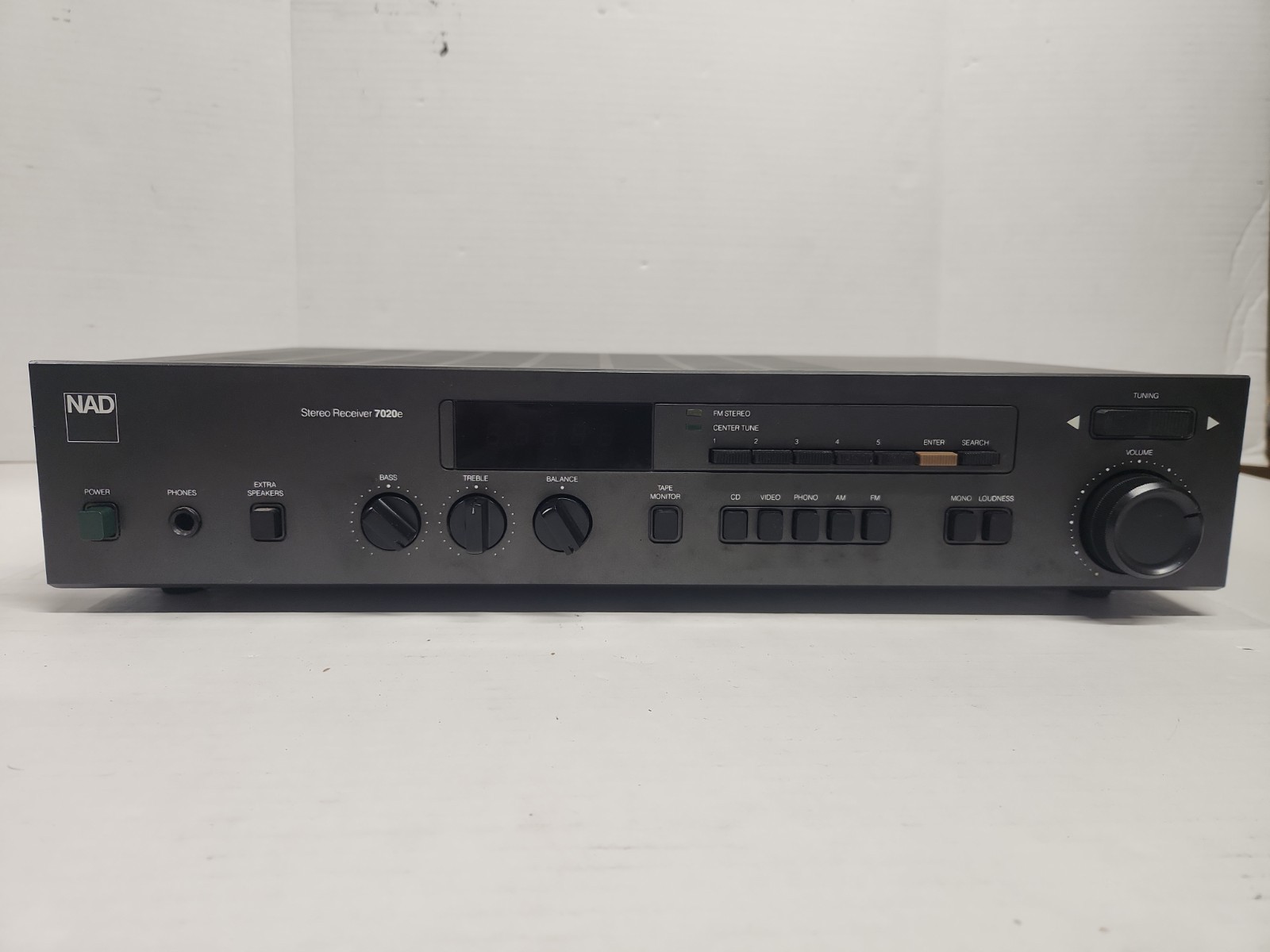
The 7020 is the NAD 3020 with a tuner built in, and NAD never pretended otherwise. The amplifier circuitry is the same revered design. The AM/FM front end was adapted from the NAD 4020 tuner and pressed into the same chassis. The result behaves like a small integrated amp with a radio attached, rather than the other way around. In 1979, that was not how budget receivers were built.
The headline number is 20 watts per channel continuous into 8Ω, 20 Hz to 20 kHz, both channels driven, at no more than 0.02% THD. That figure comes straight from the owner's manual, and it is the number to trust. Some later write-ups inflate the 7020 to 35 watts. The manual and the period press don't support it. What matters more is what the 20 watts can actually do. The manual is blunt about this: designing an amp to make 20 watts into an 8-ohm test resistor is easy, but real loudspeakers are lower and reactive. The 7020 carries a high-current supply and the same rugged output transistors found in many "60-watt" receivers of the day. NAD rates it stable into loads down to 2Ω - the spec sheet lists a 2Ω - 8Ω speaker range - and the IHF dynamic power figures are 40W short-term into 8Ω, 58W into 4Ω, 72W into 2Ω. Audio (June 1980, p.84) measured the receiver against those claims and, in its listening notes, called the 7020 one of the best-sounding receivers in its power and price class the magazine had auditioned.
Distortion is quoted at under 0.02% across 20 Hz - 20 kHz for the power amp, and under 0.02% for the phono stage over the same bandwidth. Audio (June 1980, p.84) found the IHF intermodulation products too low to measure, below the 0.02% NAD claimed. Frequency response is specified at ±0.5 dB from 20 Hz to 20 kHz.
Physically it's a compact box: 420 × 119 × 240 mm, 6.8 kg net, 8.4 kg shipping. The manual notes that those dimensions are for the cabinet without feet. Add up to 18 mm for total height. The depth figure excludes terminals, sockets, controls, and buttons. There is also a matte silver version that turns up far less often than the usual black.
Key Features
High-Current Output Stage Rated at 2Ω
The 7020's output stage is the reason the power rating undersells the receiver. NAD's own literature describes a high-current power supply paired with output transistors normally found in "60-watt" receivers. That is how a 20-watt amp ends up comfortable driving speaker impedances down to 2Ω. Into 8Ω the IHF dynamic power is 40W; into 4Ω, 58W; into 2Ω, 72W. The dynamic headroom figure is +3 dB at 8Ω.
Soft Clipping™
NAD's exclusive Soft Clipping circuit gently limits the waveform voltage when the 7020 is overdriven past its rated power. It keeps the output transistors out of saturation and out of hard clipping. In practice the receiver can produce remarkably high peak levels without turning harsh. It compresses instead of shattering. NAD built it into the 7020's standard feature set rather than saving it for a flagship.
Tuner Section with Three Ceramic IF Filters
The FM front end uses a junction FET for pulling in weak signals. Unusually for the price, it also has three ceramic IF filters rather than one or two, which gives the tuner its selectivity on a crowded dial. A PLL multiplex decoder handles stereo separation. The manual claims FM reception audibly identical to many costlier separate tuners in both sensitivity and sound quality, and the measured numbers back the sensitivity claim: mono usable sensitivity of 10.8 dBf (1.9 µV) for 30 dB quieting, stereo at 16 dBf (3.5 µV) for 50 dB S/N and 37 dBf (40 µV) for 60 dB S/N. Alternate-channel selectivity is 65 dB, capture ratio 1.5 dB, image rejection 50 dB, AM suppression 60 dB. Harmonic distortion runs 0.2% mono and 0.3% stereo. Signal-to-noise is 75 dB mono and 70 dB stereo. Channel separation at 1 kHz is 42 dB, and frequency response is ±0.5 dB from 30 Hz to 15 kHz. Tuning is aided by a set of three LEDs indicating exact tuning and signal strength. The AM section uses an adjustable ferrite rod aerial, with usable sensitivity of 250 µV, image rejection of 50 dB, and, per the manual, good suppression of static and adjacent-channel interference.
Six-Transistor Phono Stage
NAD deliberately avoided the economy preamp circuit common to budget receivers. The 7020's phono section is a six-transistor design with 47kΩ / 47pF input impedance and 2.5 mV input sensitivity referenced to 20W, with signal-to-noise of 75 dB A-weighted with a cartridge connected and THD under 0.02% from 20 Hz to 20 kHz. The manual claims a 107 dB dynamic range, enough in NAD's words for the digitally-mastered recordings of the 1980s, and states the stage is quiet enough for either moving-magnet or high-output moving-coil cartridges. Audio (June 1980, p.80) noted the receiver combined modular circuit elements, solid-state IF filters and ICs in the tuner, to get good performance at reasonable cost, with the phono stage interfacing correctly with cartridge impedances. Line-level inputs run 86 dB signal-to-noise A-weighted referenced to 1W, with ±0.5 dB response across 20 Hz - 20 kHz.
Infrasonic and Ultrasonic Filters
An infrasonic filter rolls off at −3 dB at 15 Hz with a steep 24 dB/octave slope, stripping turntable rumble and acoustic feedback before they reach the amplifier. Bass and treble controls are tailored for musically effective response at the frequency extremes without disturbing the critical midrange balance. An Audio Muting switch expands the useful range of the volume control and suppresses residual circuit noise for low-level listening or sensitive headphones. A stereo headphone output is fitted.
Preamp Out / Power Amp In
Separate preamp-out and power-amp-in jacks on the rear panel let owners insert an equalizer, dynamic range expander, or time-delay unit between the two halves of the receiver. The rest of the connections are the tape monitor loop, phono (MM), tape, auxiliary, and tuner inputs, and 75-ohm and 300-ohm antenna terminals. That means the 7020 can be the front half or back half of a larger system.
Historical Context
The 7020 came out in 1979, after the 3020. It is best understood as the 3020 with a tuner attached: the same amplifier architecture, with the AM/FM front end derived from the NAD 4020. NAD positioned it as a premium receiver in its own lineup. The manual frames the design intent plainly: an unusually high proportion of the cost went into circuit engineering and electronic parts rather than elaborate styling, seldom-used controls, or esoteric features. Production ran from 1979 to 1983.
The naming needs a warning attached. NAD later built a 7020i and a 7020e, and those are different receivers. The 7020e dates to 1988 and pairs a 400-series digital tuner with 3020e amplifier architecture. Listings and forum posts mix the three freely, and eBay titles for the 7020e have been known to advertise "150W 4/8ohm," which matches nothing in any NAD documentation and should be treated as seller noise. If you're shopping, confirm which model you're looking at before comparing specs. The base 7020 is the 1979 design with the analog tuner and the 20-watt rating.
Collectibility & Value
The 7020 is a sought-after piece among vintage audio enthusiasts. Its reputation as a "giant killer" was earned by the 3020 amplifier the 7020 is built around, and it carries over to the receiver variant. Completed eBay sales over the past twelve months show a range of roughly $143 - $322, with a median around $194 across 30 sales. The twelve-month high sits near $398 and the low near $97. Typical volume runs about six units a month, so supply is steady but not deep. Well-maintained examples with original boxes and clean cosmetics reportedly command $250 - $450.
The usual age-related failures apply: dried-up electrolytic capacitors, worn potentiometers, and degraded rubber belts in the tuner mechanism. Many owners opt for a full recapping and servicing, and an $80 recap kit with filter capacitors circulates on eBay specifically for the 7020. A new power switch is available for around $40 and is shared across a wide swath of the NAD line, including the 1020, 3020, 3020A, 3060, 3120, 3130, and the 7020PE. The hum-on-power-up complaint and the bias-setting transistor failures documented in owner threads apply to the later 7020e, not the base 7020.
Receivers with unmodified circuitry and intact NAD branding hold more value than modified examples. Some enthusiasts have fitted upgraded power cords or external DACs for modern sources, but purists prefer stock. With the 7020's preamp-out jack, there's no need to modify anything to integrate a modern source. Feed it into the AUX input.
Market Value
┌──────────────────────────────────────────────────────────────────────────┐
│ NAD 7020                                                        Nov 2026 │
├──────────────────────────────────────────────────────────────────────────┤
│ High      $398                                    Latest             $97 │
│ Median    $194                                    Trend                — │
│ Low       $97                                     Volume           ~6/mo │
├──────────────────────────────────────────────────────────────────────────┤
│   $400 ┤                                                                 │
│        │    .           .                                                │
│        │                .            .                                   │
│   $250 ┤      .   ..             .       .     .                         │
│        │       .     .              .                                    │
│        │.       .   .     .       ..      .        .      .    .   .     │
│        │      .                    ..                                    │
│    $50 ┤                                                                .│
│        ├─────────────────────────────────────────────────────────────────│
│    vol │▄   ▄ █▄▄ ▄▄▄▄  █ ▄      ▄███▄   ▄▄    ▄   █      ▄    ▄   ▄    ▄│
│        └─────────────────────────────────────────────────────────────────│
│         2026-02                      2026-05                      2026-07│
└──────────────────────────────────────────────────────────────────────────┘
eBay completed sales. Excludes accessories, parts, and non-working units. Hover points for details.
eBay Listings
Recently sold on eBay: $143–$322 (median $194, based on 30 completed sales, past 12 months)


As an eBay Partner, we earn from qualifying purchases. This helps support our independent vintage technology research.
Related Models
- NAD 160 (1975-)
- NAD 7045
- NAD 7100
- NAD 7125
- NAD 7140
- Marantz 2226 (1974-1976)
- Marantz 2226B (1979-1980)
- Marantz 2235 (1974-1977)
- Marantz 2238B (1978-1980)
- Marantz 2250B (1978-1980)