Motorola 56001
The DSP chip inside NeXT workstations and Symetrix digital recorders, and almost by accident the audio industry's default.
Overview
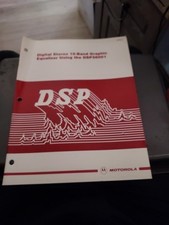
The 56001 wasn't a consumer product. It was a DSP chip, a processor built to run the math digital audio needs. By the late 1980s it had turned up in so many manufacturers' boxes that Recording Engineer (1989) flatly predicted it would become the de facto DSP chip of the industry. In hindsight that reads like an inventory count. At one AES show in Los Angeles, every company exhibiting DSP development boards was using the Motorola 56001. Motorola used the same show to announce a lower-priced version of the chip.
What made it stick was speed per dollar. Dane Butcher, president of Symetrix, told Recording Engineer (1989) that his company chose the 56001 because "at the time it came out, it had more speed per dollar than anything else on the market." Custom DSP hardware was the old way to build a digital reverb or a digital delay. It was expensive, and it required a deep, task-specific understanding of the problem. Off-the-shelf DSP chips like the 56001 changed that. A mid-sized manufacturer could buy processing power instead of designing it.
The applications multiplied fast. Symetrix built its DPR-100 digital processing recorder around multiple 24-bit DSP ICs - the Motorola 56001 - with a stated throughput of 50 million instructions per second. That was enough to run level, pan, and 3-band parametric EQ simultaneously in real time, all automatable, plus off-line processing such as a time squeeze/expand program. Digidesign's Sound Tools hard-disk recording and editing system used a 56001-based circuit card inside the Macintosh for processing. Studer EdiTech's Dyaxis system used a 56001 in its "EXcellerator" card for equalization, dynamic mixing, and time scaling. Ariel Corporation's DM-N digital microphone was designed to plug straight into the NeXT computer, which had the 56001 on board. Ariel also showed PC cards using Motorola and AT&T chips. Spectrum Signal Processing built a dual-56001 processor board that Recording Engineer (September 1990, p.111) described as reportedly the first PC-based processor to use multiple 56001s.
The NeXT is why a lot of people who never touched a rack of outboard gear still ended up owning a 56001. Mix (April 1990, p.53) noted that the NeXT machine carried a Motorola 56001 DSP chip alongside its playback path - a 22/44.1 kHz sample rate through gold-plated RCA connectors, a stereo mini jack, a small monitor speaker, and a speech-quality 8 kHz A/D converter. The chip sat inside a general-purpose computer, not a dedicated audio box, so third parties could write software for it.
The software question was the one nagging gap. Recording Engineer (1989) observed that a general-purpose, high-level, audio-based developers' package to support the chip in depth seemed inevitable, and that Rank Corporation had announced one but hadn't shipped it yet. The hardware was ahead of the tools. That's a familiar pattern with DSP platforms, and it's part of why the 56001's dominance was a matter of adoption rather than of anyone's master plan.
In the period press, the 56001 was not a finished consumer product you could buy and plug in. It was a component, a chip that other people's products were built around. Symetrix's DPR-100, the Dyaxis, Sound Tools and the NeXT are the artifacts. The 56001 is the part inside them.
eBay Listings


As an eBay Partner, we earn from qualifying purchases. This helps support our independent vintage technology research.