McIntosh MQ101 (1973–1978)
A glass-fronted equalizer that doesn’t just fix your room—it talks back to it, with surgical control and that unmistakable McIntosh glow.
Overview
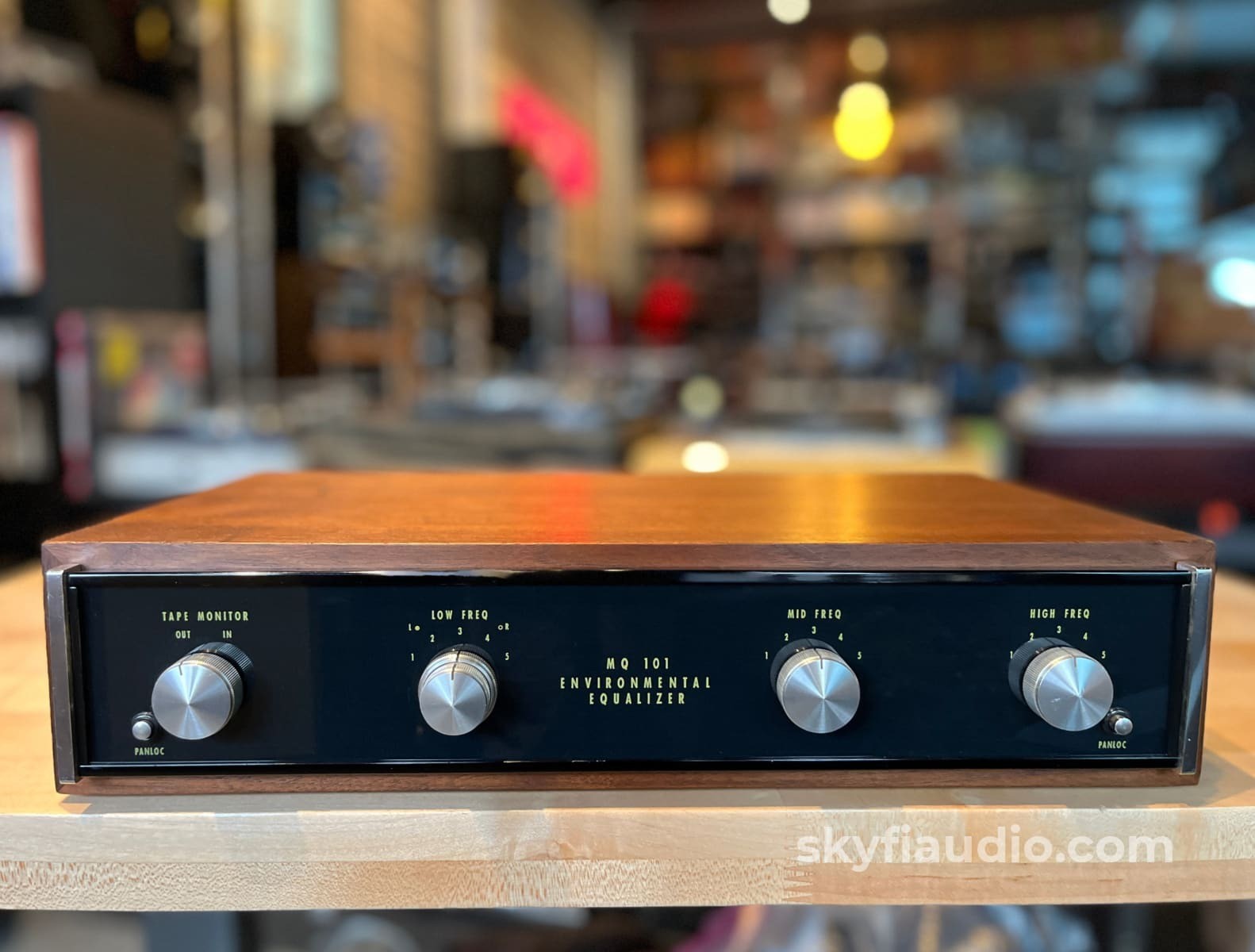
Turn on a McIntosh MQ101 in a dark room and you’ll understand why people still hunt for these decades later: the illuminated gold-on-teal glass panel glows like a control console from a 1970s sci-fi dream, soft and authoritative all at once. But this isn’t just a pretty face bolted to a chassis. The MQ101 was engineered as a system partner to the legendary ML-1C loudspeakers, though its usefulness extends far beyond that pairing. It’s an environmental equalizer—McIntosh’s elegant term for a room-correction tool decades ahead of its time. While most graphic EQs of the era slapped broad strokes across the frequency spectrum, the MQ101 offered targeted, musically relevant adjustments that preserved tonal balance instead of obliterating it. It doesn’t just let you tweak your sound; it teaches you how your room fights against it.
McIntosh didn’t build the MQ101 to be a tone sculptor for the casual listener. It was part of a larger philosophy: that high-fidelity reproduction isn’t just about the gear, but about how that gear interacts with real-world spaces. The company’s engineers understood that bass response could swing by 9dB depending on speaker placement—a corner versus a wall, a floor versus a stand. Rather than force users into idealized setups, they gave them the tools to adapt. The result is a device that feels less like a compromise and more like a collaboration between listener, speaker, and space. It’s rare for a piece of audio gear to feel both clinical and intuitive, but the MQ101 pulls it off. The low-frequency control, for example, is boost-only—no cut—which keeps the system from collapsing into thinness if overadjusted. The mid and high bands offer symmetrical ±5dB and ±4dB ranges, respectively, letting you counteract overly damped or overly reflective rooms without tipping into harshness or muddiness.
Despite its specialized role, the MQ101 fits naturally into a McIntosh stack. It shares the brand’s signature Panloc mounting system, so it locks securely into racks alongside amplifiers and preamps. There’s no power switch—just plug it in, and it’s live—so it behaves more like a signal path component than a standalone processor. And while it lacks the heft of a tube preamp or power amp, its 15-pound chassis feels substantial, grounded by a walnut cabinet that ages gracefully. Used today, it slots into vintage systems with ease, especially those built around the 1970s McIntosh ecosystem. But even outside that context, it serves as a remarkably transparent EQ—solid-state, yes, but with a neutrality that doesn’t impose its own character. It’s the rare piece of corrective gear that doesn’t make you wish you’d just lived with the problem.
Specifications
| Manufacturer | McIntosh Laboratory, Inc. |
| Production Years | 1973–1978 |
| Original Price | $250 |
| Type | Solid-state environmental equalizer |
| Frequency Response | 20Hz to 20,000Hz (±0.5dB) |
| Total Harmonic Distortion | 0.1% at rated output, 20Hz–20kHz |
| Signal-to-Noise Ratio | 85dB |
| Hum and Noise | –80dB below rated output (250µV) |
| Input Sensitivity | 2.5V |
| Input Impedance | 60k ohms |
| Input Attenuator | 0dB, –6dB, –12dB (switchable) |
| Main Output Level | 2.5V into 47k ohms or higher |
| Tape Monitor | Inputs and outputs with switch |
| Equalization (Low Frequency) | 0 to +17dB at 20Hz in 5 steps (0, +6, +9, +13, +17dB) |
| Equalization (Mid Frequency) | –5 to +5dB at 4,000Hz in 5 equal steps |
| Equalization (High Frequency) | –4 to +4dB at 20,000Hz in 5 equal steps |
| Power Requirement | 120V, 50/60Hz, 20 watts |
| Dimensions (Front Panel) | 16.625" W × 3.5" H × 10" D (knob clearance: 1.5") |
| Weight | 15 lbs (net), 19 lbs (shipping) |
| Chassis Finish | Chrome and black |
| Mounting | McIntosh Panloc system |
| Enclosure | Walnut cabinet with illuminated glass panel |
Key Features
Three-Band Precision with Room Intelligence
The MQ101 doesn’t try to equalize everything—only what matters most in real listening environments. The low-frequency band targets 20Hz with a boost-only design, addressing the most common room-induced bass loss without inviting phase chaos or overcorrection. The five-step selector (0, +6, +9, +13, +17dB) isn’t infinite, but it’s thoughtfully spaced: enough granularity to dial in the right lift without encouraging fussy tweaking. The mid band, centered at 4,000Hz, hits a critical zone where vocal presence and instrument attack live. Too many rooms absorb this range, making music sound lifeless; the ±5dB control here brings it back without tipping into sibilance. The high-frequency band at 20kHz handles air and sparkle—±4dB is subtle by design, preventing the kind of treble hype that turns cymbals into shrapnel. Together, these three bands form a surprisingly complete toolkit for taming room anomalies without sacrificing musicality.
Integrated System Design with Panloc and Illuminated Front Panel
McIntosh didn’t just build components—they built ecosystems. The MQ101’s Panloc mounting system ensures it locks securely into any McIntosh rack, aligning perfectly with other gear and resisting vibration. The illuminated glass front panel isn’t just for show; it provides consistent, glare-free visibility in dim environments, and the gold lettering on teal glass is instantly recognizable as McIntosh’s design language of the era. There’s no power switch, which might seem odd until you realize the unit draws minimal current and is meant to be left in circuit. The lack of a switch also reduces signal path complexity—no relays, no contacts to degrade. The front panel includes a tape monitor loop with a dedicated switch, making it easy to integrate into systems with tape decks or external processors. And despite its age, the layout remains intuitive: large, tactile knobs with clear detents, no cryptic menus or hidden functions.
High-Impedance, Low-Load Signal Path
One of the MQ101’s quiet strengths is how it handles signal flow. With a 60k ohm input impedance and 47k ohm minimum load on output, it presents an easy load for virtually any preamp or amplifier. It doesn’t demand high drive current, nor does it load down sensitive sources. This makes it compatible with tube gear, early solid-state preamps, and even some receivers of the era. The output is buffered, so it can drive long interconnect runs without high-frequency roll-off. And because it’s solid-state, there’s no warm-up time, no tubes to replace, and no hum from heater circuits. The circuit topology prioritizes stability and transparency over coloration—this isn’t a unit that adds “vibe.” It’s there to fix problems, not create new ones.
Historical Context
The MQ101 arrived in 1973, at a time when high-end audio was shifting from pure component obsession to system thinking. Audiophiles were beginning to realize that no matter how good your amplifier or speakers, the room could ruin everything. While other companies offered tone controls or crude bass/treble adjustments, McIntosh took a scientific approach. The MQ101 was born from internal research into speaker-room interaction, particularly the way low-frequency output doubles with each boundary placement (corner vs. wall vs. free space). Instead of pretending rooms didn’t matter, McIntosh embraced them. The MQ101 wasn’t marketed as a tone shaper but as an “environmental equalizer”—a tool for restoring flat response in non-ideal conditions. It was sold alongside the ML-1C speaker system, which relied on the EQ to achieve its rated 20Hz extension. Without the MQ101, the ML-1Cs were reportedly “unlistenable,” according to forum reports from owners who tried them solo.
Competitors like Marantz and Sansui offered graphic EQs around the same time, but they were often broad, noisy, and sonically intrusive. The MQ101 stood apart with its surgical bands, low distortion, and McIntosh’s reputation for build quality. It wasn’t the first equalizer, but it was one of the first designed specifically for high-fidelity music reproduction rather than live sound or broadcast. In that sense, it was a bridge between professional audio tools and consumer gear—rare for its time. While Bose would later popularize room correction with the 901 system (which also required an EQ), McIntosh got there first with a more refined, less hyped approach. The MQ101 didn’t promise magic; it offered measurement-backed correction, and it did so with the quiet confidence of a brand that didn’t need to oversell.
Collectibility & Value
Today, the MQ101 trades between $400 and $800, depending on condition and completeness. Units with the original walnut cabinet, unblemished glass panel, and full function command the higher end, especially if they’ve been professionally serviced. Those missing cabinets or with dim or flickering illumination are harder to place, even if electrically functional. The illuminated panel is a known failure point—older units can suffer from failing lamps or degraded wiring behind the glass—so buyers should verify the lights work before committing. The Panloc brackets are also fragile; missing or bent brackets reduce resale value and complicate rack integration.
Common failures include intermittent pots, which manifest as crackling in the signal path, and degraded capacitors in the power supply, though the circuit is relatively simple and doesn’t stress components heavily. Because it’s solid-state and not densely packed, repairs are usually straightforward for a technician familiar with vintage gear. The lack of user-serviceable parts means most owners won’t open it themselves, but it’s not a “throw it away if it fails” device. Re-capping and pot cleaning can restore a tired unit to like-new performance.
For collectors, the MQ101 is a 7/10 on the desirability scale—not as iconic as a McIntosh MC275 or C22, but prized by system builders restoring 1970s McIntosh stacks. It’s particularly sought after by ML-1C owners, for whom it’s essentially mandatory. But even outside that niche, it’s valued as a well-engineered, sonically transparent EQ that doesn’t degrade the signal. If you’re buying one, prioritize units with verified function, intact cabinets, and working illumination. Avoid anything with a cloudy or chipped glass panel—replacements are not available. And remember: this isn’t a unit to buy for “vintage flavor.” It’s a tool. Treat it like one, and it’ll earn its place in your rack.
eBay Listings


As an eBay Partner, we earn from qualifying purchases. This helps support our independent vintage technology research.
Related Models
- McIntosh C47 (2020-present)
- McIntosh C712 (1998-2002)
- McIntosh MAC4200 (1995-1999)
- McIntosh MC2002 (1993-1999)
- McIntosh MC2250 (1977-1980)
- Akai AM-2850 (1975)
- Akai AP-206 (1975)
- Nakamichi BX-1 (1985)
- Acoustic Research research-ar-17 (1978)
- Acoustic Research AR-19 (1994)