McIntosh MCD301
A 12-kilogram SACD/CD spinner that McIntosh built to do two jobs — disc playback and digital preamplification — and priced accordingly.
Overview
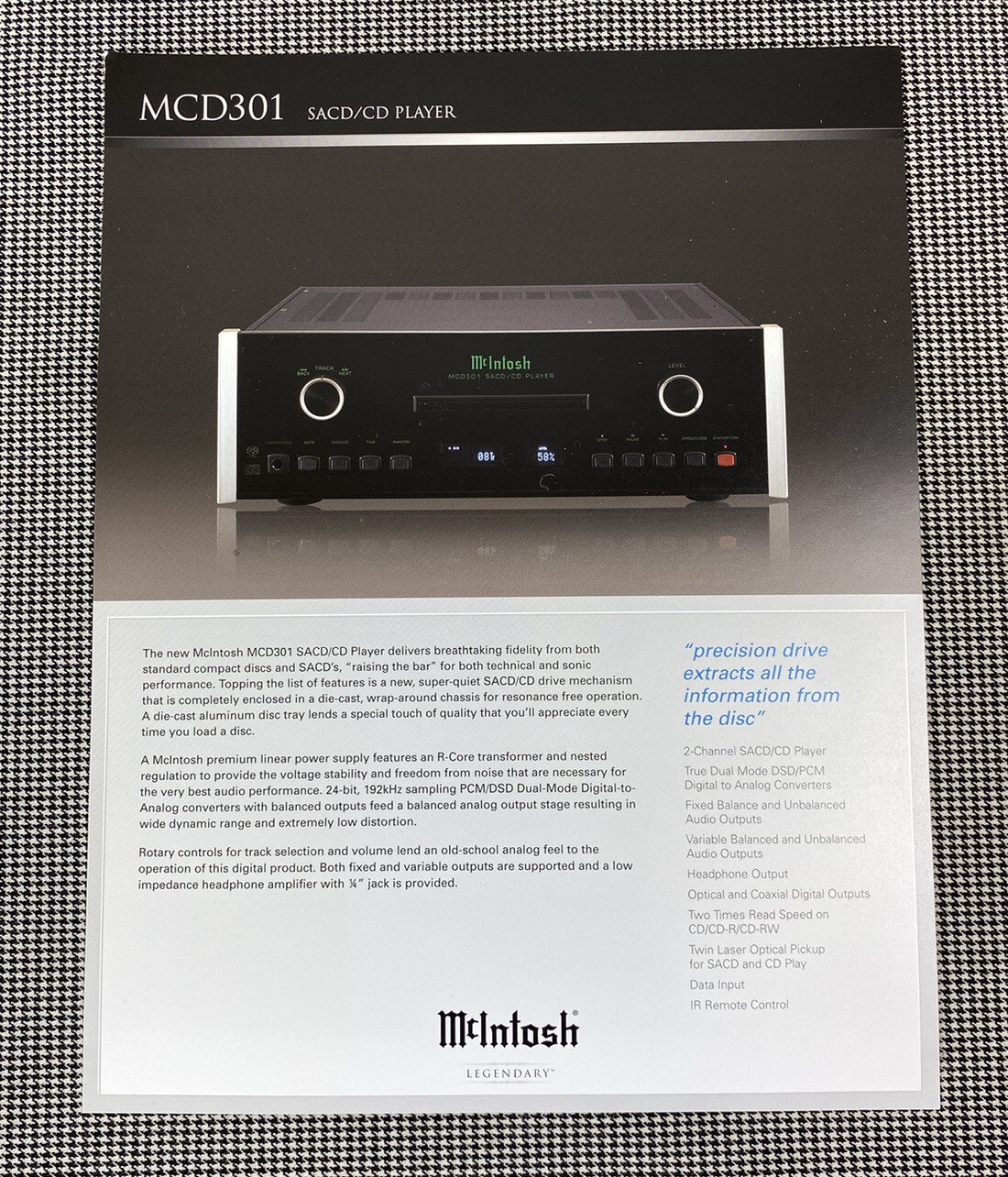
The MCD301 is a two-channel SACD/CD player from McIntosh Laboratory in Binghamton, New York, and the first thing that registers when you lift one is the mass: approximately 12 kg, which is a lot of chassis for a disc spinner. That weight is not decorative. McIntosh's own literature describes a premium-grade D/A converter section paired with a robust power supply, and the company positioned the player as an SACD/CD deck and a digital preamp — a claim that appears in dealer listings but is not corroborated across the manufacturer documentation, so treat the "digital preamp" label as a dealer description rather than a factory spec.
Pricing is where the record gets muddy. McIntosh's original list is documented at $5,000.00 in one source and as $4,500.00 "Est. Retail" in another — a real conflict, not a rounding error, and the kind of discrepancy that shows up when dealers quote street pricing against MSRP. The UK figure is documented at £4195. Whichever number a buyer anchored to, the MCD301 was never a budget component, and it is no longer in production: the availability status on dealer pages reads simply "This product is no longer available."
The feature set is straightforward and format-focused. The player handles SACD, CD, MP3, and WMA — one source lists the formats as CD, SACD, and MP3 without WMA, so the WMA support is single-sourced and worth hedging. It is a two-channel machine, full stop. Where it gets interesting is the converter architecture: a "true dual mode" design using multi-bit DSD and 24-bit PCM digital-to-analog converters, rated at 24-bit/192kHz. That dual-mode approach means the deck runs separate conversion paths for DSD (SACD) and PCM (CD and compressed files) rather than forcing everything through one pipeline — the sort of design choice that matters more to someone comparing SACD layers against Red Book than to a casual listener.
Key Features
"True Dual Mode" Multi-Bit DSD and 24-Bit PCM Converters
McIntosh's own description of the conversion stage emphasizes wide dynamic range and low distortion, and the dual-mode architecture is the technical heart of the player. SACD's DSD stream and CD's PCM stream are fundamentally different signals, and running dedicated multi-bit DSD and 24-bit PCM converters rather than a single shared chip is the design decision that separates the MCD301 from a universal player of the same era. The 24-bit/192kHz rating applies to the PCM side. Whether that architecture translates into an audible advantage is the owner's call, but it is the reason the deck exists as a distinct model rather than a rebadged CD player.
Twin Laser Optical Pickups
The transport uses twin laser optical pickups — separate lasers for SACD and CD playback rather than one laser switching wavelengths. This is a real engineering commitment: two pickup assemblies in one transport means more parts, more alignment, and more cost, but it also means each format gets a laser optimized for its own wavelength rather than a compromise. For a player designed to handle both SACD and Red Book CD, it is the honest way to do it.
2X Speed Read for CD-R and CD-RW
McIntosh documents 2X speed reading on CD-R and CD-RW media, which is a practical nod to the reality that a lot of listening happens on burned discs. It is not a headline spec, but it speaks to a player built to be used rather than displayed.
Power Control Input/Output Jacks
The rear panel carries Power Control Input and Output jacks on 1/8-inch stereo mini phone plugs, designed to send and receive power on/off signals when the MCD301 is connected to other McIntosh components. This is the McIntosh system-integration feature that lets a stack of separates wake and sleep together from a single trigger — a small thing until you have lived with a rack of gear that does not do it.
Remote Control Included
A remote control ships with the player. Documentation notes that the MCD301 pairs with the McIntosh HR056 remote — worth knowing for anyone hunting a replacement, since the handset is a separate part and a missing remote is a common gap on the used market.
Collectibility & Value
The MCD301 sits in that comfortable middle ground of McIntosh digital gear: recent enough to be genuinely useful, old enough to trade at a real discount, and branded well enough to hold value. Documented sales and listings sketch the range. A US Audio Mart listing from July 2023 asked $2,500, described as 40% of original. TMR Audio listed a unit at 49% off an estimated retail of $4,500.00. On the European side, Taste For Audio offered one in "good condition" with a new remote control and a one-year warranty, listed at €649,00 original against a €545,00 current price — a notably lower figure than the US market, which is worth knowing if cross-border shopping appeals. SkyFi Audio advertised a "restored" example, and an Audiogon listing exists without a documented price.
The practical takeaway for a buyer: a clean, complete MCD301 with its remote and original packaging should command meaningfully more than a bare unit, and the spread between the US listings and the European one suggests patience pays. The fact sheet carries no documented failure modes, no known-issues list, and no parts-availability information for this model — so the usual caveats about laser assemblies and transport servicing apply as generic risk, not as documented MCD301 problems. Anyone considering one should confirm the remote is present and ask about transport health directly, because the record simply does not tell us what tends to break.
eBay Listings



As an eBay Partner, we earn from qualifying purchases. This helps support our independent vintage technology research.