McIntosh MC2250 (1982–1987)
Only 499 were made — a rare, no-compromise powerhouse that shares its DNA with the legendary MC2255, built like a tank and still capable of driving the most demanding speakers with authority.
Overview
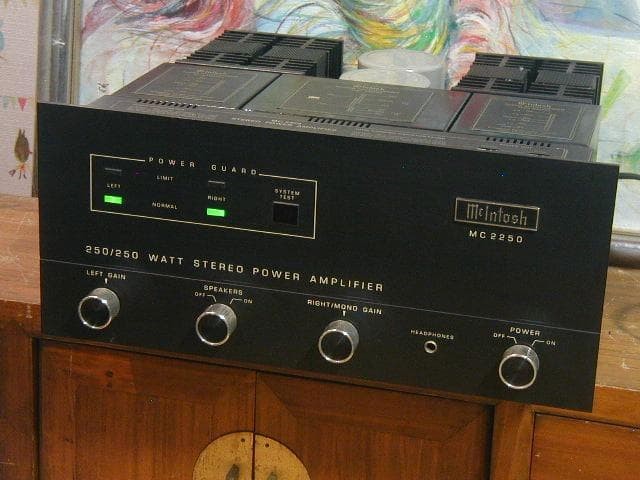
When you uncrate an MC2250, you’re not just unpacking an amplifier — you’re wrestling with 80 pounds of solid-state muscle wrapped in chrome, black steel, and anodized gold. This isn’t one of McIntosh’s glass-fronted showpieces with glowing meters; it’s a stripped-down, industrial-grade beast designed for real work. And yet, despite its utilitarian looks, it sings with that unmistakable McIntosh warmth — smooth, rich, and effortlessly in control, even when driving loads that would make lesser amps whimper.
Produced in extremely limited numbers — just 499 units between 1982 and 1987 — the MC2250 was never meant for the average living room. It was generally designed for the commercial market, which explains its rack-mountable chassis, rugged build, and no-nonsense front panel. But don’t mistake its lack of glass and meters for a lack of soul. Owners report it delivers that “typical McIntosh warm sweet sound,” even under the harshest conditions. It’s been called a “brute” and a “massive powerhouse,” and one forum user put it simply: “The 3a’s love him,” referring to the notoriously hard-to-drive Acoustic Research AR-3a speakers.
It’s essentially a rare, limited-run sibling of the highly regarded MC2255, sharing its core engineering but tailored for professional and high-demand applications. At launch, it carried a price tag of $2,495 — a serious investment at the time, equivalent to a luxury car. Today, it’s a collector’s item not just for its scarcity, but for what it represents: the peak of McIntosh’s 1980s solid-state design, where brute power met surgical precision.
Specifications
| Manufacturer | McIntosh |
| Model | MC2250 |
| Product Type | Stereo Power Amplifier |
| Year of Production | 1982–1987 |
| Power Output Stereo | 250 watts minimum sine wave continuous average power output, per channel, both channels operating into 1 ohm, 2 ohms, 4 ohms, or 8 ohms load impedance |
| Power Output Mono | 500 watts minimum sine wave continuous average power output into 0.5 ohm, 1 ohm, 2 ohms, 4 ohms, 8 ohms, or 16 ohms load impedance |
| Output Load Impedance Stereo | 1 ohm, 2 ohms, 4 ohms, and 8 ohms; separate terminals are provided for each output |
| Output Load Impedance Mono-Parallel | 0.5 ohm, 1 ohm, 2 ohms, and 4 ohms; obtained by connecting together the appropriate terminals of both channels |
| Output Load Impedance Mono-Bridged | 2 ohms, 4 ohms, 8 ohms, or 16 ohms, balanced to common connections |
| Rated Power Band | 20 Hz to 20,000 Hz |
| Total Harmonic Distortion Stereo | 0.02% maximum harmonic distortion at any power level from 250 milliwatts to 250 watts per channel from 20 Hz to 20,000 Hz, both channels operating |
| Total Harmonic Distortion Mono | 0.02% maximum harmonic distortion at any power level from 250 milliwatts to 500 watts from 20 Hz to 20,000 Hz |
| Intermodulation Distortion Stereo | 0.02% maximum if instantaneous peak power output is 500 watts or less per channel with both channels operating for any combination of frequencies, 20 Hz to 20,000 Hz |
| Intermodulation Distortion Mono | 0.02% maximum if instantaneous peak power output is 1000 watts or less for any combination of frequences, 20 Hz to 20,000 Hz |
| Frequency Response (at one watt output) | 20 Hz to 20,000 Hz +0 -0.25 dB. 10 Hz to 100,000 Hz + 0.25 - 1 dB. |
| Noise and Hum | 95 dB below rated output |
| Damping Factor | Greater than 30 |
| Input Impedance | 50,000 ohms |
| Input Sensitivity | Switchable: 0.75 volt or 2.5 volts—level control provided for higher input voltages |
| Power Guard | Clipping is prevented and THD does not exceed 2% with up to 20 dB overdrive at 1 KHz |
| Power Requirements | 120 volts 50/60 Hz 0.7 to 12 amps |
| Semiconductor Complement | 76 silicon transistors, 37 silicon rectifiers and diodes, 9 integrated circuits |
| Size Front Panel | 16 inches wide (40.7 cm) by 6-31/32 inches high (17.7 cm) |
| Size Chassis | 14-9/16 inches wide (37 cm) by 6-1/2 inches high (16.5 cm) by 14-1/2 inches deep (36.8 cm), including connectors. Knob clearance required is 1 inch (2.5 cm) in front of mounting panel |
| Finish | Front panel is anodized gold. Chassis is chrome and black |
| Weight | 80 pounds (36.3 kg) net, 94 pounds (42.6 kg) in shipping carton |
Key Features
Autoformer Output Technology
Like all high-end McIntosh amplifiers of its era, the MC2250 uses Autoformer output transformers — a signature technology that allows it to deliver full rated power into any load, whether 1 ohm or 16 ohms. This isn’t just marketing fluff; it means the amp doesn’t have to work harder into low-impedance speakers, reducing stress and distortion. It’s one of the reasons McIntosh amps are legendary for driving difficult loads like the AR-3a or Apogee ribbons without breaking a sweat.
Power Guard and 7-Stage Protection
The MC2250 includes McIntosh’s Power Guard circuit, which actively monitors the signal to prevent clipping — not just by limiting peaks, but by shaping the waveform in real time. A 7-stage implementation ensures that even with 20 dB of overdrive at 1 kHz, total harmonic distortion never exceeds 2%. This isn’t just about protecting speakers; it’s about preserving the integrity of the signal, even when pushed hard. It’s a big reason why these amps survive decades of abuse and still sound pristine.
Rack-Mountable Industrial Design
Unlike the domestic-focused models with glass fronts and backlit logos, the MC2250 features vintage cosmetics rather than glass/meters. It’s built for 19-inch racks, with a rugged chrome and black chassis and a simple anodized gold front panel. There are no meters, no glowing logos — just business. But don’t mistake minimalism for compromise. The dual mono design, massive toroidal transformer, and full discrete circuitry are all hidden beneath that no-frills exterior.
Historical Context
The MC2250 was a rare, limited-production model — only 499 units were ever made — and it was generally designed for the commercial market. It shares its core architecture with the highly regarded MC2255, making it a sort of stealth sibling: same power, same precision, but repackaged for studios, broadcast facilities, and high-end commercial installations. Its scarcity wasn’t due to poor sales, but likely due to its niche role. It never appeared in mainstream McIntosh brochures, which may explain why it’s less known than its siblings — but not less respected among those who’ve used one.
Collectibility & Value
With only 499 ever produced, the MC2250 is a genuine rarity. A unit listed on Audio Exchange sold for $2,249 in excellent physical and working condition, fully tested by a professional technician. Another listing on Reverb showed a price of $2,499 as recently as December 2025, indicating stable demand among collectors and audiophiles.
Because of its age, a proper restoration is often necessary. A full recap of all electrolytic capacitors on all PCBs is considered essential — not optional. Capacitors should be checked for bulging, shrunken wrappers, or leakage, as these are telltale signs of predictive failure. One unit was previously serviced by Audio Classics, who adjusted the DC offset pots and performed a routine service, suggesting that while robust, these amps do require expert attention over time.
An optional McIntosh wood cabinet is available as an add-on for $450, and a dedicated restoration kit for filter capacitor repair is listed at $195 — a small price compared to the amp’s value. Given its build quality and parts count (76 transistors, 37 diodes, 9 ICs), a well-maintained MC2250 isn’t just a collector’s item — it’s a working masterpiece that can still outperform modern competition in sheer drive and control.
eBay Listings


As an eBay Partner, we earn from qualifying purchases. This helps support our independent vintage technology research.
Related Models
- McIntosh C47 (2020-present)
- McIntosh C712 (1998-2002)
- McIntosh MAC4200 (1995-1999)
- McIntosh MC2002 (1993-1999)
- McIntosh C70 (2020-present)
- Akai AM-2850 (1975)
- Akai AP-206 (1975)
- Nakamichi BX-1 (1985)
- Acoustic Research research-ar-17 (1978)
- Acoustic Research AR-19 (1994)