McIntosh ML-1C (1970–1977)
The first speaker McIntosh ever made—and the one that proved they weren’t just about amplifiers.
Overview
Pull one out of the crate, dust off the rosewood veneer, and you’re holding a piece of McIntosh history that doesn’t glow with blue meters but still commands respect: the ML-1C, the company’s debut loudspeaker, launched in 1970 as a full-range statement that high-end sound could come in a matched system. These aren’t sleek modern towers—they’re wide-hipped, floor-standing four-ways with a presence that fills the room before you even turn them on. At first glance, they look like furniture from a 1970s audiophile’s dream den: real wood, clean lines, and that classic McIntosh badge front and center. But behind the handsome exterior is a design built to go deep—flat down to 20Hz, no subwoofer needed, if you believe the original claims. That was a bold promise in 1970, and it hinged on one critical detail: the MQ101 equalizer, which wasn’t optional in practice, even if it was sold separately. Without it, the ML-1C’s bass dips into a hole; with it, the system sings with authority and balance. It’s not a speaker for the EQ-averse. But if you’re willing to wire up that extra box and dial it in, you’re rewarded with a sound that’s rich, articulate, and surprisingly modern in its clarity—especially after restoration.
Positioned as McIntosh’s entry into the speaker market, the ML-1C sat at the foundation of what would become a full line of ML-series loudspeakers. It wasn’t the most refined model they’d eventually build, nor the most powerful, but it was the blueprint. Above it came the ML-2C and later the ML-3, each refining the formula with better drivers and crossovers. Below it? Nothing—this was ground zero. For a company known for amplifiers with near-mythical reliability and sound, the ML-1C had something to prove. And while it didn’t instantly redefine the speaker world, it established McIntosh as serious about acoustics, not just electronics. It competed in an era when Advent, AR, and KLH were dominating the high-efficiency, compact speaker market, while big floor-standers from JBL and Acoustic Research were chasing flat response and deep bass. The ML-1C aimed squarely at the latter, offering a full-range alternative with the same engineering rigor that defined their amps.
Specifications
| Manufacturer | McIntosh Laboratory |
| Production Years | 1970–1977 |
| Model | ML-1C |
| Type | 4-way, floor-standing loudspeaker |
| Drivers | 12" woofer, 8" mid-bass, 5" midrange, 1" tweeter, 3/4" super tweeter |
| Crossover Frequencies | 500 Hz, 3 kHz, 10 kHz |
| Frequency Response | 20 Hz – 20 kHz (±1 dB, with MQ101 equalizer) |
| Sensitivity | 88 dB (1W/1m) |
| Nominal Impedance | 8 ohms |
| Minimum Impedance | 5 ohms |
| Recommended Amplifier Power | 50–200 watts |
| Enclosure Type | Ported (bass reflex) |
| Port Location | Rear-firing |
| Dimensions (H×W×D) | 42" × 15" × 19" |
| Weight | 85 lbs (38.6 kg) per speaker |
| Finish | Walnut or rosewood veneer |
| Grille | Fabric-covered, removable |
| Equalizer Requirement | MQ101 or MQ102 recommended for flat response |
Key Features
A Four-Way Crossover with a Purpose
Most speakers from this era settled for two or three drivers. The ML-1C went all in with five: a 12-inch woofer for foundation, an 8-inch mid-bass to handle the upper bass and lower mids, a 5-inch midrange for vocals, a 1-inch dome tweeter, and a 3/4-inch super tweeter for air above 10 kHz. That last one is the giveaway—this wasn’t just about bass extension, it was about full-spectrum fidelity. The crossover network is complex for its time, splitting duties at 500 Hz, 3 kHz, and 10 kHz. But it’s not passive perfection. Left alone, the speaker rolls off steeply below 100 Hz. The flat response claim only holds when paired with the MQ101 equalizer, which applies a carefully shaped bass boost to compensate for the ported cabinet’s natural roll-off. It’s a system, not a standalone speaker—and that integration was part of McIntosh’s vision. Roger Russell, the legendary McIntosh engineer who later documented the design, emphasized that the speaker and EQ were tuned as a pair. Skip the EQ, and you lose the point of the whole design.
Built Like a Component, Not a Box
The cabinet is heavy—85 pounds heavy—and not just from the drivers. The ML-1C uses thick MDF and real wood veneer, finished to match McIntosh’s amplifiers of the era. It’s not just about looks; the mass helps control resonance, and the internal bracing was more advanced than many contemporaries. The rear-ported design requires space from the wall—too close and the bass turns boomy—but set up correctly, it delivers deep, controlled low end. The front baffle is wide enough to accommodate the array of drivers, but the tweeter and super tweeter are mounted on a angled pod, aimed toward the listener to improve high-frequency dispersion. That detail hints at McIntosh’s attention to time alignment and off-axis response, even in their first speaker. The binding posts are solid, typical of the brand, and accept banana plugs or bare wire. But the real connection point is the EQ: the speaker links to the amplifier through the MQ101, which sits in-line like a preamp. It’s a clunky setup by today’s standards, but in 1970, it was a high-end solution.
Restoration Transforms Performance
Few original ML-1Cs survive in fully functional condition. The foam surrounds on the woofers and mid-bass drivers degrade over time, leading to flapping, distortion, or complete failure. The capacitors in the crossover also dry out, dulling the highs and muddying the mids. But unlike some vintage speakers that are too far gone, the ML-1C responds exceptionally well to restoration. Replacing the foam, refreshing the crossover caps, and upgrading the tweeter and super tweeter—especially with Roger Russell’s recommended upgrades—can elevate a tired pair into something that competes with modern floor-standers. Owners report that properly restored ML-1Cs deliver a soundstage that’s wide, deep, and stable, with bass that feels more felt than heard. The midrange is natural, never shouty, and the highs, once lifeless, regain their sparkle with the right tweaks. It’s not a plug-and-play vintage relic—it’s a project speaker that rewards investment.
Historical Context
When McIntosh launched the ML-1C in 1970, they were already legends in amplifier design. The MC275 and MC30 were in high demand, revered for their power, reliability, and that signature blue glow. But the company had never made a speaker. The ML-1C was their answer to a growing trend: the integrated high-fidelity system. Competitors like AR and Advent were selling complete packages, and McIntosh saw an opportunity to offer a matched solution. The ML-1C wasn’t just a speaker—it was a statement that McIntosh could engineer the entire signal chain. At the same time, the audio world was shifting. Solid-state amplifiers were replacing tubes, and speaker design was moving toward more scientific measurement-based tuning. The ML-1C fit right in: it was designed using anechoic chamber data and equalized for flat response, a rarity at a time when many speakers were still tuned by ear. The MQ101 equalizer, with its fixed curve tailored to the ML-1C’s response, was a bold move—essentially admitting that passive crossover design alone couldn’t achieve the target. It was a precursor to modern DSP, albeit in analog form. While not the first speaker to use EQ, it was one of the first from a major brand to make it a core part of the design.
Collectibility & Value
The ML-1C is a niche collectible—respected among McIntosh enthusiasts but often overlooked in broader vintage audio circles. Pairs in original, un-restored condition typically sell for $200–$400, reflecting their age and the near-certainty of needing refoaming. That price jumps to $800–$1,500 for fully restored pairs, especially those upgraded with Roger Russell’s recommended components. The presence of the original MQ101 or MQ102 equalizer adds another $200–$400 to the value, and complete systems (speakers + EQ) are rare. What breaks? Everything foam-related. The 12-inch and 8-inch drivers almost always need refoaming after 40+ years. The foam in the port can also disintegrate, causing rattles. Crossover capacitors, especially the electrolytics, degrade and should be replaced during any serious restoration. The super tweeter is fragile and often damaged by overdriving or age. Before buying, check for cone tears, stiff surrounds, and any buzzing at low frequencies. Test the speaker with music that has deep bass—if the bottom end flaps or distorts, budget for refoaming. Also verify that the EQ, if included, powers on and outputs signal. These aren’t fragile, but they’re not plug-and-play. They’re a restoration project with a payoff: a speaker that, when cared for, sounds like it belongs in a high-end system, not a museum.
eBay Listings


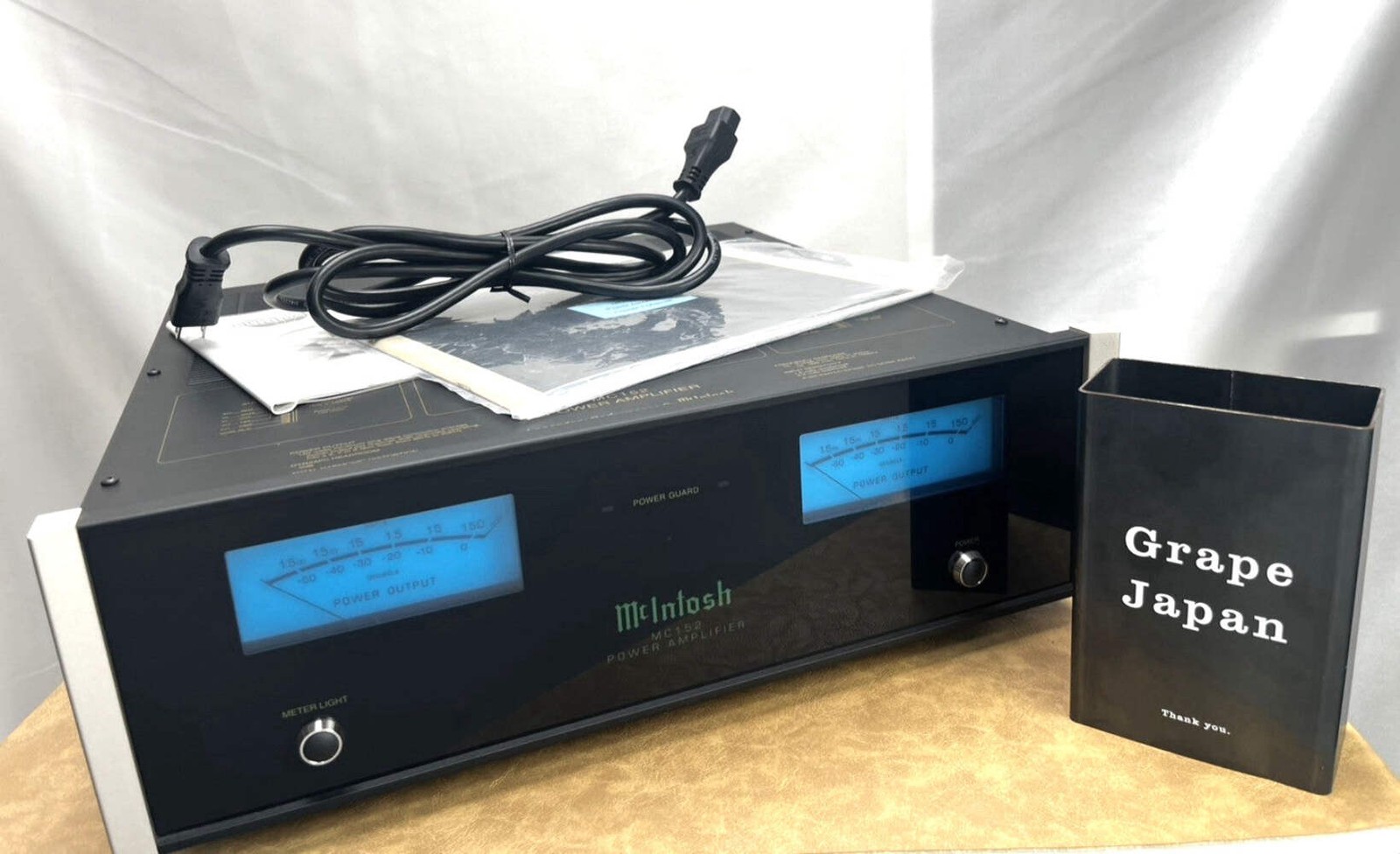

As an eBay Partner, we earn from qualifying purchases. This helps support our independent vintage technology research.
Related Models
- McIntosh C47 (2020-present)
- McIntosh C712 (1998-2002)
- McIntosh MAC4200 (1995-1999)
- McIntosh MC2002 (1993-1999)
- McIntosh MC2250 (1977-1980)
- Akai AM-2850 (1975)
- Akai AP-206 (1975)
- Nakamichi BX-1 (1985)
- Acoustic Research research-ar-17 (1978)
- Acoustic Research AR-19 (1994)