McIntosh MC100 (1970–1974)
One hundred watts of solid-state muscle wrapped in blue-lit glass — the amplifier that proved McIntosh could conquer transistors without losing its soul.
Overview
That first flicker of the blue meter lighting up as the power comes on — it’s not just a visual signature, it’s a promise. The McIntosh MC100 isn’t just an amplifier; it’s a declaration that solid-state didn’t have to mean sterile. Introduced in 1970, right when the industry was teetering between tubes and transistors, the MC100 arrived like a heavyweight with impeccable manners — 100 watts per channel of clean, controlled power, delivered through the same Autoformer technology that had made McIntosh’s tube amps legendary. It didn’t scream for attention, but once you heard it drive a pair of inefficient horns or a pair of Quad ESLs, you understood: this was high fidelity with authority, built to last longer than the house it played in.
Positioned just below the flagship MC2105, the MC100 wasn’t the top dog, but it was the sweet spot for many serious listeners who wanted McIntosh performance without the premium price tag. It offered the full suite of engineering hallmarks: the glass front panel, the illuminated meters tracking output, the massive toroidal power supply, and most importantly, the patented Autoformer on the output stage — a feature that allowed it to deliver full power into 2, 4, or 8 ohm loads without strain or distortion. In an era when most solid-state amps would clip or overheat trying to drive difficult speakers, the MC100 just kept going, cool and composed. It wasn’t marketed as a “hi-fi toy” — it was a tool for audiophiles and professionals who needed reliability and transparency, whether in a living room or a broadcast suite.
Sound-wise, the MC100 splits the difference between tube warmth and transistor precision. It doesn’t have the romantic bloom of a vintage MC275, but it avoids the clinical edge that plagued so many early solid-state designs. Instead, it delivers a balanced, dynamic presentation with a solid midrange foundation, smooth treble, and bass that’s tight without being lean. It won’t “wow” you with hyper-detail like some modern amps, but it pulls you into the music with coherence and authority. Play a live jazz recording, and the piano has weight, the cymbals shimmer without sizzle, and the saxophone breathes with natural presence. It’s not flashy, but it’s honest — and that honesty has earned it a loyal following among collectors who value longevity as much as tonality.
Specifications
| Manufacturer | McIntosh Laboratory, Inc. |
| Production Years | 1970–1974 |
| Original Price | $299 |
| Power Output | 105 watts per channel (stereo, both channels driven) |
| Frequency Response | 20Hz – 20kHz (±0.5dB) |
| THD | Less than 0.25% |
| IM Distortion | Less than 0.25% |
| S/N Ratio | 110 dB (A-weighted) |
| Damping Factor | Over 50 (1kHz, 8Ω) |
| Input Sensitivity | 1.2V for rated output |
| Input Impedance | 47kΩ |
| Output Impedance | Autoformer-coupled (compatible with 2Ω, 4Ω, 8Ω) |
| Inputs | 2 pairs unbalanced (RCA) |
| Outputs | Speaker taps for 2Ω, 4Ω, 8Ω (binding posts) |
| Power Consumption | 650 watts (max) |
| Weight | 52 lbs (23.6 kg) |
| Dimensions (W×H×D) | 19" × 7.25" × 18.5" (48.3 × 18.4 × 47 cm) |
| Cooling | Convection (no fan) |
| Construction | Steel chassis, aluminum faceplate, glass front panel |
| Protections | Short-circuit, thermal, and turn-on/off surge protection |
Key Features
The Autoformer Advantage
McIntosh didn’t just adapt to solid-state — they re-engineered it. The MC100’s Autoformer isn’t just a gimmick; it’s the core of its performance. Unlike most amplifiers that struggle with low-impedance or reactive speaker loads, the MC100 uses a custom output transformer (yes, even in solid-state) to ensure consistent power delivery across all speaker types. This means whether you’re running a pair of 4Ω AR-3as or a set of 8Ω JBL L100s, the amp delivers the same clean, undistorted output. It also eliminates the need for multiple amplifier channels or impedance-matching switches — just connect and play. The result is a level of speaker compatibility that few contemporaries could match, and even fewer can today.
Build Quality That Ages Gracefully
Open the chassis of a well-maintained MC100, and you’re not looking at fragile PCBs or glued-in capacitors — you’re seeing hand-point-to-point wiring, heavy-duty terminal strips, and military-grade components laid out with obsessive neatness. The heat sinks are massive aluminum extrusions, bolted directly to the output transistors, and the entire assembly is built to dissipate heat without fans. That’s why so many of these units still work flawlessly 50 years later. The front panel, with its brushed aluminum trim and thick glass, feels like it could survive a minor earthquake. And the blue analog meters? They’re not just for show — they give real-time feedback on output levels, helping users avoid clipping and protecting their speakers. It’s a rare example of form and function being perfectly aligned.
Designed for Real-World Use
McIntosh didn’t build the MC100 for showrooms — they built it for people who actually listened. The input selection is simple and robust, with gold-plated RCA jacks that resist corrosion. The rear panel is cleanly laid out, with clearly labeled speaker terminals and grounding posts for hum reduction. The power switch is a satisfying mechanical toggle, and the unit includes McIntosh’s signature “Power Guard” circuitry, which monitors signal peaks and prevents clipping by slightly reducing gain before distortion occurs. It’s not a limiter in the modern sense — it’s a subtle, transparent protection system that preserves dynamics while protecting downstream components. For users in the 1970s, this meant they could crank the volume without fear of blowing tweeters or frying transistors.
Historical Context
The early 1970s were a turning point for high-fidelity audio. Transistors had proven they could outperform tubes in power and reliability, but many listeners missed the warmth and musicality of vacuum tubes. McIntosh, having built its reputation on tube amplifiers like the MC30 and MC275, faced a challenge: how to transition to solid-state without alienating its loyal customer base. The MC100 was part of the answer. Alongside the MC2105 and MC2300, it demonstrated that McIntosh could deliver the same build quality, reliability, and sonic integrity in a transistorized package. Competitors like Marantz, Harman Kardon, and Sansui were pushing solid-state designs, but few matched McIntosh’s engineering rigor or long-term reliability. The MC100 wasn’t the most powerful amp on the market, but it was one of the most trustworthy — a reputation that helped solidify McIntosh’s position as a leader in both consumer and professional audio.
Collectibility & Value
Today, the MC100 occupies a sweet spot in the vintage market — not as rare or coveted as the MC275, but far more collectible than mass-market receivers of the era. Units in excellent original condition with bright meters and clean chassis typically sell for $800 to $1,500. Those that have been professionally restored — with recapped power supplies, cleaned controls, and tested output transistors — can command $1,800 or more. However, condition is everything. These amps are 50 years old, and the electrolytic capacitors are long past their lifespan. A unit that powers on but hums or distorts likely needs a full recap, which can cost $300–$500 depending on the technician. Output transistors can fail, especially if the amp was overheated or driven into sustained clipping, but replacements are still available through specialty suppliers.
When buying, check the meters — they should light evenly and return to zero when off. Listen for hum or channel imbalance, and inspect the heat sinks for signs of previous overheating (discoloration or warped fins). The binding posts should be tight and free of corrosion, and the glass front panel should be intact. Avoid units with replaced power cords or non-original modifications — they often indicate past failures. For those on a budget, the MC100 offers a legitimate entry into the McIntosh ecosystem without the premium price of the tube models. And unlike many vintage amps, it can still drive modern speakers with authority — a rare combination of nostalgia and practicality.
eBay Listings


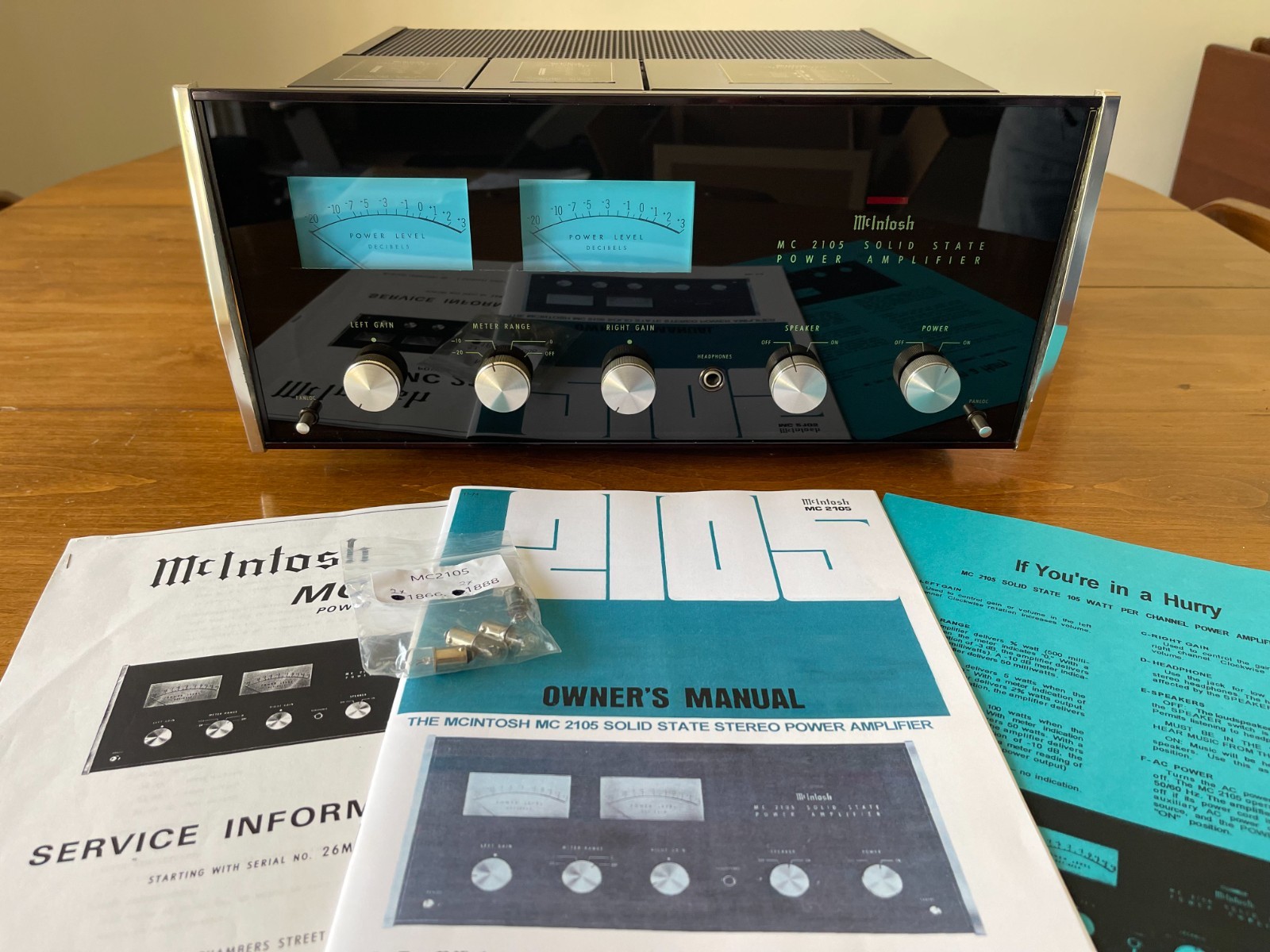
As an eBay Partner, we earn from qualifying purchases. This helps support our independent vintage technology research.
Related Models
- McIntosh C47 (2020-present)
- McIntosh C712 (1998-2002)
- McIntosh MAC4200 (1995-1999)
- McIntosh MC2002 (1993-1999)
- McIntosh MC2250 (1977-1980)
- Akai AM-2850 (1975)
- Akai AP-206 (1975)
- Nakamichi BX-1 (1985)
- Acoustic Research research-ar-17 (1978)
- Acoustic Research AR-19 (1994)