McIntosh MAC4200 (1985-1988)
You can practically hear the hush of reverence when someone powers up a MAC4200—this is the one that collectors whisper about, the rare beast that fused late-'80s luxury with McIntosh’s unshakable engineering soul.
Overview
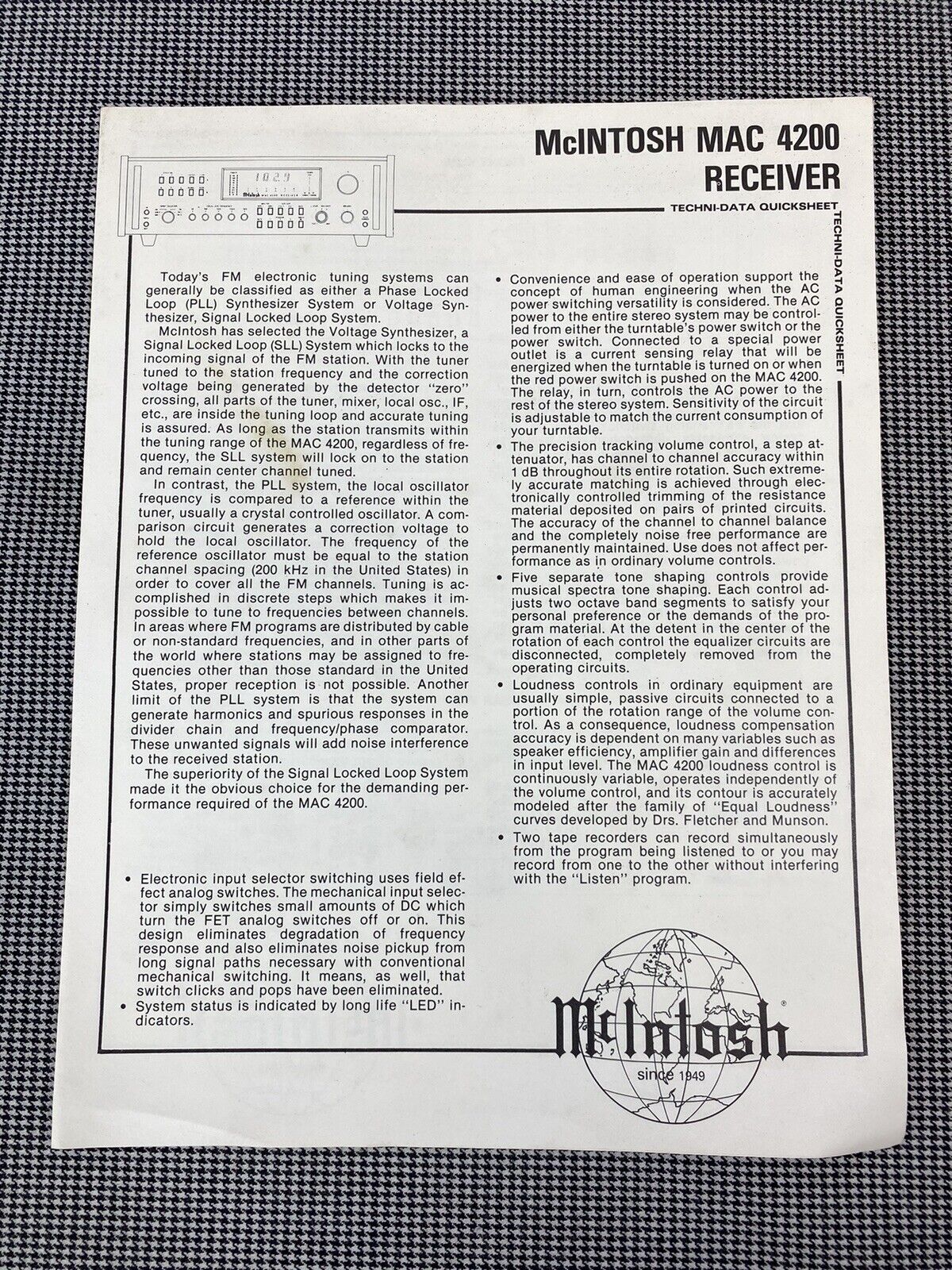
The McIntosh MAC4200 AM/FM Stereo Receiver isn’t just another high-end receiver from the 1980s—it’s a statement. Built between 1985 and 1988 by McIntosh Laboratory, Inc., it stands as a 2-channel AM/FM stereo receiver that collectors now call “classic, rare and very collectable.” And for good reason: this thing was priced at $2,890 when new (some sources say $2,800 in late-’80s dollars), a staggering sum that put it firmly in the realm of the audiophile elite. It wasn’t just expensive—it was overbuilt. One observer put it perfectly: “This receiver really was over-engineered for its intended use.” And that’s the McIntosh way, taken to the extreme.
Owners report it delivers 75 watts per channel into 8Ω with solid-state, direct-coupled circuitry and the company’s signature Power Guard protection, which prevents clipping without sacrificing dynamics. It’s a full-featured stereo hub with AM/FM stereo tuning across FM and MW bands, It’s not flashy, but everything about it—the weight, the layout, the sheer component count—tells you this was built to last decades, not just survive a few years of fashion.
One quirky but clever touch: it uses rechargeable batteries to keep preset stations in memory indefinitely. No losing your favorite stations when the power flickers. That kind of thoughtful engineering, combined with its scarcity and the fact that some units have received complete restorations by specialists like Audio Classics, has cemented its reputation. Some owners even go so far as to call it “The King of McIntosh receivers IMO.” High praise, especially in a brand lineup known for near-religious devotion.
Specifications
| Manufacturer | McIntosh Laboratory, Inc. |
| Model | MAC4200 |
| Product Type | AM/FM Stereo Receiver |
| Production Years | 1985 - 1988 |
| Power Output | 75 watts per channel into 8Ω (stereo) |
| Frequency Response | 20Hz to 20kHz |
| Total Harmonic Distortion | 0.02% |
| Damping Factor | 40 |
| Input Sensitivity | 2.5mV (MM), 250mV (line) |
| Signal to Noise Ratio | 90dB (MM), 100dB (line) |
| Output | 250mV (line) |
| Speaker Load Impedance | 4Ω to 8Ω |
| Semiconductors | 37 x IC, 21 x FET, 67 x transistors, 142 x diodes |
| Dimensions | 471 x 133 x 356mm |
| Weight | 18.1kg |
| Tuner Type | AM/FM Stereo |
| Tuning Range | FM, MW |
Collectibility & Value
The MAC4200 has achieved near-legendary status among McIntosh collectors. Described as “classic, rare and very collectable,” it commands serious attention when it surfaces. While original pricing was around $2,800 to $2,890 in the late 1980s, today’s market reflects both its scarcity and the quality of restoration. One fully restored unit sold for $1,050 through Audio Classics, while another recapped and rebuilt example was listed at $2,000 as of late 2025. These aren’t off-the-couch finds—they’re labor-of-love restorations, often accompanied by glowing reports: “Very good physical condition and sounds great,” with one unit rated 8/10 “for age only.”
Given its complexity and age, a full or complete restoration by a specialist like Audio Classics is often a prerequisite for reliable performance and maximum value. Owners note that such work has been done on verified units, underscoring the investment required to keep these running. Meanwhile, even the manual has become a collectible—selling for $45 to $50 on its own. If you’re hunting for a MAC4200, expect to pay a premium for anything that’s been properly serviced. It’s not just a receiver; it’s a piece of McIntosh history that refuses to fade.
eBay Listings


As an eBay Partner, we earn from qualifying purchases. This helps support our independent vintage technology research.
Related Models
- McIntosh C47 (2020-present)
- McIntosh C712 (1998-2002)
- McIntosh MC2002 (1993-1999)
- McIntosh MC2250 (1977-1980)
- McIntosh C70 (2020-present)
- Akai AM-2850 (1975)
- Akai AP-206 (1975)
- Nakamichi BX-1 (1985)
- Acoustic Research research-ar-17 (1978)
- Acoustic Research AR-19 (1994)