McIntosh MA-5100 (1966–1972)
McIntosh's first fully solid-state integrated amplifier - 45 watts a side, a glass faceplate, and a reputation for being the easiest-listening entry point into the brand.
Overview
The MA-5100 tells you which McIntosh era you're standing in. Built between 1966 and 1972, it's generally regarded as McIntosh's first fully solid-state integrated unit. The company stopped leaning on tubes for its all-in-one chassis and committed to transistors. The brief was simple on paper and hard in practice: keep the McIntosh voice, lose the tubes. Whether it fully succeeded is a matter of taste. One widely repeated owner assessment calls it an early solid-state McIntosh that wasn't as impressive as the tube gear it sat beside, but built specifically to preserve the signature house sound.
The numbers look better than that assessment suggests. The MA-5100 is rated at 45 watts per channel into 8 ohms, and a test bench figure from AURAL HiFi found verified power exceeding 45 watts RMS per channel at clipping. McIntosh under-promised. Frequency response is quoted at 10Hz to 20kHz, total harmonic distortion at 0.25%, and damping factor at 80. Those aren't spectacular figures for the period, but they're honest ones. A damping factor of 80 is enough to keep a grip on the woofers, which flabby early solid-state designs couldn't do.
There is one confusing data point in the historical record. High Fidelity (October 1966, p.91) published a power-bandwidth measurement of 22 watts at 0.5% distortion, and the surviving fragment doesn't make clear whether that figure is per channel or summed across both. It sits awkwardly next to the 45-watt rating that three separate sources agree on. Treat the 22-watt figure as a product of an incomplete test report, not a contradiction of the rated output.
The naming trips people up in listings. The research document calls it a stereo integrated amplifier, and an eBay listing for the same unit calls it a "Preamp Amplifier." Both refer to the same box. The MA-5100 is an integrated, with preamp and power amp sharing one chassis, and "preamp amplifier" is just loose listing language.
Key Features
45 Watts Per Channel Into 8 Ohms
This is the headline number, and it determines what speakers you can realistically pair with it. Three sources agree on 45 watts per channel into 8 ohms, with one variant spec sheet describing it as 45 RMS watts continuous into 4 or 8 ohms with both channels operating from 20Hz to 20,000Hz. That matters because the amplifier doesn't fold up when you drop to a 4-ohm load, which is more than can be said for a lot of mid-Sixties solid-state. It won't drive inefficient modern speakers to party levels, but into period-appropriate efficient designs it has room to spare. AURAL HiFi's bench finding that it exceeds its rating at clipping suggests McIntosh was being conservative, as it usually was.
Solid-State Topology — McIntosh's First Fully Transistorized Integrated
The MA-5100 is described in multiple sources as McIntosh's first fully solid-state integrated unit, and as one of the first solid-state integrated amplifiers the company made. The internal topology isn't documented in surviving material, so the circuit can't be described here. The amplifier arrived while McIntosh was shifting from vacuum-tube designs toward solid-state circuitry, and the MA-5100 was the integrated that carried the brand across that line.
Glass Faceplate and Wooden Case
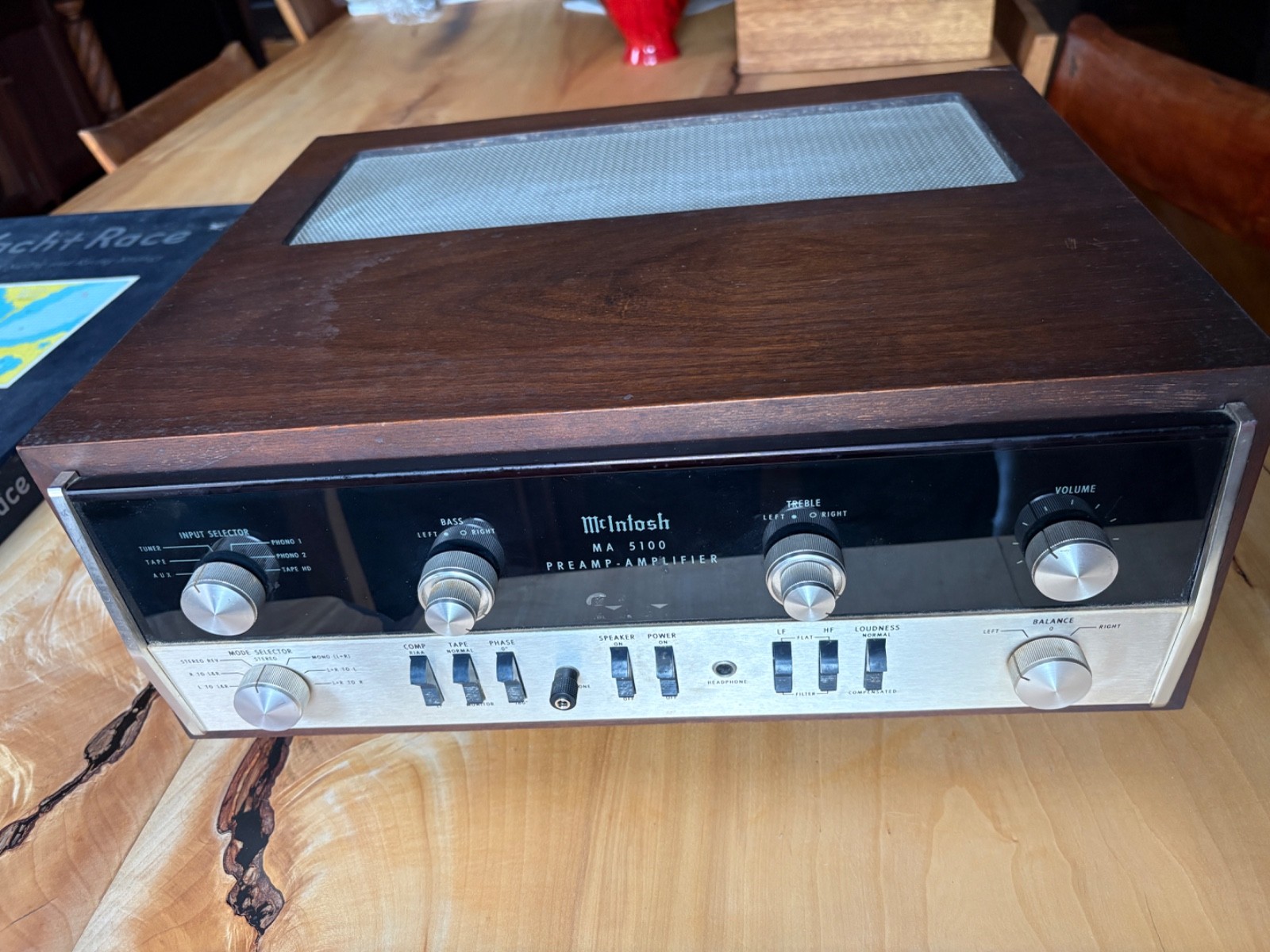
The MA-5100 wears the McIntosh glass front panel - "frontal de cristal McIntosh" in one Spanish-language listing - and at least some units shipped with an original wooden case. The glass is the most important cosmetic item on any vintage McIntosh, and the most fragile. Service records for this model routinely mention new glass, so the panels crack and replacements exist. A pristine faceplate is the difference between a $600 amplifier and a $1,500 one.
Tone Controls, Balance, Loudness Compensation, and a Headphone Jack
Per the owner's manual, the MA-5100 provides tone controls, a balance control, a loudness compensation switch, and a headphone jack. It's a full-function integrated with a complete control set, not a stripped-down purist line stage. The loudness switch is a period-correct feature that modern amplifiers have largely abandoned, and it's useful at low listening levels. Some units are also described as "Bi-Tensión," factory-set to run on 220 volts, so check before you plug one in.
Dual Phono Inputs
A product listing references dual phono inputs, and the manual's specification line for input sensitivity begins with 2mV (MM) before the source truncates. So there's a moving-magnet phono stage on board, and at least two phono inputs. The full input sensitivity figure isn't recoverable from available documentation, because the value cuts off mid-specification. Anyone needing the exact number will have to consult a physical manual.
Historical Context
Production ran from 1966 to 1972, which places the MA-5100 in McIntosh's transitional mid-1960s lineup. It was a 45-watt integrated amplifier from 1966, and it arrived as the company was moving away from tubes across its range. The surviving commentary makes the relationship to the tube gear explicit: the MA230 was the tube alternative, and the MA-5100 was pitched at buyers who didn't want to fuss with tubes or who had a space with limited airflow. Same look, same feel, same feature set, different output devices.
Contemporary print coverage is thin but not absent. High Fidelity (October 1966, p.91) ran a test report that included the power-bandwidth measurement discussed above. HiFi/Stereo (November 1971, p.85) documented the only known example of the amplifier in a listener's home: a custom console built by Arthur P. Greenberg of Falls Church, Virginia, with the MA-5100 driving a pair of Bozak B-302A speakers, an Empire 498 turntable with a Stanton 681EE cartridge, and a McIntosh MR-series tuner.
The research document's summary of the MA-5100's archival footprint is blunt: it remains a phantom in the McIntosh catalog, named in period directories and glimpsed in ads, but lacking the detailed record collectors expect for most McIntosh products. No factory specification sheet survives in this archive. No original retail price has been located. The amplifier is well enough known to have a market, but thinly enough documented that anyone writing about it has to work from fragments.
Collectibility & Value
Prices are all over the map, which is typical for a McIntosh model with an incomplete paper trail. An eBay listing for a tested unit sits at $1,499. A Subito listing out of Italy asks €1,500. A retailer lists a regular price of Dhs. 5,850.00 AED. Against those numbers, a Turntable Store listing showing $150 is an outlier - either a parts unit, a typo, or a very different condition tier. The realistic range for a working, presentable example is somewhere in the high three figures to low four figures, with the top of that band reserved for units with pristine glass and documented service history.
The two failure points that come up repeatedly are the glass faceplate and the capacitors. Service listings for this model routinely mention new glass, and one owner's writeup specifically references capacitor work on the PCB sections - "cap stuffing," in their phrasing. Neither is surprising for a 50-plus-year-old amplifier, but both are worth budgeting for. A unit described as a one-owner piece with pristine faceplate and glass, kept in one place its whole life, is the one to hold out for. Serial numbers in the 95Hxx range appear in the wild, giving at least a rough sense of production scale.
On sound, the owner consensus is warm rather than neutral. The MA-5100 is described as an entry-level vintage McIntosh with a sweet, non-fatiguing character, and as an amplifier famous for delivering beautiful, easy-to-listen-to music at its 45-watt rating. One Spanish-language listing sums it up as "gran calidez de sonido" - great warmth of sound. If you want the last word in transparency, this isn't the McIntosh for you. If you want the house sound without tube maintenance, it is.
The MA-5100 is a large, heavy device that may require a dedicated space and additional support for installation. The exact weight and dimensions aren't recoverable from available documentation. A manual is referenced as containing them, but the values themselves aren't in the record.
eBay Listings


As an eBay Partner, we earn from qualifying purchases. This helps support our independent vintage technology research.