McIntosh C712 (1993–1997)
That first glow of the incandescent display, the soft click of the motorized knob—this is McIntosh minimalism that still feels like luxury.
Overview
The McIntosh C712 System Control Center isn’t the brand’s flashiest preamp, but it might be one of its most quietly satisfying. Built between 1993 and 1997, it was McIntosh’s entry point into their separates lineup during the mid-90s—a time when even high-end audio was starting to streamline. At $1,500 at launch, it was the most affordable way to own a McIntosh-branded control center, but don’t mistake "entry-level" for compromise. This thing still wears the build quality like a tailored suit: thick glass faceplate, machined knobs, and that unmistakable glow behind the panel. It’s compact by McIntosh standards, but not small—just lean, with a solid-state, slim-line design that fits neatly into a shelf without sacrificing presence.
Owners report a preamp that delivers the classic McIntosh balance: neutral but never cold, detailed without being clinical. The phono stage is a standout, with a smooth, gutsy character that handles moving-magnet cartridges with ease. One reviewer called it a “wonderful, neutral sounding component,” and that tracks—this isn’t a colorist, it’s a communicator. It does the heavy lifting of system control with eight sets of RCA inputs, including dedicated phono, tuner, video, and dual CD inputs, plus three RCA outputs and a headphone jack. If you’re pairing it with the MC7100 power amp, as many did, you’ve got a compact but full-featured 90s McIntosh stack that still holds up sonically.
Specifications
| Manufacturer | McIntosh Laboratory |
| Year of Production | 1993–1997 |
| Frequency Response | 20Hz to 20kHz |
| Total Harmonic Distortion | 0.002% |
| Gain | 40dB (MM), 20dB (line) |
| Input Sensitivity | 2.5mV (MM), 250mV (line) |
| Signal to Noise Ratio | 90dB (MM), 105dB (line) |
| Output | 2.5V (Pre out), 8V (Pre out Max) |
| Dimensions | 17.5" x 3.62" x 17.5" (445 x 92 x 445mm) |
| Weight | 7.7kg (17 lbs.) |
| Inputs | Standard inputs for tuner, phono, video, and 2 CD players |
| Outputs | Balanced outputs (XLR) and unbalanced (RCA) |
| Features | Bass, treble, and loudness controls, balanced outputs, several inputs, headphone output, remote control |
| Accessories | C712 remote control |
| Remote Control | Yes |
Key Features
Phono Stage That Punches Above Its Class
The C712 includes a dedicated MM (moving-magnet) phono input, and owners consistently praise its performance—describing it as quiet, smooth, and detailed. With 40dB of gain and an input sensitivity of 2.5mV, it’s well-matched to most MM cartridges. It doesn’t try to over-dramatize; instead, it extracts clarity and depth without adding harshness. Some users even claim they didn’t notice a significant sonic downgrade compared to higher-end McIntosh preamps like the C33 when playing vinyl.
Balanced Outputs in an Entry-Level Box
It’s not common to see balanced XLR outputs on an entry-level unit from this era, but the C712 has them. That means you can run low-noise, interference-resistant connections to a compatible power amp—like the MC7100—without stepping up to a more expensive preamp. Combined with the 8V maximum pre-out level, it ensures strong signal drive even in electrically noisy environments.
Smart Tone Control Design
The bass and treble knobs aren’t just tacked on—they’re engineered. When turned to the flat position, they’re electronically removed from the signal path. That means you’re not losing any signal quality or adding coloration when you want a neutral tone. The loudness button and balance control are also front and center, along with a mono switch for summing channels, which is handy for older mono recordings.
System Integration Made Simple
McIntosh built the C712 to work within a larger ecosystem. It includes TUNER CONTROL and CD1/CD2 CONTROL connectors for use with compatible McIntosh sources like the MR7083 tuner or CDR1 CD changer. There are also eight DATA PORTS for linking to other audio and video accessories—unusual for a preamp of this size. The included C712 remote is solid in the hand and works reliably, though it can’t control other brands’ gear.
Headphone Output and Front-Panel Usability
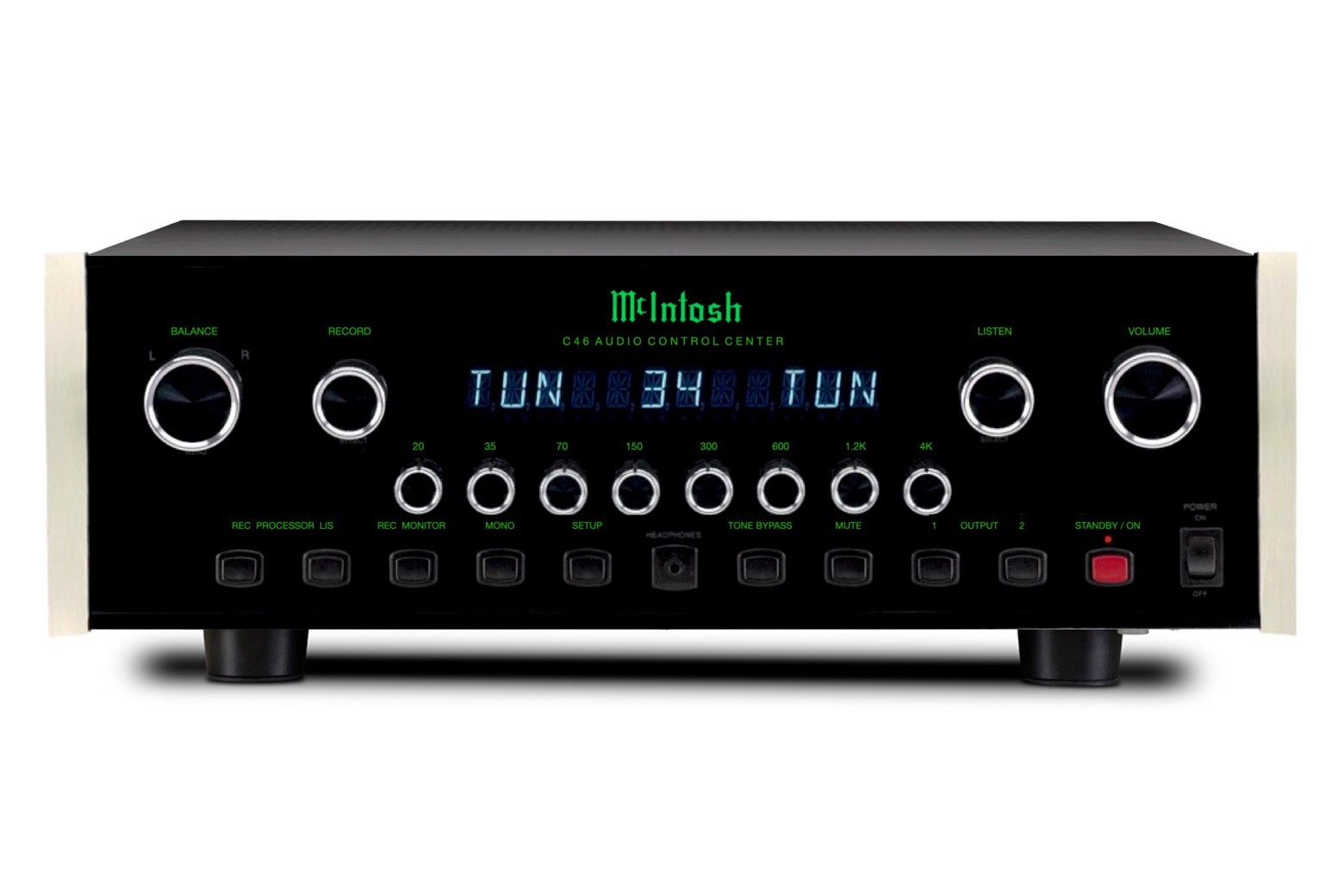
The front panel is clean but fully functional: volume and source selector knobs, tone controls, and a headphone jack. The motorized volume knob feels satisfyingly precise, and the incandescent backlighting gives that warm, analog glow McIntosh fans love. The headphone amp is competent, though not reference-grade—fine for late-night listening, but not a full replacement for a dedicated headphone amp.
Historical Context
The C712 was McIntosh’s least expensive preamp/control center during the mid-1990s, designed to bring the brand’s engineering and build quality to a broader audience. It occupied the entry-level tier of the Component Series, offering a compact, solid-state alternative to the larger, more complex preamps above it. It was eventually superseded by the C15, though some users argue the C712 had better build quality. Commonly paired with the MC7100 power amp, it formed a streamlined, high-performance duo for audiophiles who wanted McIntosh reliability without the bulk.
Collectibility & Value
The C712 is no longer available from specialist dealers, having been sold out for years, but it surfaces regularly on the used market—often in good, serviced condition. Many units come with original boxes, manuals, remotes, and cables, which adds to their appeal. A used example was priced around $600 circa 2004, though current pricing data is limited. Owners note two recurring service issues: the incandescent display bulbs require soldering to replace, and some units develop “solder type” issues over time, likely related to aging joints on the power or signal boards. The good news? Original service manuals are available, and the design is straightforward enough that competent techs can restore them reliably. With a user rating of 4.7 out of 5 from audioreview.com, it’s clear this preamp left a strong impression.
eBay Listings



As an eBay Partner, we earn from qualifying purchases. This helps support our independent vintage technology research.
Related Models
- McIntosh C47 (2020-present)
- McIntosh MAC4200 (1995-1999)
- McIntosh MC2002 (1993-1999)
- McIntosh MC2250 (1977-1980)
- McIntosh C70 (2020-present)
- Akai AM-2850 (1975)
- Akai AP-206 (1975)
- Nakamichi BX-1 (1985)
- Acoustic Research research-ar-17 (1978)
- Acoustic Research AR-19 (1994)