McIntosh C504 (1980–1988)
A compact preamp with serious pedigree—don’t let its size fool you, this one’s got the DNA of a giant.
Overview
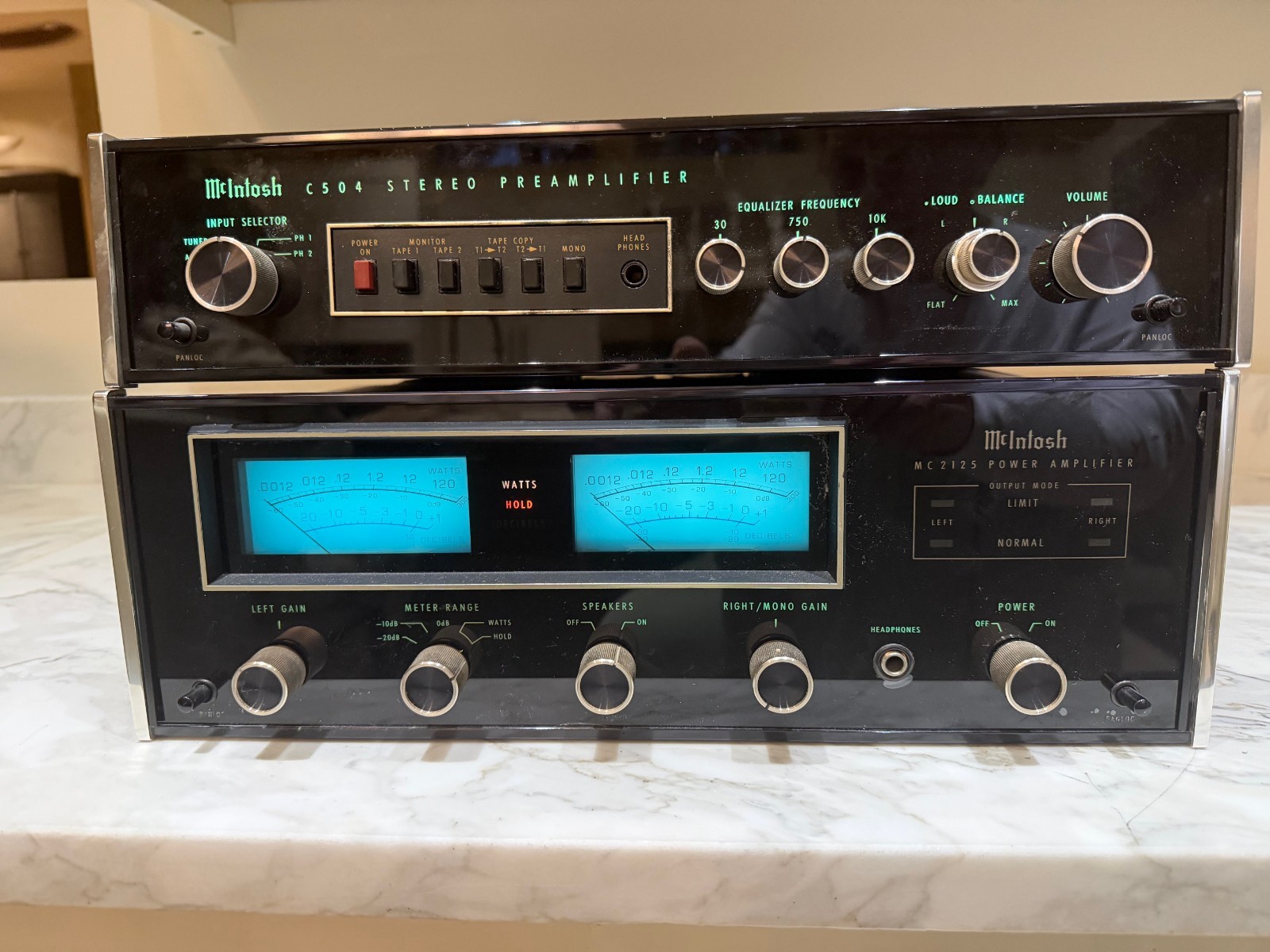
You open the cabinet, expecting something modest, and there it is: that iconic black glass face, green-lit dials glowing like embers, the familiar McIntosh weight in the chassis—even if the footprint is smaller than most. The C504 isn’t one of the flagship preamps that dominated audiophile magazines in the '80s, but it’s no afterthought either. Built between 1980 and 1988, this Stereo-SL (Slim Line) control amplifier was designed to deliver core McIntosh performance in a more space-conscious package. At $1,090 when new—a serious investment back then—it wasn’t cheap, but it wasn’t trying to be the center of attention. Instead, it played a supporting role with quiet confidence: a “super compact yet capable vintage preamp” that owners report pairs beautifully with contemporaries like the MC502 power amplifier.
And that pairing wasn’t accidental. The C504 was originally conceived as a match for the MC502, offering a streamlined but faithful front-end solution. It shares design philosophy with the larger C33, following its schematic in a more compact form, though with a simplified power supply and build that reflects its modest positioning in the lineup. Still, McIntosh didn’t cut corners on the essentials. Solid-state throughout, it uses 15 transistors, 14 FETs, 11 diodes, and 11 ICs to deliver a clean, neutral signal path with distortion held to just 0.02% across the full 20 Hz to 20 kHz range at 2.5V output. That’s not just good for the era—it’s excellent by any standard.
What really sets it apart, though, is how it handles the little things. The input switching, for example, uses ICs controlled by minute DC voltage, which McIntosh claimed eliminated switching noise without affecting frequency response. No crackles when you toggle from Phono to AUX. No pops. Just silence and then music. And while it’s not loaded with inputs by today’s standards, it’s well-equipped for its time: dual phono inputs (with 2.2mV sensitivity and 47kΩ impedance), plus AUX, Tuner, and two tape loops, all with 250mV sensitivity. The main output delivers 2.5V at 100Ω or less, feeding power amps without strain.
It’s also got that classic McIntosh user experience. The loudness control isn’t a simple on/off switch—it’s a continuously variable “LOUD” knob. Flat gives you full volume and a flat response; twist it to the right, and you ease the volume down while boosting bass to compensate for how our ears hear at lower levels. It’s a subtle but thoughtful touch, the kind of thing that makes late-night listening feel natural, not thin or lifeless.
Specifications
| Manufacturer | McIntosh |
| Product type | Control amplifier / Preamplifier |
| Production years | 1980 - 1988 |
| Original price | $1,090.00 |
| Frequency characteristic | 20 Hz to 20 kHz |
| Distortion factor | 0.02% or Less (20 Hz ~ 20 kHz, at 2.5 V Output) |
| Input Sensitivity / Impedance Phono1, 2 | 2.2mV/47k Ω (50 pF) |
| Input Sensitivity / Impedance AUX, Tuner, Tape1, 2 | 250mV/47k Ω |
| Hum and noise (signal-to-noise ratio) Phono1, 2 | IHF 90 dB, 10 mV or less |
| Hum and noise (signal-to-noise ratio) AUX, Tuner, Tape1, 2 | IHF 100 dB, 250 mV or less |
| Output Level / Impedance Main output | 2.5V/100 Ω or less |
| Output Level / Impedance Tape output | 250mV/200 Ω or less |
| Equalizer characteristics | 30 Hz, 750 Hz, 10 kHz : ± 12 dB |
| Semiconductor used | 15 tr, 14 fet, 11 di, 11 ic |
| Power | 120 VAC, 50Hz/60Hz |
| Power consumption | 45W |
| External dimensions | 406 mm wide x 92 mm high x 368 mm deep (16 x 3-5/8 x 14-1/2 in) |
| Weight | 6.4kg |
| Inputs | Dual phono inputs |
| Equalizer | Three-band EQ |
| Features | Remote Control |
Key Features
Three-Band EQ with ±12 dB Adjustment
Tone controls on high-end preamps were often seen as a compromise, but McIntosh gave the C504 a proper three-band equalizer with ±12 dB adjustment at 30 Hz, 750 Hz, and 10 kHz. This isn’t just a bass/treble roll-off—it’s surgical enough to correct room issues or tailor the sound to specific speakers. And because it’s implemented with care, it doesn’t degrade the signal when set flat. Owners who’ve used it report it’s transparent when disengaged, and effective when needed, especially in balancing older speakers or dealing with less-than-ideal acoustics.
Continuous Loudness Control
The “LOUD” knob is one of those details that feels uniquely McIntosh: analog, intuitive, and engineered for real-world use. Instead of a stepped or fixed loudness curve, it’s continuously variable. At the FLAT position, you get full output and a flat frequency response. Turn it clockwise, and volume drops while bass is gradually boosted to match the ear’s reduced sensitivity at lower levels. It’s not a gimmick—it’s psychoacoustics done right, and it makes a real difference when you’re listening at night and don’t want to wake the house but still want full-bodied sound.
IC-Based Input Switching
One of the quiet triumphs of the C504’s design is its input switching. Instead of mechanical relays or wiper-based selectors that can crackle over time, McIntosh used ICs controlled by a minute DC voltage to switch inputs. This eliminated the typical pops and thumps associated with changing sources, and more importantly, it didn’t compromise the frequency response. The signal path stays clean, and the switching is silent. It’s a small thing—until you’ve lived with a preamp that clicks every time you switch to your turntable.
Compact Chassis, Classic Look
Measuring just 406 mm wide and 92 mm high, the C504 fits in spaces where full-width gear won’t. But despite its “Slim Line” designation, it doesn’t feel cheap or downscaled. The black glass front panel with green backlighting maintains the brand’s iconic aesthetic, and the wood case—with the original McIntosh “Walnut” sticker still intact on many surviving units—adds warmth and heft. It’s a preamp that looks like it belongs in a high-end stack, even if it’s not taking up the whole shelf.
Historical Context
The C504 emerged during a period when McIntosh was refining its approach to integrated audio systems. While the big, full-width preamps like the C24 and C33 remained the benchmarks, there was growing demand for more compact, system-friendly components—especially as home audio moved from dedicated listening rooms to living spaces. The C504 answered that need without abandoning the brand’s engineering principles. It was originally paired with the MC502 power amplifier, forming a cohesive, mid-tier system that delivered authentic McIntosh performance in a smaller footprint. Though it followed the schematic of the larger C33, it used a more streamlined power supply and build, making it a “modest” but capable alternative.
Collectibility & Value
The C504 isn’t a blue-chip collector’s item like a C22 or C7, but it’s far from forgotten. On the secondary market, listings are often marked “Sold out” or show no price, suggesting limited availability and steady demand among those who know what it is. One unit was noted to be in 8/10 physical condition and 10/10 working order, including original paperwork and power cable—but no remote, which the seller listed as “Not Applicable.” The original box is also typically missing.
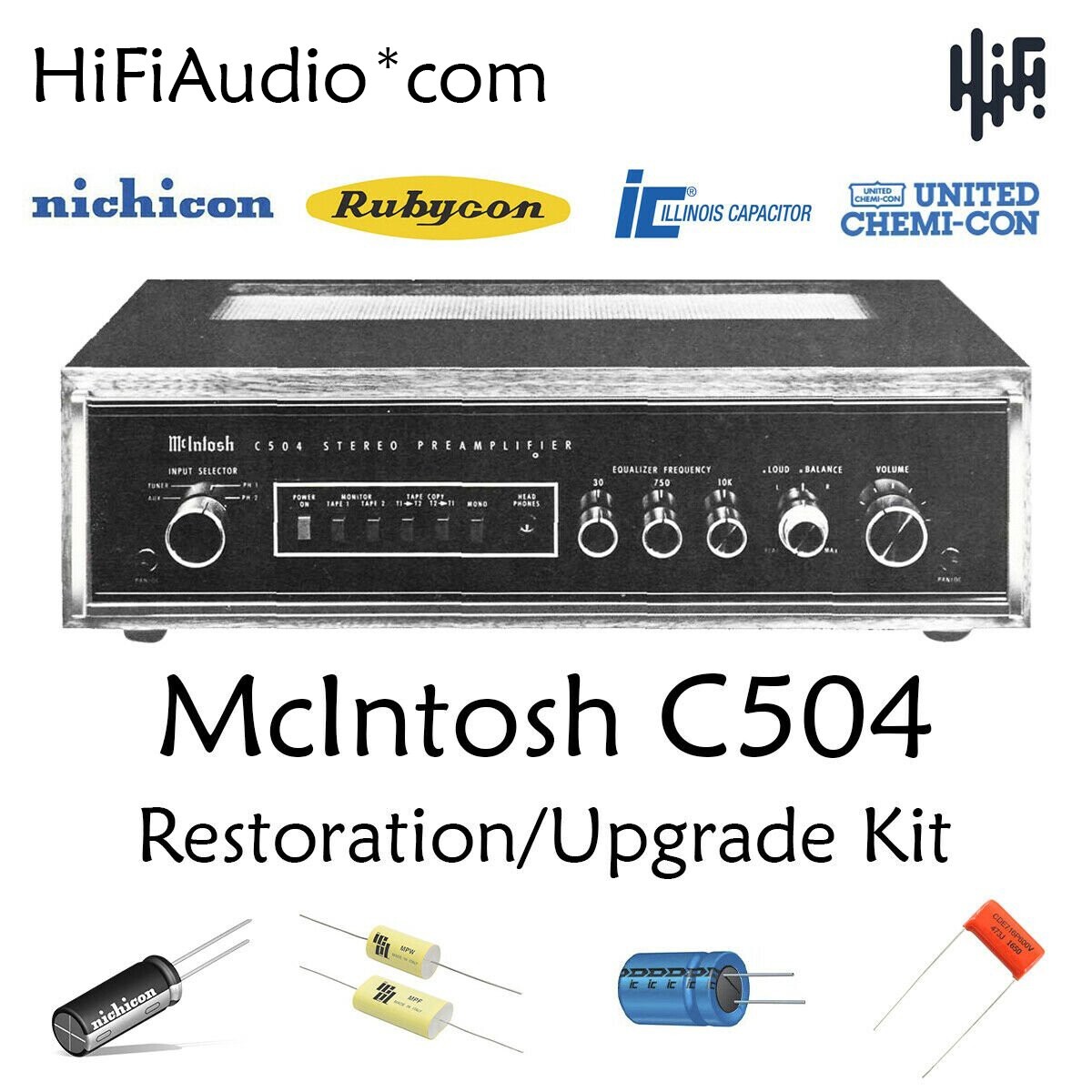
Maintenance-wise, the power supply is flagged as the most common source of failure in preamps, so any unit you consider should have been checked there. Switches and potentiometers benefit from lubrication and cleaning with contact cleaner, especially if the unit has been stored for years. A dedicated restoration or recap service kit is available, which is good news for long-term ownership. Given its solid-state design and relatively simple circuitry, the C504 is not a high-maintenance vintage piece—but like any 35+ year-old electronics, it deserves a proper checkup before you trust it with your speakers.
eBay Listings


As an eBay Partner, we earn from qualifying purchases. This helps support our independent vintage technology research.
Related Models
- McIntosh C47 (2020-present)
- McIntosh C712 (1998-2002)
- McIntosh MAC4200 (1995-1999)
- McIntosh MC2002 (1993-1999)
- McIntosh MC2250 (1977-1980)
- Akai AM-2850 (1975)
- Akai AP-206 (1975)
- Nakamichi BX-1 (1985)
- Acoustic Research research-ar-17 (1978)
- Acoustic Research AR-19 (1994)