McIntosh C37 (1991-1992)
That first glow of the blue meters and the hushed click of the relays—this is McIntosh quiet confidence, distilled into a preamp.
Overview
The McIntosh C37 isn’t a relic from the golden age of tubes or a forgotten prototype—it’s a late-era statement piece from a company that refused to compromise, even as the audio world shifted beneath its feet. Built between 1991 and 1992, the C37 2-Channel Solid State System Control Center arrived when digital was ascendant, yet McIntosh doubled down on analog precision, industrial weight, and that unmistakable blue glow. It wasn’t trying to be flashy; it was built to be final. At $2,399 when new, this wasn’t an entry point—it was a destination for those who wanted the full McIntosh experience in a preamplifier with integrated system control. And despite its short production run, it carries the brand’s DNA like a fingerprint: overbuilt, over-specified, and engineered to last longer than the systems it commands.
This is a solid-state preamp through and through, but not the kind that sounds clinical. Owners report a soundstage that opens wide and deep, with a smoothness that somehow avoids sounding soft. One longtime audiophile put it plainly after switching from Marantz: “I will never go back. The Soundstage sounds so much bigge…” That trailing off? It’s not a typo—it’s the moment words fail. The C37 doesn’t shout; it reveals. Whether feeding a pair of MC275s or a modern monoblock stack, it delivers a flat frequency response, particularly on its tuner input, and measured distortion in the 0.002% range—numbers that still raise eyebrows today. It’s not just clean; it’s quiet, with a signal-to-noise ratio of 105dB on line inputs, making whispers in recordings feel like they’re happening just behind your shoulder.
And yes, it came with a remote—no small thing in 1991. The C37’s remote control wasn’t an afterthought; it was part of the vision of a centralized command hub. With tuner inputs and phono inputs that include proper EQ (and which a technician once noted “looks good”), it was designed to be the nucleus of a serious two-channel system. No need to lean in and twist knobs: switch inputs, adjust balance, tweak tone—all from the couch. That level of convenience, wrapped in a 15.6-pound (8.2kg) chassis with the classic McIntosh faceplate, made it a sleeper hit among those who valued both control and calm.
Specifications
| Manufacturer | McIntosh |
| Model | C37 |
| Production Years | 1991 - 1992 |
| Original Price | $2,399 |
| Dimensions | 6” x 16” x 13” |
| Weight | 15.6 lbs. |
| Frequency Response | 20Hz to 20kHz |
| Total Harmonic Distortion | 0.002% |
| Gain | 60dB (MM), 20dB (line) |
| Input Sensitivity | 2.5mV (MM), 250mV (line) |
| Signal to Noise Ratio | 90dB (MM), 105dB (line) |
| Output | 2.5V (Pre out), 8V (Pre out Max) |
| Technology | Solid State |
| Features | Remote Control, Tuner Inputs, Phono Inputs with EQ |
Key Features
Solid-State Precision, McIntosh Style
The C37 is pure solid-state, but it doesn’t feel like a departure—it feels like evolution. McIntosh didn’t chase trends; they refined their own path. The circuitry delivers 0.002% THD, a number that wasn’t just for brochures. One technician testing a unit confirmed it “measured in the 0.002% distortion range. Very nice!” That kind of consistency isn’t accidental. It’s the result of obsessive layout, shielding, and component selection—all wrapped in a chassis that weighs nearly 16 pounds. This isn’t ballast; it’s anti-resonance. The unit sits like a boulder, indifferent to vibration or chatter.
System Control with Authority
McIntosh called this a “System Control Center” for a reason. It’s not just a preamp—it’s a command module. With dedicated tuner inputs and fully equalized phono inputs (RIAA curve applied, and as one tech put it, the EQ “looks good”), it handles both modern line-level sources and vintage turntables without compromise. The remote control was a big deal at the time, giving users full input selection, volume, balance, and mute from the listening position. No more getting up to swap between CD and FM—this was high-end convenience before it became standard.
Build That Outlasts Trends
Open the back panel, and you’ll find switched AC outlets—perfect for powering associated gear in sequence. But that convenience comes with a known quirk: an intermittent power-up issue has been traced to a cold solder joint on the neutral leg of the bus feeding those rear outlets. It’s not widespread, but it’s documented. Likewise, the front panel lamp can burn out, and worse, some units show signs of prior improper repair—like a resistor jumpering the lamp’s fuse in the backup power supply. The fix? Rip it out and install the correct fuse. Clean, proper, McIntosh-approved. No shortcuts.
Collectibility & Value
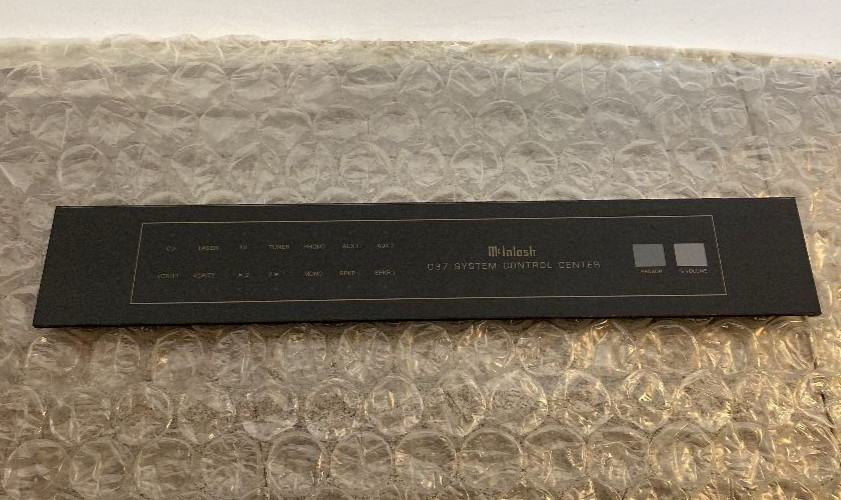
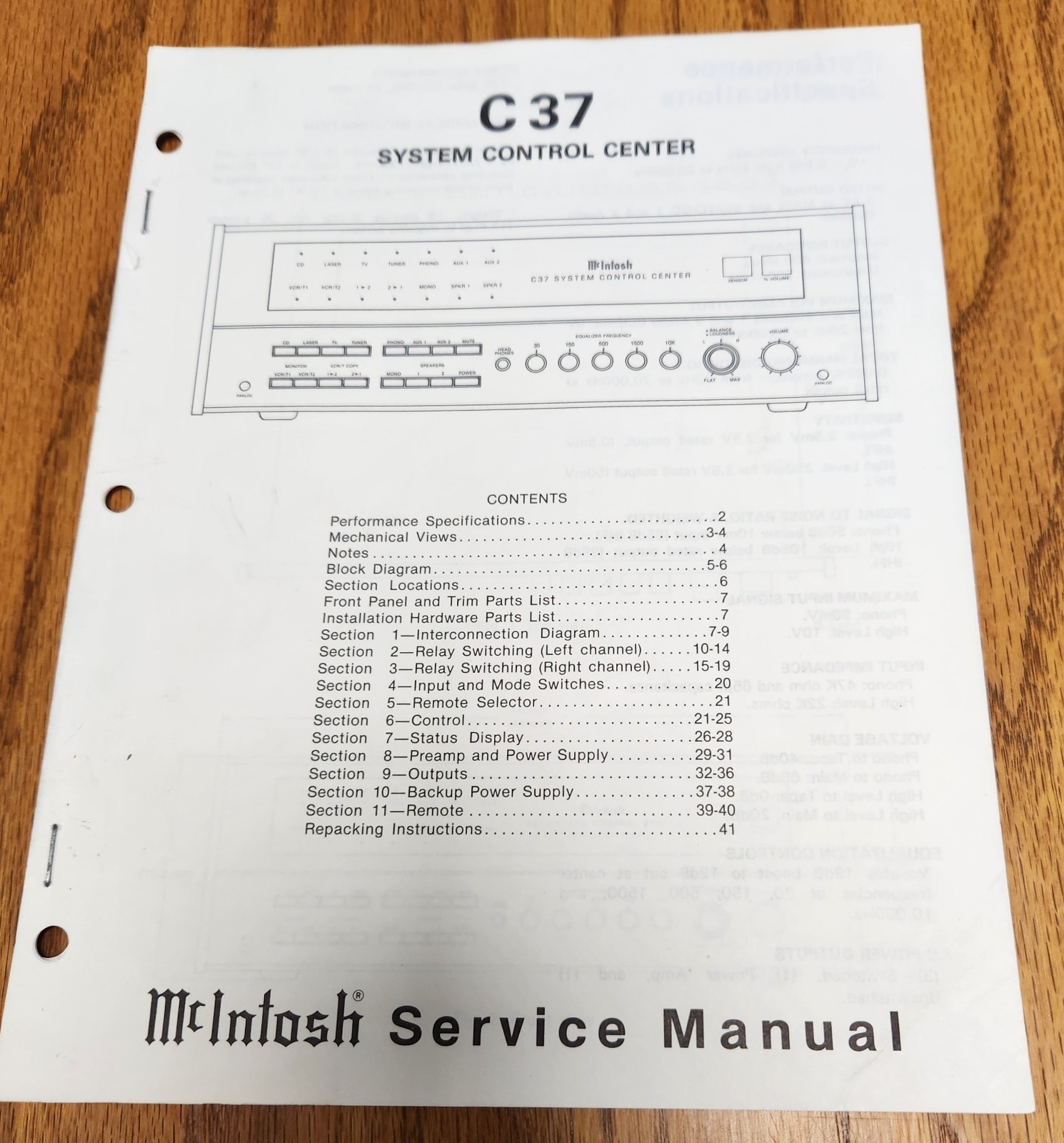
The C37 isn’t a blue-chip trophy like a C22 or C26, but it’s gaining quiet respect among McIntosh collectors who appreciate its late-era craftsmanship and full feature set. While no current resale value data exists in the fact sheet, the market for parts tells a story. A new narrow glass faceplate sells for $249.95; a complete wide version faceplate with side rails hits $299.95. That kind of aftermarket support suggests demand—and concern for originality. Restoration isn’t cheap: a full recap and filter capacitor rebuild kit runs $136 to $145, and replacement LED lamp sets are $28.50. Factor in a $20 owner’s manual and $17 for an original brochure, and you’re investing in more than sound—you’re maintaining a system.
Failures are specific and often repairable. The most serious issue is blowing fuses, traced to a shorted capacitor on the +/-15V supply’s rectifier input. It’s a known weak point, not random failure. Get it fixed right, and it’s not likely to return. Same with the cold solder joint on the switched outlet bus—once reflowed, it’s stable. These aren’t design flaws so much as aging quirks, the kind of thing a competent tech can diagnose in an afternoon. What you’re not likely to hear about? Catastrophic channel drift or noisy pots. When a C37 works, it works cleanly. One unit tested “performed well” across the board, and another was described as “operational condition... excellent, fully tested and no issues found. Works as it should delivering excellent sounds.” That’s the norm, not the exception.
If you’re hunting one, prioritize originality and service history. A recapped unit with clean relays and a working remote is worth the premium. And if you see one with a hacked power supply—walk away. The C37 deserves better.
eBay Listings


As an eBay Partner, we earn from qualifying purchases. This helps support our independent vintage technology research.
Related Models
- McIntosh C47 (2020-present)
- McIntosh C712 (1998-2002)
- McIntosh MAC4200 (1995-1999)
- McIntosh MC2002 (1993-1999)
- McIntosh MC2250 (1977-1980)
- Akai AM-2850 (1975)
- Akai AP-206 (1975)
- Nakamichi BX-1 (1985)
- Acoustic Research research-ar-17 (1978)
- Acoustic Research AR-19 (1994)