McIntosh C33 (1981-1985)
One of the quietest, most feature-rich solid-state preamps of its era—warm, full-bodied, and built like a tank, with a phono stage that still impresses.
Overview
The McIntosh C33 isn’t just a preamplifier—it’s a control center, a statement, and a time capsule of early 1980s high-end audio engineering. Released at a moment when solid-state design was hitting its stride, the C33 didn’t just follow trends; it packed an unusually dense array of circuitry into that iconic gold-and-black front panel. Owners report a sound that’s warm and tonally rich without sacrificing clarity, with a full-bodied presentation that holds up even by modern standards. It’s often described as one of McIntosh’s best and quietest preamps, thanks to its exceptionally low noise floor and precise signal handling.
What sets the C33 apart isn’t just its audio performance, but its sheer completeness. It includes a phono stage (with 2mV sensitivity for moving magnet cartridges), a five-band equalizer, a variable loudness control, and even a compandor for dynamic range compression and expansion—features that were rare even on high-end units at the time. The compandor, with a 2:1 compression and 1:2 expansion ratio, a threshold of -20dB, and a level match range of ±10dB, was aimed at tape enthusiasts trying to tame hiss or restore dynamics. It’s not a gimmick; when engaged, it works transparently, and its filter rolls off at 6dB per octave below 50Hz to avoid muddying the bass.
And yes, it has a built-in 20-watt-per-channel amplifier—enough to drive small-room speakers without an external power amp. That monitor amplifier delivers 11 volts maximum output and maintains a frequency response of 20Hz to 20kHz (+0, -0.5dB), with hum and noise 90dB below rated output. Total harmonic distortion is a mere 0.01% maximum, which was exceptional for the era. This makes the C33 a rare hybrid: a full-featured preamp with enough muscle to stand alone in modest setups.
The input switching uses a low-distortion FET design located right at the input jacks, minimizing signal degradation before it even reaches the core circuitry. Input impedance is 100K ohms for high-level sources and 47K ohms with 50pF capacitance for phono—standard but well-implemented. Output impedance across main, tape, and monitor amp outputs is a consistent 600 ohms, which helps maintain stability when driving long cables or multiple downstream devices.
Specifications
| Manufacturer | McIntosh Laboratory Inc. |
| Model | C33 |
| Product Type | Solid state stereo preamplifier |
| Production Years | 1981-1985 |
| Internal Amplifier Power | 20 watts per channel into 8 ohms |
| Frequency Response (Monitor Amplifier) | 20Hz to 20kHz, +0, -0.5dB |
| Total Harmonic Distortion (Monitor Amplifier) | 0.01% maximum |
| Input Sensitivity | 2mV (MM), 250mV (line) |
| Signal to Noise Ratio (Phono) | 75dB (below 10mV) |
| Signal to Noise Ratio (High Level) | 90dB (below 0.5V) |
| Maximum Output (Main, Tape) | 8.0 volts |
| Maximum Output (Monitor Amp) | 11.0 volts |
| Semiconductors | 31 x transistors, 76 x FET, 35 x IC, 107 x diodes |
| Dimensions | 17 inches (43.2 cm) wide, 6 inches (15.2 cm) high, 15 inches (38.1 cm) deep |
| Weight | 26 lbs. |
| Finish | Anodized gold and black front panel |
| Input Impedance (Phono) | 47K ohms, 50pF |
| Input Impedance (High Level) | 100K ohms |
| Output Impedance (Main, Tape, Monitor Amp) | 600 ohms |
| Phono Overload (1kHz) | 200mV at 0.005% distortion |
| Phono Overload (10kHz) | 35mV at 0.05% distortion |
| RIAA Equalization Accuracy | +0, -0.5dB, 30Hz to 15kHz |
| Tone Control Range (Bass, 50Hz) | +14, -14dB |
| Tone Control Range (Treble, 10kHz) | +14, -14dB |
| Loudness Control (Volume at -40dB) | +6dB at 50Hz, +3dB at 10kHz |
| High Filter | 6dB per octave above 5kHz |
| Low Filter | 6dB per octave below 50Hz |
| Compandor Filter | 6dB per octave below 50Hz |
| Compandor Expansion Ratio | 1:2 |
| Compandor Compression Ratio | 2:1 |
| Compandor Threshold | -20dB |
| Compandor Level Match Range | +10, -10dB |
| Compandor Input Voltage Limit | 2.0 volts RMS |
| Crosstalk (Phono, 1kHz) | 70dB |
| Crosstalk (High Level, 1kHz) | 70dB |
| Monitor Amplifier Hum and Noise | 90dB below rated output |
Key Features
Built-in Monitor Amplifier
The C33 includes a full 20-watt-per-channel solid-state amplifier, making it usable as a standalone system in small rooms. This isn’t a headphone amp or a buffer—it’s a real power section capable of driving efficient speakers. The amplifier section maintains McIntosh’s reputation for clean, stable performance, with a flat frequency response and ultra-low distortion. It’s not meant to replace a high-powered external amp, but for late-night listening or secondary systems, it’s a major convenience.
Five-Band Equalizer and Loudness Control
The five-band equalizer (often referred to as a 5-stage EQ) gives users precise tonal shaping, while the variable loudness control compensates for the ear’s reduced sensitivity to bass and treble at low volumes. At -40dB, it applies +6dB at 50Hz and +3dB at 10kHz—subtle but effective. The loudness function is praised for being musical rather than artificial, a rarity among tone controls of the era.
Compandor for Tape Optimization
The compandor is a standout feature for tape enthusiasts. With a compression ratio of 2:1 and expansion of 1:2, it can reduce dynamic range on recording and restore it on playback, minimizing tape hiss. The -20dB threshold ensures it only engages when needed, and the ±10dB level match range helps balance output. Input voltage is limited to 2.0 volts RMS to prevent overloading the circuit.
Phono Stage and Input Flexibility
The phono stage is consistently noted as excellent, with high overload margins (200mV at 1kHz, 35mV at 10kHz) and accurate RIAA equalization (±0.5dB from 30Hz to 15kHz). Input switching uses FETs located at the jacks, reducing crosstalk (70dB at 1kHz for both phono and high-level inputs) and preserving signal integrity.
Auto Turn-On and SCR2 Compatibility
The C33 features “Auto Turn-On,” which activates the unit when it detects current from a turntable motor—convenient for systems where the turntable is the primary source. It’s also compatible with the McIntosh SCR2 speaker relay module, allowing front-panel speaker switching without external switching boxes.
Collectibility & Value
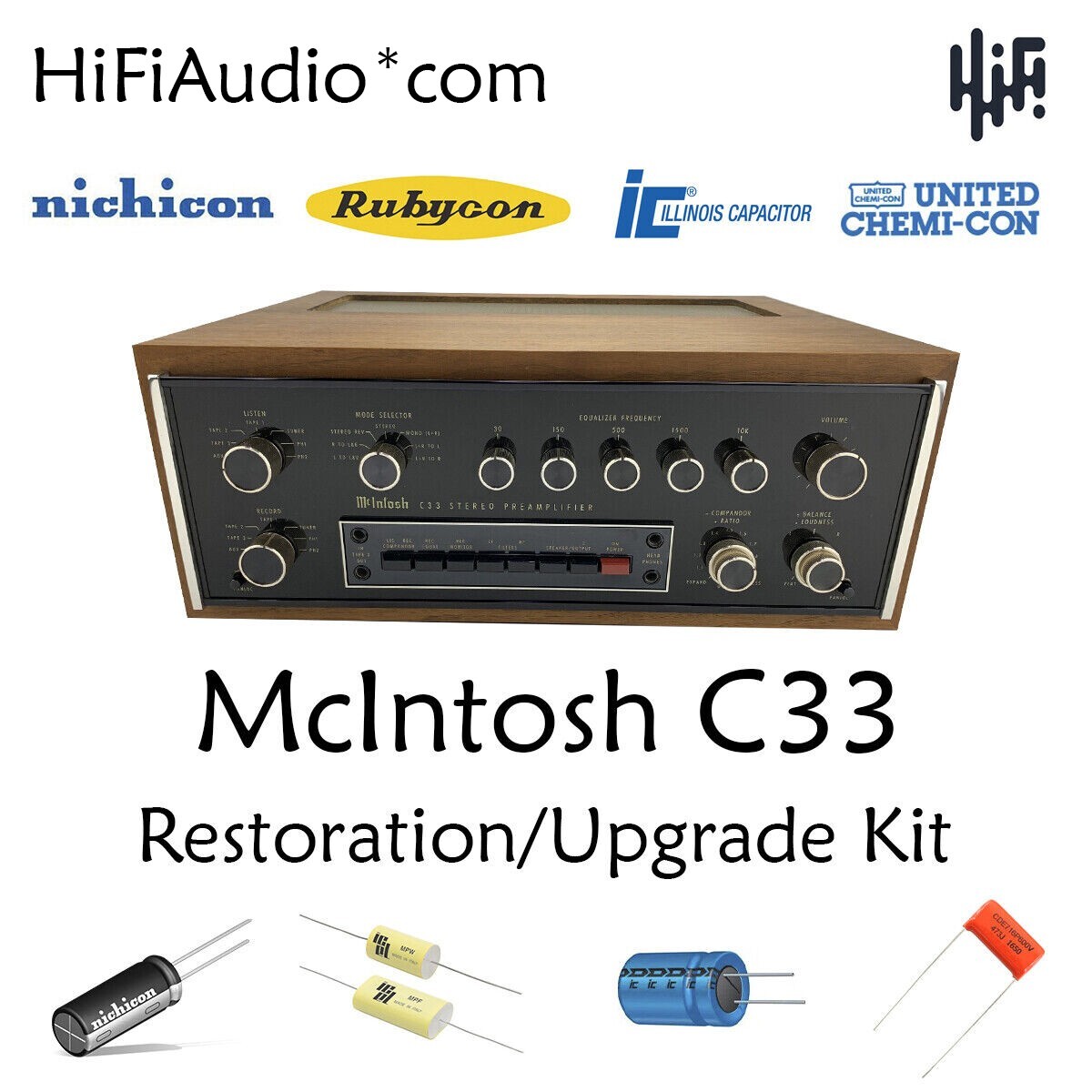
The McIntosh C33 was originally priced at $2,450, a premium cost that reflected its advanced feature set and build quality. Today, market listings show wide variance, with units ranging from $1,500 to $9,999—this volatility likely reflects condition, restoration status, and whether the unit has been professionally recapped. Many C33s have undergone restoration, and filter capacitor kits are available for DIY repairs. Replacement bulbs and lamps are also obtainable, which helps maintain originality.
Collectors value the C33 for its completeness and sonic performance. It’s frequently described as one of McIntosh’s best and quietest preamps, with a warm, full-bodied presentation that avoids the sterility some associate with early solid-state gear. However, some user comparisons note a slower, less dynamic presentation than certain tube preamps—this isn’t a flaw, but a characteristic of its design. If you’re after slam and speed, this might not be your pick. But if you want richness, refinement, and a feature set that still feels comprehensive decades later, the C33 delivers.
The SCR2 accessory is often listed separately, so buyers should confirm whether it’s included. Units restored by reputable technicians, such as Terry DeWick, command higher prices and are generally more reliable. Given the age, checking capacitor health is essential—many have already been recapped, but unverified units should be approached with caution.
eBay Listings



As an eBay Partner, we earn from qualifying purchases. This helps support our independent vintage technology research.
Related Models
- McIntosh C47 (2020-present)
- McIntosh C712 (1998-2002)
- McIntosh MAC4200 (1995-1999)
- McIntosh MC2002 (1993-1999)
- McIntosh MC2250 (1977-1980)
- Akai AM-2850 (1975)
- Akai AP-206 (1975)
- Nakamichi BX-1 (1985)
- Acoustic Research research-ar-17 (1978)
- Acoustic Research AR-19 (1994)