McIntosh MX114
An FM tuner-preamplifier with published specs the front panel lives up to. The service manual survives, which is more than a lot of its contemporaries can say.
Overview
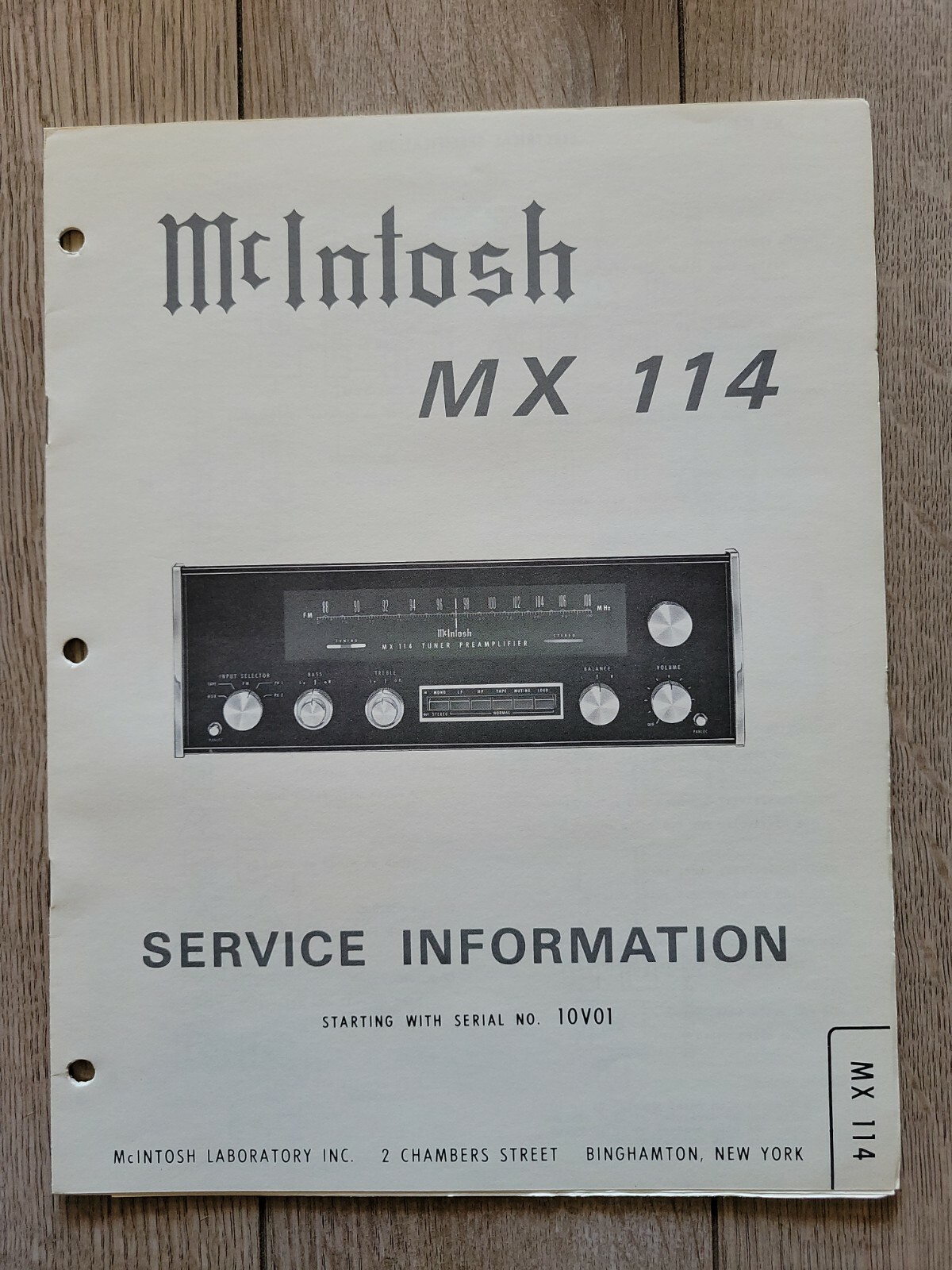
The MX114 is a tuner-preamplifier. It isn't a receiver and it isn't a standalone tuner. It sits between your sources and your power amplifier and does the FM tuning besides. The surviving factory documentation is unusually complete for a piece of this vintage: alignment instructions, preamplifier section specs, tuner section specs, and a full parts list with McIntosh's own part numbers for the potentiometers, transformers, ICs, and lamps. That parts list is the useful part. A schematic without one is a puzzle. A schematic with part numbers is a repair.
The preamplifier section is documented with the precision McIntosh was known for. Frequency response is quoted at +0.5dB, 20Hz to 20,000Hz. Distortion is less than 0.1% at 2.5 volts from 20Hz to 20kHz. Main output is 2.5 volts with rated input, and the manual notes that up to 10 volts can be developed without distortion. That helps if you're running a power amp with modest input sensitivity. Phono 1 and phono 2 are specified at 2 millivolts for 2.5 volts output at 1kHz, with hum and noise 72dB below a 10 millivolt input. Aux and tape inputs want 0.25 volts for 2.5 volts out, and their hum and noise figure is 85dB below rated output. There's a center-channel output too, at 2 volts with rated input to both channels. MX-series units were built for the era when a third speaker in the middle was a serious option.
The tone controls are generous by modern standards. Bass is adjustable from −18dB to +16dB at 20Hz, and treble from +20dB at 20,000Hz. There are filters for both ends. The low-frequency filter rolls off below 50Hz and is down 12dB at 20Hz. The high-frequency filter rolls off above 5000Hz and is down 12dB at 20,000Hz.
The tuner section is FM-only, and the numbers made McIntosh tuners a reference point. Usable sensitivity is better than 2.5 microvolts on the IHF usable sensitivity standard. Capture ratio is better than 1.5dB, a good figure, and the one that determines whether a strong local station can push a weaker distant one off the dial. Signal-to-noise is better than 65dB. Spurious rejection is 90dB or greater, and image rejection is 75dB or greater at 100MHz. Harmonic distortion is less than 0.5% in mono and less than 0.8% in stereo. Stereo separation is better than 30dB at 1kHz. Frequency response across the tuner is flat from 20Hz to 20kHz with standard de-emphasis and the 19kHz pilot filter engaged.
The manual documents the unit down to the component level. The tuner uses a 6HU6 tube alongside two integrated circuits, a hybrid arrangement from a transitional period. There are four FM IF transformers, an FM discriminator transformer, a 19kHz RF transformer, and a 38kHz RF transformer, plus a balun on the antenna input. The preamp boards are 043-991 (left) and 043-992 (right), the MPX board is 043-974, and the power supply/center channel board is 044-007. The tone control module is a discrete part, 130-027. Lamps are listed by McIntosh part number: #1828 for the MPX indicator, #1866 for the front panel, and a festoon lamp for the dial glass. If you're restoring one, this is the document that saves you a weekend of guessing.
Alignment is covered in detail, and the manual is blunt about the prerequisite: have the proper test equipment or don't attempt it. The specified gear includes an FM signal generator (Measurements 188 or equivalent), a VTVM, a multiplex generator (RCA WR-51A or equivalent), a 10.7 MHz generator preferably crystal-controlled, an oscilloscope (Hewlett-Packard 120B or equivalent), and a harmonic distortion analyzer (Hewlett-Packard 333A or equivalent). The alignment sequence runs FM first, then MPX. The manual prints McIntosh's service department address, 2 Chambers Street, Binghamton, New York, for anyone who needs parts or guidance. Replacement parts are ordered by part number rather than by description.
One quirk to know before reading the schematic notes. The voltage measurements in the manual assume a specific set of front-panel conditions: tuning indicator at 100MHz with no signal, volume fully counterclockwise, mode in stereo, muting out, input selector on FM, panel lights bright. They also assume an 11 megohm input impedance VTVM and AC input at 117 volts, 50/60Hz. Take the readings with the controls in any other position and the numbers won't match, which has sent more than one owner chasing a fault that wasn't there.
Period coverage of the MX114 in the surviving print literature is thin. The MX115, MX117, MX118, and MX130 appear in classified listings in Audio (June 1998, p.79). Beyond that, the record is mostly the factory documentation itself.
eBay Listings


As an eBay Partner, we earn from qualifying purchases. This helps support our independent vintage technology research.