McIntosh C34V (1986)
At 11.8 kg, it lands on the rack like a declaration—this is not a preamp for the faint of purpose.
Overview
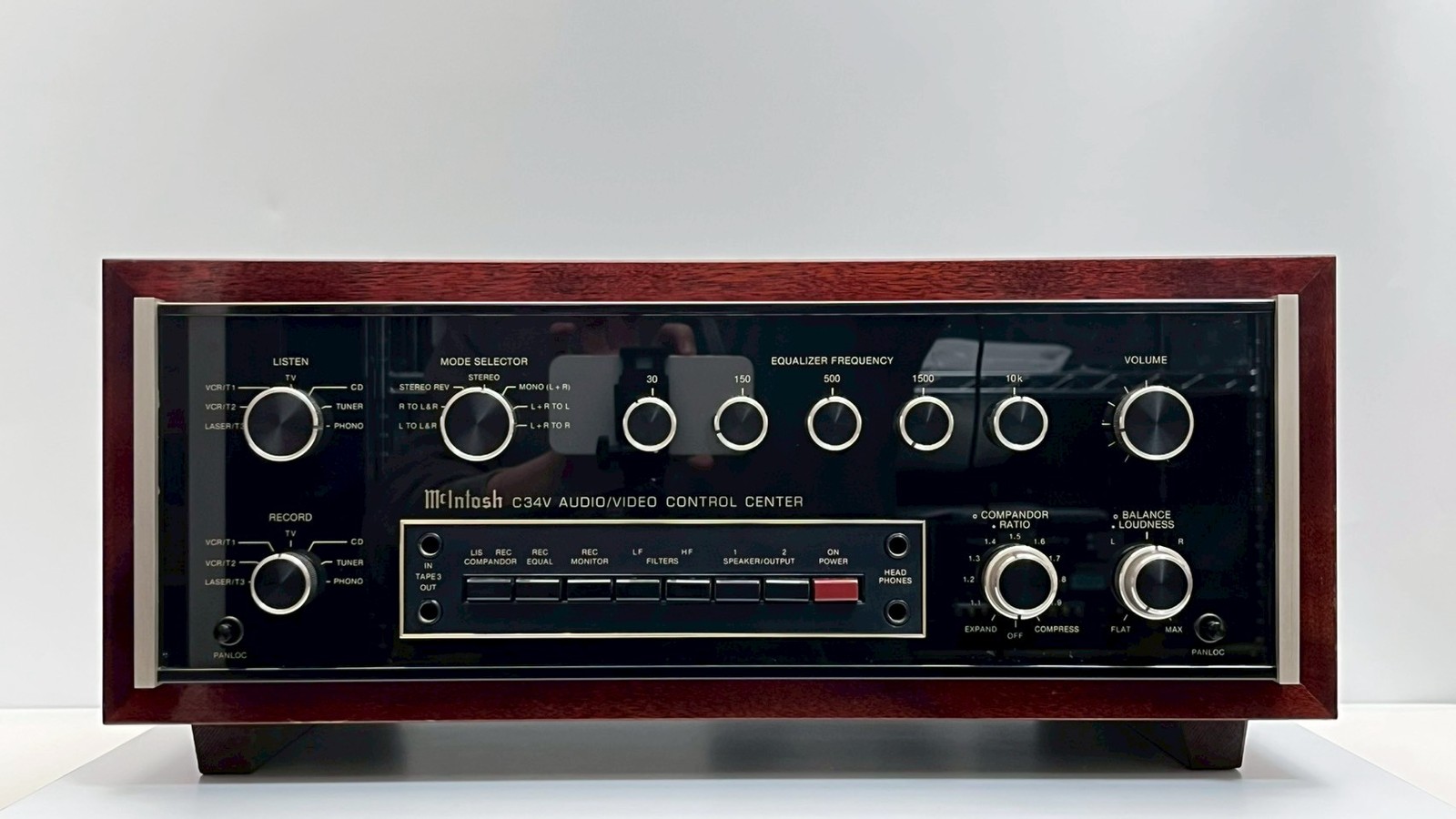
The McIntosh C34V AUDIO/VIDEO CONTROL CENTER isn’t just another preamplifier squeezed into a silver chassis. Released in October 1986, it arrived as a response to the rising tide of home AV complexity, when living rooms began filling with VCRs, laserdisc players, and satellite receivers—all threatening to corrupt the purity of the audio signal. This unit was engineered to be the analog command center for that era, built for both fidelity and control. It carries the heft of serious engineering—this isn’t just a preamp. With a 20W + 20W monitor amplifier section onboard and full video switching capability, the C34V straddles the line between integrated amplifier and system hub, a rare hybrid in the McIntosh lineup. Designed for the U.S. market and sold with a Japanese price point of ¥680,000, it reflects a moment when high-end audio companies began acknowledging the video signal path as a legitimate concern for audiophiles.
Weighing in at 11.8 kg, the C34V fills its 406 mm wide chassis with purpose. It’s a no-compromise approach to signal routing: phono inputs with 2 mV sensitivity, high-level inputs at 250 mV, and a maximum output voltage of 10 V ensure compatibility with even the most demanding power amplifiers. The preamp section delivers a flat frequency response from 20 Hz to 20 kHz within ±0.5 dB, with total harmonic distortion held to an impressive 0.01% or less across the audible band. Signal-to-noise ratios are equally robust—90 dB or better on phono (at 10 mV input), and 100 dB or more on high-level inputs. Input impedance is standard at 47k Ω and 65 pf for MM phono, and 50k Ω for line-level sources, making it a straightforward match for most gear of the period.
But the C34V doesn’t just pass signals—it shapes them. A five-band equalizer with ±12 dB of adjustment at 30 Hz, 150 Hz, 500 Hz, 1.5 kHz, and 10 kHz allows for room correction or tonal tailoring, and the equalizer circuit can be inserted into a recording loop, suggesting McIntosh envisioned it as part of a broader studio-grade setup. A loudness control, LF and HF filters (12 dB/octave roll-off at 50 Hz and 7 kHz), and a compander system—listed as "Venonat der Ratio: 2 : 1 Compression to 1 : 2 Expansion"—hint at noise reduction and dynamic range management, though the exact implementation remains undocumented. Whether used for broadcast monitoring or home refinement, these tools place the C34V in a class above basic preamps.
The built-in monitor amplifier, rated at 20W + 20W into 8 Ω, is no afterthought. Its frequency response is even tighter than the preamp’s—±0.2 dB from 20 Hz to 20 kHz—and it boasts a 100 dB signal-to-noise ratio. Input sensitivity is 750 mV into 27k Ω, making it compatible with the internal preamp stage. This section likely served as a dedicated zone for headphones, a secondary room, or perhaps a nearfield monitoring setup. Combined with the preamp, it gives the C34V a rare dual identity: a full-featured control center with enough power to drive efficient speakers directly, should the need arise.
Specifications
| Manufacturer | McIntosh |
| Product type | Audio/Video Control Center / Preamplifier |
| Production years | Released in October 1986 |
| Original price | ¥ 680,000 |
| Frequency response (Preamplifier) | 20 Hz ~ 20 kHz +0, -0.5 dB |
| Maximum output voltage (Preamplifier) | 10 V (20 Hz ~ 20 kHz) |
| Total harmonic distortion (Preamplifier) | 0.01% or less (20 Hz ~ 20 kHz) |
| Input sensitivity Phono | 2 mV |
| Input sensitivity High level | 250 mV |
| Signal-to-noise ratio Phono | 90 dB or more (input 10 mV) |
| Signal-to-noise ratio High level | 100 dB or more |
| Maximum allowable input Phono | 100 mV |
| Maximum allowable input High level | 10 V |
| Input impedance Phono | 47k Ω, Capacitance 65 pf |
| Input impedance High level | 50k Ω |
| Equalizer | ± 12 dB (center frequencies: 30 Hz, 150 Hz, 500 Hz, 1.5 kHz, 10 kHz) |
| Venonat der Ratio | 2 : 1 Compression to 1 : 2 Expansion |
| LF and HF filters | 12dB/oct (roll-off 50 Hz, 7 kHz) |
| Loudness control | Continuously variable |
| Rated output (Monitor Amplifier) | 20W + 20W (8 Ω, 20 Hz to 20 kHz) |
| Frequency response (Monitor Amplifier) | 20 Hz ~ 20 kHz +0, -0.2 dB |
| Input sensitivity (Monitor Amplifier) | 750 mV (27k Ω) |
| Signal-to-noise ratio (Monitor Amplifier) | 100 dB |
| AC outlet Turntable interlock (100W, green) | 1 |
| Power switch interlock (black) | 3 |
| Power switch not linked (red) | 2 |
| Power | 100 VAC, 50Hz/60Hz |
| Dimensions | 406 mm (W) x 138 mm (H) x 330 mm (D) |
| Weight | 11.8 kg |
Key Features
Optional MVS-1 Interlocking Video Switching
To combat interference in stacked AV systems, the C34V was designed to work with the optional MVS-1 external interlocking switch. This allowed video source selection to occur outside the main chassis, isolating the audio circuits from potential crosstalk and ground loops. In an era when composite video cables ran alongside RCA audio interconnects, this was a forward-thinking solution. The MVS-1 system ensured that video switching didn’t compromise the integrity of the audio path—a rare consideration in preamps of the time.
Five-Band Equalizer and Compander System
The inclusion of a five-band equalizer with ±12 dB of adjustment at strategic frequencies suggests the C34V was intended for environments where room acoustics or speaker response needed correction. Unlike tone controls, this EQ allows surgical adjustments. Even more intriguing is the compander system, labeled “Venonat der Ratio: 2 : 1 Compression to 1 : 2 Expansion.” While the term “Venonat” does not appear in other McIntosh documentation, the description matches a dynamic range compression and expansion circuit, possibly intended for tape monitoring or broadcast applications. Whether used for noise reduction or dynamic control, it reflects a level of sophistication beyond typical consumer gear.
Integrated 20W + 20W Monitor Amplifier
Few preamps from this era included a built-in power amplifier, but the C34V does—20 watts per channel into 8 ohms, with a flat frequency response and low distortion. This monitor amp likely served as a convenience for headphone distribution, a secondary zone, or nearfield monitoring. Its 750 mV input sensitivity and 27k Ω impedance make it a natural match for the internal preamp, and its 100 dB signal-to-noise ratio ensures clean output. While not intended to drive main speakers in a high-end setup, it adds significant utility.
Comprehensive Power Outlet System
The C34V features a sophisticated power distribution system: one 100W green-labeled turntable interlock outlet, three black-labeled interlocked power switches, and two red-labeled outlets that are not linked to the main power switch. This allows users to sequence power-up (protecting delicate turntables) while keeping always-on devices like VCRs or clocks active. It’s a thoughtful touch for a system controller, reducing inrush current and preventing turntable motor interference.
SCR-2 Speaker and AC System Relay Compatibility
The C34V was designed to work with the optional SCR-2 speaker control relay, enabling switching between two speaker pairs and two AC systems. This level of integration suggests McIntosh envisioned the C34V as the centerpiece of a large, multi-zone installation. The ability to toggle between different listening environments—say, main speakers in the living room and a secondary pair in an office—adds flexibility rare in preamps of this class.
Historical Context
The McIntosh C34V was released in October 1986, a time when home entertainment systems were rapidly expanding beyond stereo. VCRs, cable boxes, and laserdisc players multiplied the number of video sources, creating new challenges for signal management and interference. The C34V emerged as a solution—a high-fidelity preamp that also addressed the practical realities of video switching and system control. By isolating video selection via the optional MVS-1 and providing robust power sequencing, it offered a clean, organized alternative to haphazard component stacks. It was not just a response to complexity, but an attempt to master it.
Collectibility & Value
Current asking prices for the C34V vary significantly. One U.S. dealer lists a unit at $1,500.00 USD, while a complete package—including the C34V, SCR-2 relay, and MC2500 amplifier—was offered for $8,500. A European reseller references a value of approximately $1,800 USD, though this appears speculative. Units described as "recently serviced" and "Gali-Free" command premium listings, suggesting that maintenance history affects desirability. Common issues appear minimal in documentation, though one listing notes a burned-out right backlight display bulb—an easy fix that doesn’t affect sound. Another mentions "static issues" in the title of a post, though no details are provided. With no widespread reports of failure modes or service bulletins, the C34V seems to have aged gracefully, assuming proper care.
eBay Listings


As an eBay Partner, we earn from qualifying purchases. This helps support our independent vintage technology research.