McIntosh C100 (1997–2000)
Two chassis, one purpose: keep the noise away from the music.
Overview
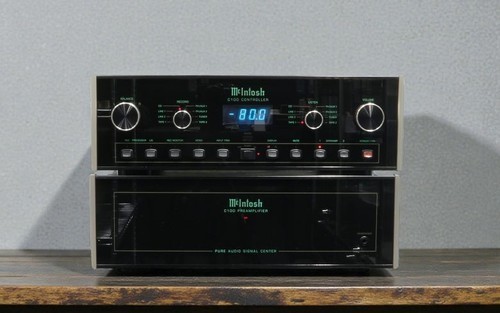
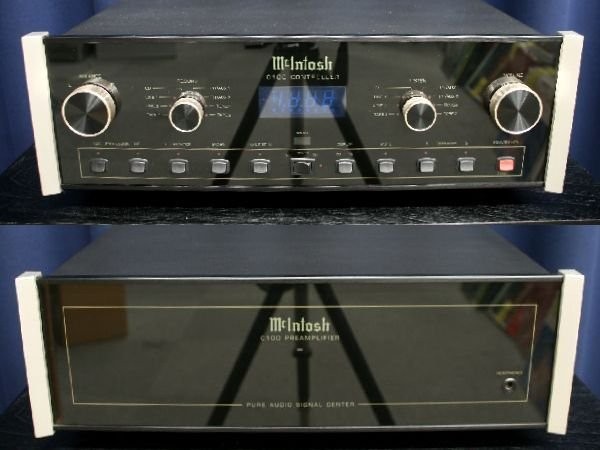
Lift the C100's control chassis off its preamplifier chassis and you can see what McIntosh was after in 1997. The power supply, the remote receiver, and the switching logic live in one box. The audio signal path lives in another. The C100 is a stereo preamplifier built in the USA from 1997 to 2000, and it was McIntosh's first dual-chassis preamplifier. The company pitched it as a "Pure Audio Control Center" - a phrase that reads like marketing, but the architecture backs it up. The upper chassis carries the low-noise power supply and remote control system. The lower chassis is dedicated to the signal path.
The circuit is fully balanced from input to output. Unbalanced signals are converted to balanced for internal transmission, and both balanced XLR and unbalanced RCA connections are provided. Each amplification stage runs its own dedicated regulator. The parts list calls for low-noise metal-coated resistors and polypropylene capacitors. Distortion is specified at a maximum of 0.002% from 20 Hz to 20 kHz at rated output, and the frequency characteristic spans 10 Hz to 40 kHz (+0, -0.5 dB). It's a spec sheet written to be measured.
Two chassis means two sets of dimensions and two weights. Each chassis measures 444 mm wide by 137 mm high by 445 mm deep. The control section weighs 11.0 kg and the preamplifier section weighs 8.7 kg. A wireless remote control is included. Sources use both "C100" and "C-100" for the same product. The owner's manual covers the two halves by their proper designations: the C100C Controller and the C100P Preamplifier.
Key Features
Dual-Chassis Architecture — Control and Power Supply Separated from the Signal Path
McIntosh's own framing of the design is blunt: separating the control and power supply section from the signal path reduces interference and preserves sound quality. The upper chassis holds the low-noise supply and the remote system. The lower chassis does nothing but carry audio. That kind of decision costs money and rack space.
Fully Balanced Circuitry with Dedicated Regulators Per Stage
Balanced operation runs end to end, and unbalanced sources are converted to balanced internally rather than run single-ended through the box. Every amplification stage gets its own regulator instead of sharing a rail. Output impedance is 100 Ω balanced and 50 Ω unbalanced, low enough to drive long cables without drama. Maximum output voltage is 25.0 V on the balanced main and switched outputs across 10 Hz to 40 kHz, and 12.0 V on the unbalanced main and switched outputs over the same band.
Phono Stage with Silver-Wire MC Transformer in a Mu-Metal Shield
The phono section handles both moving-magnet and moving-coil cartridges. The MC input uses a specially developed transformer with a silver-wire coil, enclosed in a mu-metal shield. That is a deliberate answer to the hum and noise problems that plague low-output MC step-up stages. Input impedance is 47 kΩ for MM and 5 Ω for MC. Sensitivity is specified at 4.4 mV phono and 450 mV high level, both referenced to 2.5 V rated output. Signal-to-noise is 86 dB on phono and 98 dB on high level, both A-weighted. Maximum input is 50 mV for MM phono and 5 V balanced on the high-level inputs. Voltage gain runs 70 dB from MC to tape out, 40 dB from MM to tape out, 0 dB from high level to tape out, and 15 dB from high level to main out.
Digital Attenuator with Optical Rotary Encoder
Volume is set by a digital control attenuator accurate to within ±0.05 dB, driven by an optical rotary encoder with 128 steps per rotation. Gain and balance are shown on a blue fluorescent tube display in 0.5 dB increments, or as a percentage if you prefer.
Sealed Ruthenium Relays and a Resettable Power Switch
Input switching runs through a microprocessor and relays with ruthenium-evaporated contacts sealed inside inert gas-filled glass tubes. The idea is to keep contact degradation out of the signal path for decades. The front panel is glass with illuminated teal and gold nomenclature. Controls include the BALANCE L-to-R control and a RECORD switch with indicators for TAPE 1, LINE 2, LINE 1, CD, PH/AUX 1, PH/AUX 2, TUNER, and TAPE 2. Balanced inputs and outputs, a headphone jack, listen and record switching for the various sources, volume, and speaker/amp selection round out the feature set. There is a source trim function, a processor input/output for inserting a graphic equalizer, and a resettable power switch to recover from microprocessor lockups. A Power Control connection lets the C100 turn on McIntosh power amplifiers and accessories along with itself. Four switched AC outlets and one unswitched outlet are provided.
Historical Context
The C100 arrived in 1997 and ran through 2000. It was McIntosh's first dual-chassis preamplifier. Contemporary coverage of McIntosh's build quality emphasized that the construction was apparent even before the unit was powered on (Audio, December 1992, p.21). McIntosh's own promotional language called it "without question the finest audio preamplifier ever created" - that is advertising, not a verdict. The "Pure Audio Control Center" tag carried the same intent. The design was aimed at buyers assembling uncompromising systems, and one Russian listing described it as a component for those building exactly that kind of setup. Forum discussions of the period placed it alongside other McIntosh preamps of the era without establishing any explicit hierarchy. It was also referenced in the same conversations as McIntosh power amplifiers of the period, without any relationship being claimed.
Collectibility & Value
Complete C100 pairs change hands at serious money. A recent eBay listing for a dual-chassis C100 preamplifier and control center carried an asking price of $8,288. Spares are cheaper: replacement controller faceplate lamps list around $34.50, LED lamp kits around $28.50, and a general McIntosh LED light listing at $10.00. Listings on the Russian market have shown asking prices of 390,000 ₽ and 440,000 руб. for the pair, the latter noted as a 220V unit.
Documentation survives well. Owner's manuals, a four-page brochure, and service manuals are all listed as available, and original or reprint owner's manuals turn up on the secondary market. No original MSRP has surfaced, no common failure modes are documented by owners or technicians, and no repair procedures, whether capacitor replacement, cleaning, or anything else, are described in the sources available here. Buyers should expect to source lamp replacements, which appear to be the one consumable with a visible aftermarket.
eBay Listings


As an eBay Partner, we earn from qualifying purchases. This helps support our independent vintage technology research.
Related Models
- McIntosh C104 (1950–1954)
- McIntosh C20
- McIntosh C200 (2000–2006)
- McIntosh C22 (1963–1968)
- McIntosh C35
- McIntosh C40 (1993-1999)
- McIntosh C47 (2020-present)
- McIntosh C500 (2003-2007)
- McIntosh C70 (2020-present)
- McIntosh C712 (1998-2002)