MCI JH-110
A quarter-inch machine that made studios rethink what a workhorse transport could do.
Overview
The JH-110 shows up in the background of a thousand studio photographs from the late '70s and '80s - sitting on a console bridge, reels loaded, waiting. MCI built it as a quarter- and half-inch professional recorder in mono, two- and four-track configurations. The company's own advertising called it "the most sophisticated recorder of its type." That's marketing copy, but the spec sheet behind it is serious.
Start with the transport, because that's what MCI led with. The capstan is a phase-locked DC servo design with varispeed. The fixed tape speeds depend on which capstan diameter you're running: either 3¾, 7½, and 15 ips, or 7½, 15, and 30 ips. The variable range is wider still - 5 to 45 ips on one capstan, 2.5 to 22 ips on the other. Flutter and wow is specified at 0.05% DIN at 15 ips, and start time is a claimed 0.2 seconds at 15 ips. Rewind of a full 2,400-foot reel takes 85 seconds. Tape tension is servo-controlled at 4 ounces on both supply and take-up, constant across all speeds and reel sizes. That's the kind of detail that separates a broadcast deck from a home machine, because consistent tension keeps edits clean and heads happy.
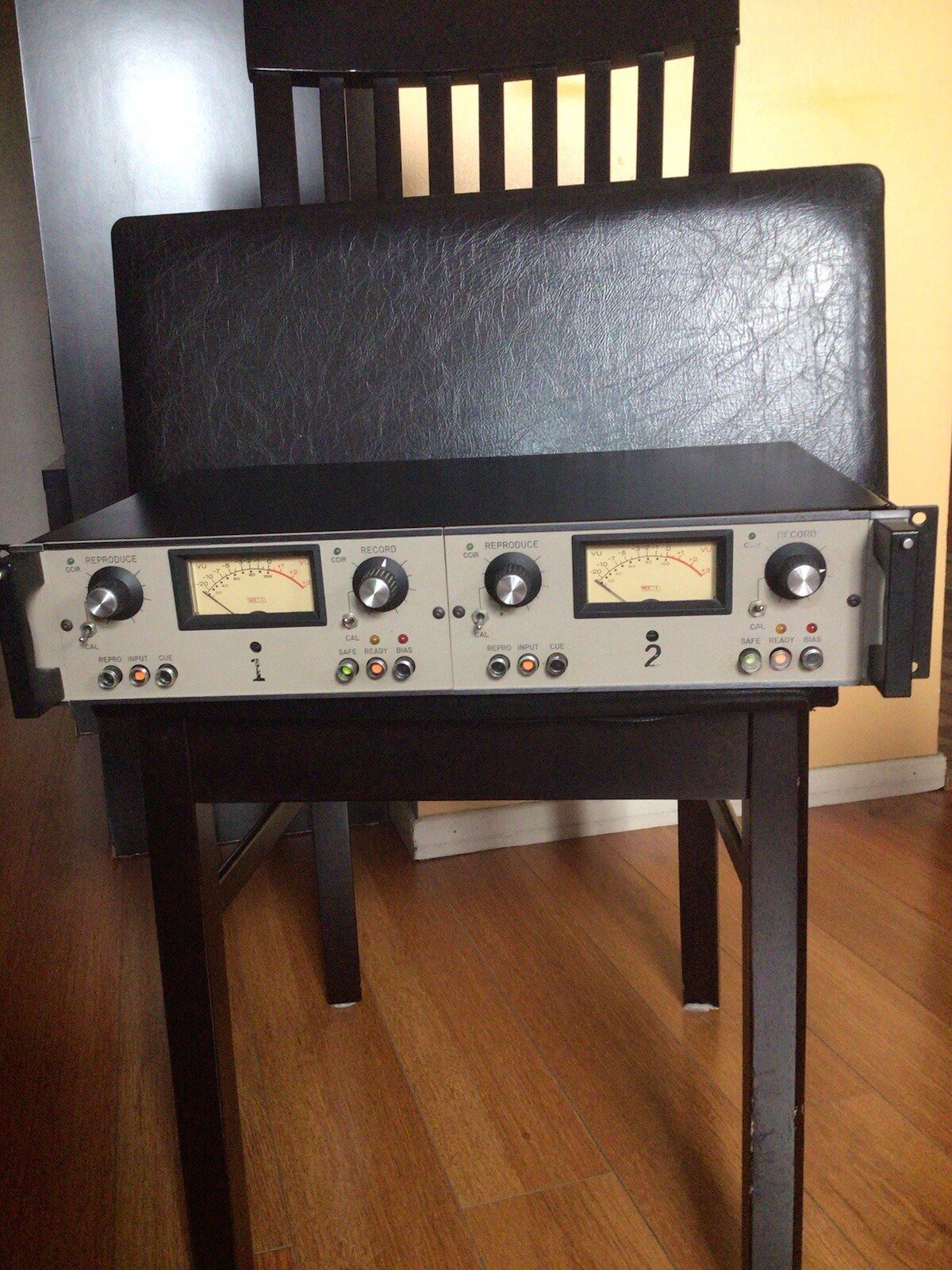
The electronics are all DC-operated internally, which is why the deck will run anywhere in the world: 100 to 220 volts, 50 or 60 Hz, selectable. Bias and erase sit at 120 kHz, with separate bias adjustment for each of the three speeds. Equalization is three-speed NAB, internally switchable to CCIR. Frequency response at 15 ips is quoted at 30 Hz to 16 kHz, ±2 dB in reproduce and ±3 dB in record and cue. Signal-to-noise for two-track reproduce is 62 dB below +4 dBm; in cue mode, 60 dB. Depth of erase is greater than 75 dB below 0 VU, and record headroom is greater than 20 dB at 1 kHz at 15 ips. Distortion is under 0.1% THD at 1 kHz and under 0.2% IM at 60 and 6000 Hz, 4:1. Inputs accept -15 to +24 dBm for 0 VU into a 10,000-ohm balanced load. Outputs are +4 dBm for 0 VU from a 50-ohm balanced source, with maximum output at clipping of +24 dBm.
Physically, it's a 190-pound system, 35 inches tall, roughly 25¼ inches wide and 26 inches deep, in an all-steel cabinet with casters and handles. The electronics live on a pull-out rack and the transport swivels. Both help when you're recapping a card at 2 a.m. and don't want to pull the whole deck out of the wall. The JH-110 converts between quarter-inch and half-inch by swapping guides and heads, and it takes reels from 3 inches up to 11¾ inches.
Studio Sound (December 1977, p.51) covered a later revision of the JH-110 built around a desk that tilts forward on a gas-spring mechanism, allowing a variety of work modes and — in the magazine's words — effortless editing. That version added a real-time minutes-and-seconds tape counter that could be paired with the JH-36 return-to-zero cue-up function, plus new bias and erase timing generators designed to eliminate clicks, gaps, and overlaps at all three speeds. Scissors and markers could be supplied as well, and the deck handled 14-inch reels in mono and stereo quarter-inch configurations. If you're shopping today, that tilting-desk variant is a meaningfully different machine from the fixed-profile version, and it's worth knowing which one you're looking at.
By the early '80s MCI was running a campaign around the JH-110's "Total Servo Transport." The copy in DB (May 1982, p.13) framed the deck as the basis of what the company called the most accepted line of studio recorders, with quartz-locked speed accuracy and a digital spot timer/locator included at no extra cost. The same advertising, in DB (May 1982, p.13), noted that JH-110 transports were designed from the ground up for synchronized work with video or other audio recorders. The sync-oriented design is consistent with what the spec sheet shows.
The JH-110 was never going to be light, cheap, or simple. It's a 190-pound steel-cabinet machine with a servo transport, three-speed bias and EQ, and a swappable head assembly. That's a lot of system to keep aligned, and these decks tend to live in studios rather than living rooms. The design is unusually serviceable for a machine of its class, with pull-out electronics and a swiveling transport. MCI also published a full spec sheet, including performance curves, at a time when the company made a point of noting that it rose above "hi-fi hype" to publish complete performance data for professionals to read. (That's MCI's own framing from a DB advertisement, October 1982, p.19. The published curves were real.)
On the used market, a classified listing in Recording Engineer/Producer offered a JH-110 30 ips two-track quarter-inch at $3,200. Another seller listed a JH-110 half-inch four-track with remote and manual alongside a quarter-inch two-track with remote and manual at $7,500 for the pair. A separate dealer listing advertised a new JH-110-A-8 eight-track one-inch machine at $8,500. Prices have moved since, and condition, especially head wear and servo health, drives everything. Parts for the JH-110 and JH-114 were already being actively sought in the classifieds by the late '80s.
The JH-110 is a professional quarter-inch machine with a servo transport, three speeds, switchable NAB/CCIR equalization, and a worldwide power supply. It is also a 190-pound steel-cabinet deck with a lot of adjustments that need to be right. Buy the one with the cleanest heads and the most complete documentation, not the cheapest one.
eBay Listings



As an eBay Partner, we earn from qualifying purchases. This helps support our independent vintage technology research.