Magnavox AMPLIFIER-CHASSIS: A Forgotten Foundation of Mid-Century Audio
In the world of vintage audio, attention often gravitates toward complete console systems, standalone receivers, or iconic tube amplifiers from brands like Fisher, Marantz, or Scott. Yet behind many of the era’s beloved entertainment centers lay unsung workhorses—chassis-based amplifier modules like the Magnavox AMPLIFIER-CHASSIS. Not a consumer product in its own right, this amplifier chassis was a critical internal component used by Magnavox in a range of console radios, television sets, and combination entertainment units from the mid-1950s through the early 1960s. While not designed for standalone use or audiophile acclaim, the AMPLIFIER-CHASSIS offers a fascinating glimpse into the engineering philosophy and mass-market audio design of its time.
Historical Context: Magnavox in the 1950s
Magnavox, founded in 1917, was a major American electronics manufacturer long before it became known for televisions and later video game consoles (notably the Odyssey). In the postwar era, Magnavox focused heavily on home entertainment systems—large wooden console radios and TV combos that anchored living rooms across America. These consoles were not just functional; they were furniture, status symbols, and technological marvels of their day.
The AMPLIFIER-CHASSIS was part of this ecosystem. Rather than designing unique amplifier circuits for each model, Magnavox employed modular chassis designs that could be reused across product lines. This standardized approach reduced manufacturing costs and simplified repairs—a key consideration in an era when vacuum tubes were routinely replaced by technicians or even savvy homeowners.
Though no single model number or schematic is universally tied to the name “AMPLIFIER-CHASSIS,” surviving service manuals and chassis units suggest this designation was likely a generic term used in documentation for various tube-based audio amplifier subassemblies produced between approximately 1955 and 1962.
Technical Specifications
The following specifications are representative of typical Magnavox amplifier chassis units from the late 1950s, based on surviving examples and service data:
| Specification | Detail |
| Year of Production | c. 1955–1962 |
| Amplifier Type | Vacuum tube (valve) |
| Output Power | 3–8 watts (RMS, depending on model) |
| Output Impedance | 3.2Ω to 8Ω (matched to field-coil or permanent-magnet speakers) |
| Frequency Response | Approx. 80 Hz – 8 kHz (typical for era) |
| Input Sources | AM radio detector, phonograph (magnetic cartridge), sometimes auxiliary |
| Tubes Used | Common types: 6AQ5, 6V6GT, 12AX7, 12AU6, 5Y3GT |
| Power Supply | Transformer-coupled, full-wave rectifier |
| Chassis Material | Steel stamping with plated mounting points |
| Dimensions (approx.) | 10" x 6" x 2.5" (varies by model) |
| Weight | 3–4 lbs |
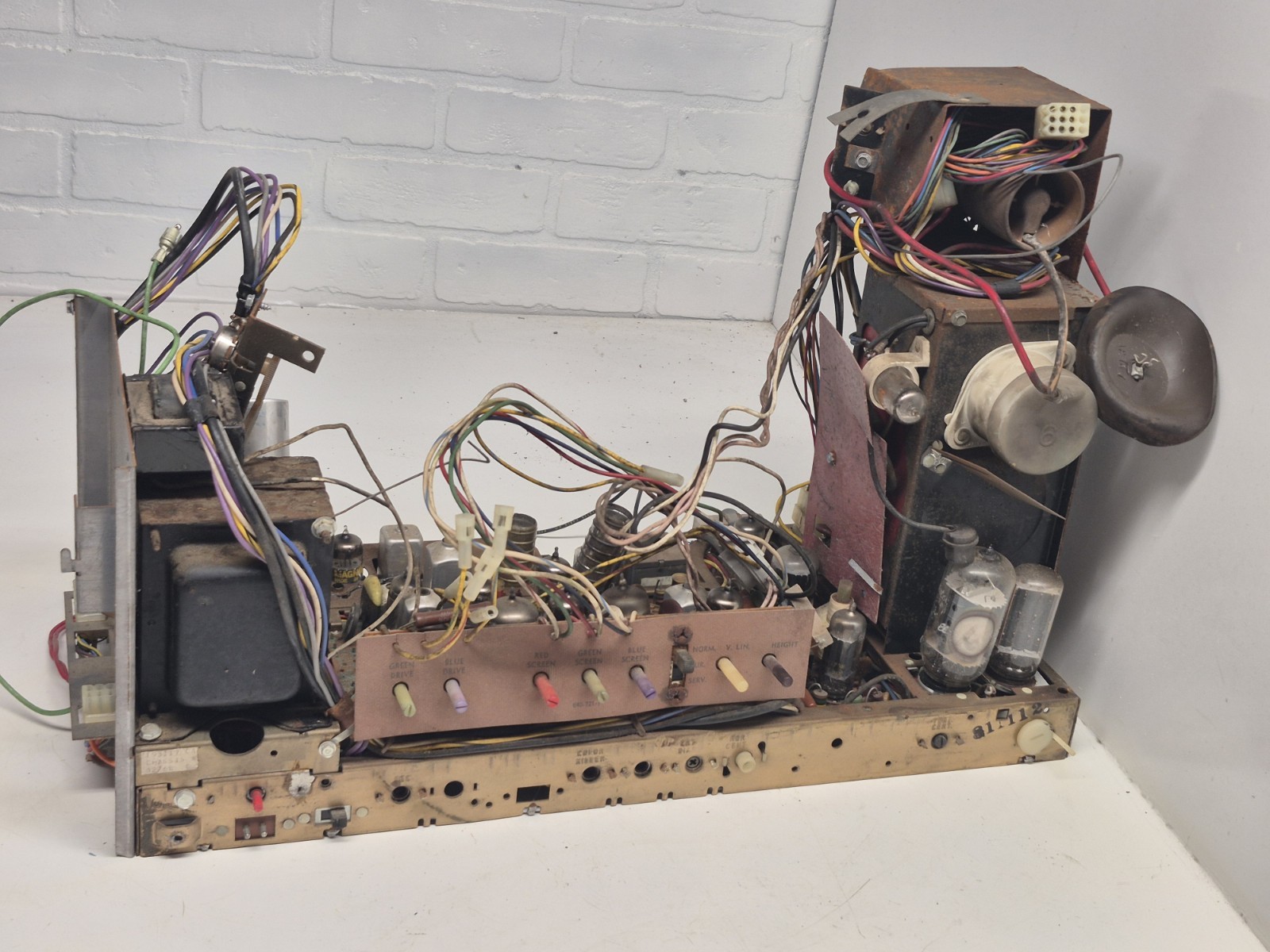
These chassis units were typically mounted horizontally within the console cabinet, connected via plug-in harnesses to the radio tuner, phonograph, and speaker. They featured point-to-point wiring (no printed circuit boards), ceramic tube sockets, and hand-soldered connections—hallmarks of mid-century electronics construction.
Sound Characteristics and Performance
By modern audiophile standards, the AMPLIFIER-CHASSIS delivers modest performance. However, within its historical context, it provided warm, listenable sound that suited the AM radio broadcasts and 78 RPM records of the era.
- Tonal Balance: Slightly midrange-forward, with rolled-off highs and limited bass extension. This was partly due to the small field-coil speakers commonly used in Magnavox consoles.
- Harmonic Distortion: Moderate (1–3%), typical for class AB push-pull designs of the time. Some listeners describe a “vintage glow” or softness to the sound.
- Dynamic Range: Limited, especially at higher volumes, where compression and distortion become noticeable.
- Noise Floor: Audible hum or hiss is common, especially if tubes or filter capacitors are aged.
Despite these limitations, the amplifier’s tube-based design gives it a certain musicality. When restored and paired with appropriate speakers, it can deliver a nostalgic, pleasing sound—ideal for background listening or period-accurate restorations.
Notable Features and Design Philosophy
The AMPLIFIER-CHASSIS reflects several key engineering principles of the 1950s:
- Modularity: Designed for easy removal and replacement. Technicians could swap out the entire chassis during servicing, minimizing downtime.
- Serviceability: Clearly labeled test points, accessible tube sockets, and standardized tube types made field repairs feasible.
- Integration: The chassis often included not just the audio amplifier, but also audio preamp stages, volume controls, and sometimes even phonograph preamplification.
- Safety and Reliability: Fused power inputs, insulated high-voltage areas, and robust transformers ensured durability in household use.
One notable feature in many of these chassis units is the use of field-coil speakers, where the speaker’s magnetic field is powered by the amplifier’s B+ supply rather than a permanent magnet. This design improved efficiency and bass response but added complexity—failure of the field coil could render the entire system silent.
Common Issues and Maintenance
Like all vintage tube gear, the Magnavox AMPLIFIER-CHASSIS requires careful attention before being powered up after years of storage. Common issues include:
- Capacitor Failure: Electrolytic and paper capacitors degrade over time. Old capacitors can leak, short, or cause hum. Recapping is strongly recommended before operation.
- Resistor Drift: Carbon composition resistors often increase in value, affecting bias and gain.
- Tube Wear: Tubes such as the 6AQ5 or 12AX7 may still function but often benefit from replacement or testing.
- Corrosion and Dust: Terminals and tube pins can oxidize. Cleaning with contact cleaner and proper ventilation helps.
- Transformer Issues: While generally robust, power and output transformers can develop shorts or open windings after decades.
Safety Note: These chassis operate at lethal voltages (300–400V DC). Only experienced technicians should attempt restoration. Always use an isolation transformer and variac when powering up for the first time.
Collectibility and Market Value
The Magnavox AMPLIFIER-CHASSIS is not a collectible in the traditional sense. Unlike standalone amplifiers or high-fidelity receivers, it was never marketed to consumers as a standalone product. As such, it rarely appears on auction sites or in vintage audio circles as a desirable item.
However, for restorers, tinkerers, and console collectors, the chassis holds significant value. Complete, working units can fetch $50–$150 when sold with matching consoles or as part of a restoration kit. Rare or well-documented variants (e.g., those with unusual tube complement or high-fidelity features) may command higher prices among niche enthusiasts.
Its real worth lies in historical and educational value—as a tangible example of mid-century electronics manufacturing, modular design, and the evolution of home audio.
Conclusion: A Humble Legacy
The Magnavox AMPLIFIER-CHASSIS may not have the prestige of a Marantz 7 or the cult following of a Fisher receiver, but it played a vital role in bringing audio into American homes during a transformative era. It represents the industrial pragmatism of postwar electronics—reliable, repairable, and built to last.
Today, it serves as a reminder that great audio experiences don’t always come from high-end gear. Sometimes, they come from a simple tube chassis humming inside a walnut console, delivering the evening news or a Sinatra record to a family gathered around.
For the vintage audio enthusiast, restoring a Magnavox AMPLIFIER-CHASSIS isn’t about chasing perfection—it’s about preserving a piece of everyday technological history, one carefully recapped capacitor at a time.
eBay Listings


As an eBay Partner, we earn from qualifying purchases. This helps support our independent vintage technology research.
Related Models
- Luxman L-530 (1975)
- Luxman R-404 (1975)
- Luxman RV-371 (1975)
- Luxman SQ-38U (1975)
- Luxman T-14 (1972)
- Luxman T-530 (1975)
- Luxman TX-101 (1975)
- Denon DRA-800 (1985)
- Denon PMA-350Z (1980)
- Denon POA-1500 (1979)