Luxman TF-LH: The Quiet Master of Signal Purity
In the golden era of high-fidelity audio, when Japanese manufacturers like Luxman, Accuphase, and Sansui were redefining performance standards, Luxman stood apart for its unwavering commitment to musicality, craftsmanship, and analog elegance. Among its diverse lineup of amplifiers, tuners, and preamplifiers, the Luxman TF-LH occupies a unique niche—not as a powerhouse amplifier or a feature-laden control center, but as a refined, minimalist solution for audiophiles seeking uncolored signal management. Introduced in 1978, the TF-LH is a passive line amplifier, a rare breed of component designed to deliver pure signal routing without active gain stages.
While it may lack the visual drama of tube amplifiers or the robust meters of contemporary receivers, the TF-LH embodies Luxman’s philosophy of “less is more.” It was engineered for purists who believed that the fewer electronic components in the signal path, the closer one gets to the original recording. In an age when active preamplifiers with tone controls and multiple gain stages were becoming common, the TF-LH was a quiet rebellion—a return to simplicity, transparency, and fidelity.
Technical Specifications
The TF-LH is not a conventional preamplifier. It contains no power supply, no transistors, and no vacuum tubes. Instead, it relies entirely on passive components—precision resistors and high-quality switches—to manage input selection and volume control. This design eliminates the coloration, noise, and distortion that can be introduced by active circuitry.
| Specification | Detail |
| Model | TF-LH |
| Manufacturer | Luxman Corporation, Japan |
| Year Introduced | 1978 |
| Type | Passive Line Amplifier |
| Inputs | 4 x RCA (Line-level) |
| Outputs | 1 x RCA (Tape Out), 1 x RCA (Main Out) |
| Volume Control | High-precision attenuator (rotary switch) |
| Tone Controls | None |
| Power Requirement | None (passive design) |
| Impedance | Not applicable |
| Gain | -6dB to -40dB attenuation (no gain) |
| Construction | Steel chassis, aluminum front panel |
| Dimensions | 430 mm (W) × 115 mm (H) × 295 mm (D) |
| Weight | Approx. 4.2 kg |
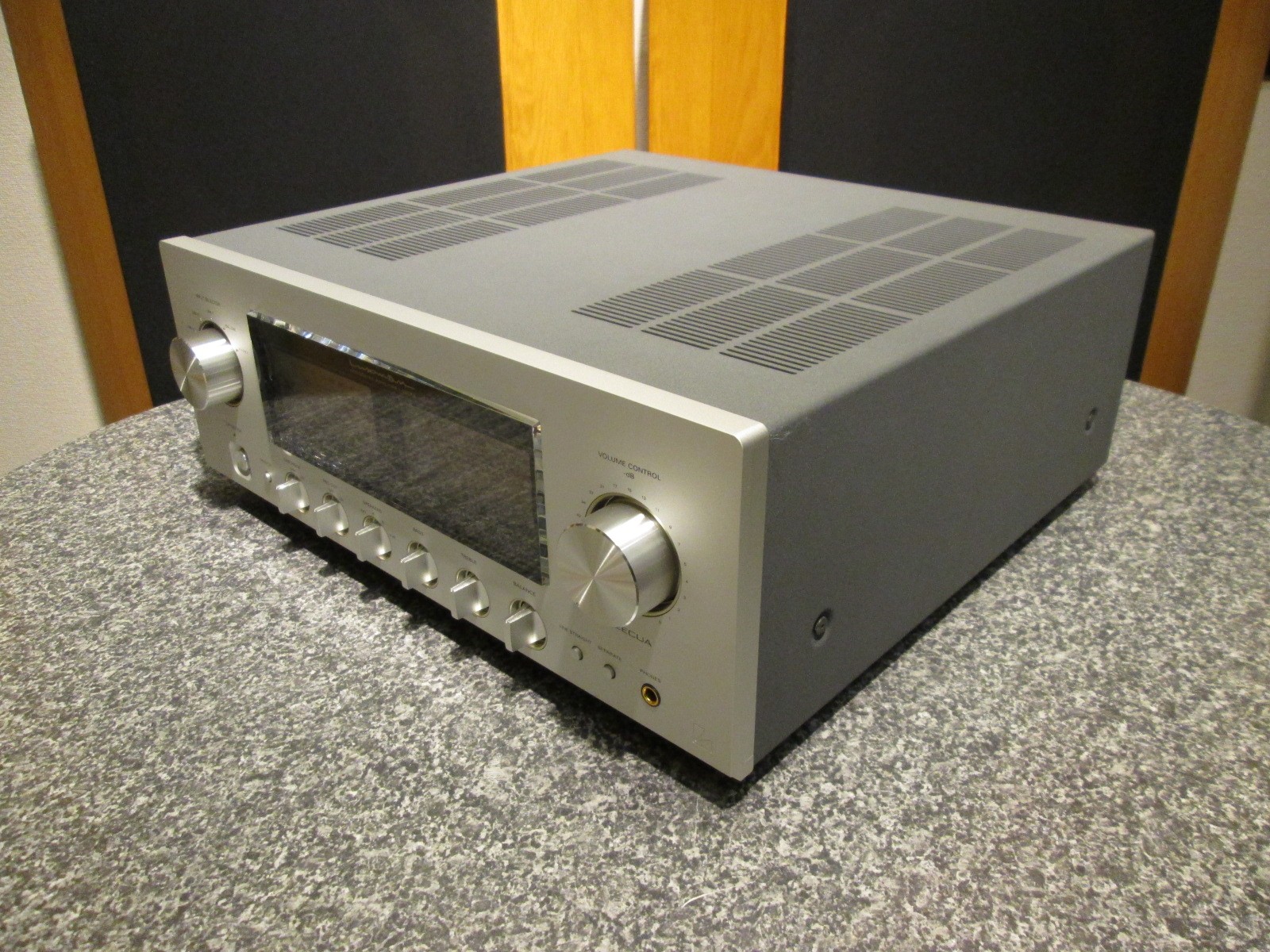
The TF-LH features a robust, no-nonsense build typical of Luxman’s late-1970s engineering. Its front panel is minimalist: a large rotary knob for volume, a smaller one for input selection, and a simple Luxman logo. The rear panel hosts four RCA inputs, a single main output, and a tape loop—standard for the era but intentionally limited to preserve signal integrity.
Sound Characteristics and Performance
The sonic signature of the TF-LH is best described as neutral, transparent, and immediate. Without active circuitry, there’s no amplifier-induced warmth or brightness—just the unadulterated signal from your source components. This makes the TF-LH an ideal match for systems where source quality is paramount: high-end turntables, FM tuners, or reel-to-reel decks.
Because it provides no gain, the TF-LH works best when paired with high-output sources and amplifiers that have sufficient sensitivity. It excels in systems where the preamplification stage is either unnecessary or already handled by another component (such as an integrated amplifier with multiple inputs). Its precision attenuator ensures smooth, channel-balanced volume control, and the lack of feedback loops or op-amps means there’s no phase shift or transient smearing.
Many users report that the TF-LH imparts a sense of “blackness” to the background—silence between notes—with exceptional clarity in the midrange and a natural decay of harmonics. It doesn’t add excitement, but it reveals what’s already there, making it a favorite among listeners who value accuracy over euphony.
Notable Features and Innovations
While the TF-LH may appear simple, its design reflects several thoughtful engineering choices:
- Passive Attenuation Circuit: Uses a stepped resistor ladder network for precise, repeatable volume control. Unlike potentiometers, which can wear and become noisy, the TF-LH’s switch-based attenuator maintains consistent performance over decades.
- High-Quality Switching: Input selection is handled by a durable, low-capacitance rotary switch, minimizing crosstalk and signal loss.
- Direct Signal Path: With no power supply, coupling capacitors, or active stages, the audio signal travels through the unit with minimal interference.
- Build Quality: Housed in a rigid steel chassis with a brushed aluminum faceplate, the TF-LH was built to last. Luxman’s attention to mechanical grounding and shielding further reduces the risk of hum or RFI.
Though not “innovative” in the sense of introducing new technology, the TF-LH represents a philosophical innovation—a commitment to signal purity at a time when complexity was often equated with performance.
Common Issues and Maintenance
Given its passive nature, the TF-LH is remarkably reliable. However, after 40+ years, a few issues may arise:
- Switch Contact Oxidation: The input selector and volume switches may develop crackling or channel imbalance due to oxidation. This can usually be resolved with careful contact cleaning using non-residue electronics cleaner. Avoid abrasive cleaners that could damage switch contacts.
- Wear on Attenuator Contacts: While more durable than potentiometers, the stepped attenuator can develop slight inconsistencies over time. If volume steps become uneven, professional servicing may be needed to clean or realign the contacts.
- Cable and Connector Wear: RCA jacks can loosen or corrode. Replacing them with modern high-quality jacks is a common upgrade among restorers.
- Cosmetic Aging: The original paint and labeling may fade. While not affecting performance, collectors often seek units in original, unmodified condition.
Because the TF-LH has no tubes or capacitors to replace, maintenance is minimal compared to active preamplifiers. However, due to its passive design, it cannot compensate for weak sources or low-sensitivity power amplifiers—so system matching is crucial.
Current Market Value and Collectibility
The Luxman TF-LH is a niche collectible, sought after by vintage audio enthusiasts who appreciate minimalist design and high build quality. It is not as widely known as Luxman’s legendary tube amplifiers (like the MB-300) or high-power solid-state receivers (like the CL-35), but it holds a special place among purists.
In recent years, working units in good condition have fetched between $200 and $400 on the secondary market, with pristine, boxed examples commanding higher prices. Fully restored units with upgraded RCA jacks or custom modifications may sell for more, though originality is highly valued.
Its collectibility is enhanced by its rarity—Luxman produced relatively few TF-LH units compared to their mainstream receivers—and its embodiment of a specific audiophile philosophy: that the best component is the one you don’t hear.
Conclusion and Legacy
The Luxman TF-LH is not for everyone. It won’t drive your speakers, add warmth, or impress with flashing lights. But for those who believe that high-fidelity audio should be about transparency and truth, the TF-LH remains a compelling choice.
It stands as a testament to Luxman’s engineering integrity—a company that, even in the late 1970s, was willing to offer a product that did less, so the music could do more. In an era increasingly obsessed with digital processing and feature overload, the TF-LH reminds us that sometimes, the most advanced technology is the one that gets out of the way.
Today, it serves both as a functional component in vintage systems and as a symbol of analog purity. For the discerning collector or minimalist audiophile, the Luxman TF-LH is not just a relic—it’s a quiet revolution in a metal box.
eBay Listings
As an eBay Partner, we earn from qualifying purchases. This helps support our independent vintage technology research.
Related Models
- Luxman L-530 (1975)
- Luxman R-404 (1975)
- Luxman RV-371 (1975)
- Luxman SQ-38U (1975)
- Luxman T-14 (1972)
- Luxman T-530 (1975)
- Luxman TX-101 (1975)
- Denon DRA-800 (1985)
- Denon PMA-350Z (1980)
- Denon POA-1500 (1979)