Luxman T-88V (1978–1979)
A tuner that doesn’t just find stations—it finds the soul in the signal.
Overview
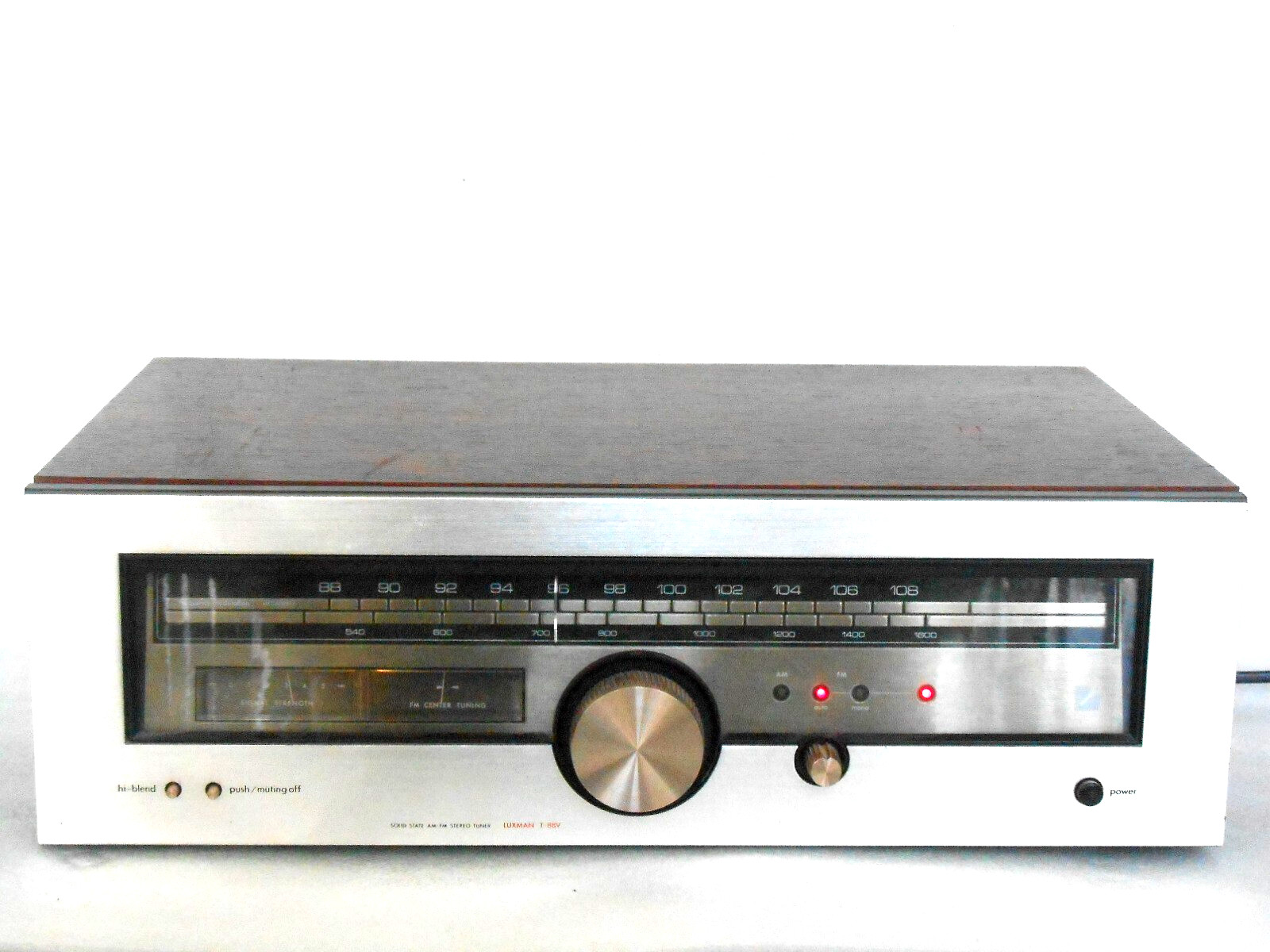
You don’t just tune in with a Luxman T-88V—you’re invited into the broadcast. Released in 1978 and built through 1979, this AM/FM stereo tuner wasn’t just another box in the rack; it was Luxman’s statement of intent: high sensitivity, fresh design, and a sound quality that made listeners forget they were hearing radio at all. Marketed as “LUXMAN'S NEW HIGH SENSITIVITY TUNER FRESH IN DESIGN PRESENTATION !”, the T-88V balanced refinement with economy, offering serious performance without the stratospheric price tag of its siblings. It’s the kind of gear that, once powered on, makes you wonder why anyone ever settled for less from their FM dial.
Positioned as a match for the L-80 series integrated amplifiers—like the L-80, L-80V, L-81, and L-85V—the T-88V completed a cohesive, high-fidelity system that looked as good as it sounded. With its wooden case and illuminated tuning scale, it had presence. But more than aesthetics, it delivered where it counted: in the clarity, depth, and stability of the signal. This wasn’t just a tuner for catching the news or a weather report—it was built for audiophiles who wanted to hear every breath in a live orchestral broadcast or the subtle reverb on a jazz vocal recorded in stereo.
And while it didn’t reach the rarified tier of Luxman’s flagship tuners like the T-110 or T-50A, it carved out a reputation as a solid performer in the “excellent milieu de la gamme tuner de Luxman”—the strong middle of Luxman’s tuner lineup. For those who wanted more than what a Sony ST-A7B offered but weren’t ready to step up to the ST-5000F or top-tier Luxman models, the T-88V was a sweet spot.
Specifications
| Type | Mono/Stereo Tuner |
| Tuning Bands | FM, AM |
| Tuning Scale | Analogue |
| FM Tuning Range | 88 to 108 MHz |
| AM Tuning Range | 520 to 1610 kHz |
| IHF usable sensitivity | 2µV (11.2dBf ; 98MHz, 1 Khz , 100% mod.) |
| Sensitivity | 2.0uV (FM) |
| Selectivity | 60 dB (at 98MHZ, 100µV, ± 400 Khz ) |
| Capture ratio | 1,8 dB (at 98MHz, 1 mV ) |
| S/N ratio | 72 dB (mono, at 98MHz, 1 mV , 1 Khz ) 68 dB (stereo, at 98MHz, 1 mV , 1 Khz ) |
| Frequency response | 20Hz to 15kHz (FM) |
| THD at 98MHz, 1 mV | 0,2% (mono, 1 Khz ) 0,2% (stereo, 100 Hz ) 0,3% (mono, 1 Khz ) 0,4% (mono, 6 Khz ) |
| Stereo separation | 43 dB (1 Khz , at 98MHz, 1 mV ) 30 dB (50 Hz ...10 Khz ) |
| Output level | 1,6 V (at 98MHz, 1 Khz , 100% mod. mono) |
| Input voltage | 220 V |
| Input frequency | 50 / 60 Hz |
| Power consumption | 20W |
| Dimensions | 450 x 300 x 160 mm (WxDxH) |
| Weight | 7 kg |
Key Features
The Heart of the Signal Path
Inside the T-88V, Luxman didn’t cut corners. The FM section is anchored by a 4-gang tuning capacitor—critical for precise tracking across the band—paired with FET RF amplifier circuits that ensure low-noise signal amplification right from the start. Between stages, an inter-stage double tuning circuit helps reject adjacent interference, while a specially designed low-distortion oscillator keeps the tuning stable and clean. This isn’t just engineering for the spec sheet; it’s the kind of attention that makes a weak station come through without that fluttery, fading quality that plagues lesser tuners.
IF and Discrimination Precision
The IF amplifier uses two pairs of linear ceramic filters—components known for their sharp, consistent filtering—alongside two transistors to maintain signal integrity. The adoption of an LC double tuning circuit and a wide bandwidth discriminator transformer means the T-88V can handle complex stereo broadcasts without smearing transients or losing high-frequency detail. A high-gain IC further boosts performance in the IF stage, ensuring even marginal signals are rendered with clarity.
MPX and Signal Management
For decoding stereo, the T-88V relies on a specially selected PLL (phase-locked loop) IC in the MPX circuit, a choice that improves stereo stability and reduces crosstalk. This was a smart move in an era when PLL-based decoding was becoming the benchmark for accurate stereo separation. The result? A more coherent soundstage and better-defined imaging, especially on stations with marginal signal strength.
Smart, Integrated Features
The T-88V comes equipped with a suite of annexed circuits: an FM high blend circuit to reduce high-frequency noise in weak signal areas, an FM muting circuit that silences the output when the signal drops below usable levels (set at 7µV), a multi-path detector to warn of signal reflections, and an output level setter for system matching. The muting circuit itself is a hybrid design—electronically controlled via transistor logic with FET-based analog audio muting—ensuring fast, click-free operation without degrading the signal path when active.
Build and Aesthetics
Beyond the circuitry, the T-88V impresses with its physical presence. Housed in a wooden case with an illuminated tuning scale, it blends warmth and precision in both form and function. The analogue scale isn’t just nostalgic—it’s functional, giving a continuous visual reference for fine-tuning. At 7 kg, it has heft without being cumbersome, and the 450 mm width ensures it fits neatly alongside other components of its era.
Historical Context
The T-88V arrived in 1978, a time when FM stereo broadcasting was maturing and high-fidelity home audio was booming. Japanese manufacturers were in fierce competition, pushing sensitivity, selectivity, and stereo decoding accuracy to new levels. Luxman positioned the T-88V as a “refined yet economical” option—more capable than entry-level tuners but not as elaborate as their flagship models. It was designed from the start to pair with the L-80 series amplifiers, offering a complete, cohesive system for mid-tier audiophiles.
It shared the stage with respected competitors like the Sony ST-A7B and ST-5000F, and while it didn’t aim to outgun Luxman’s own T-110 or T-50A, it held its own in the middle of the brand’s tuner hierarchy. In a forum assessment, one owner noted it sits in the “excellent milieu de la gamme tuner de Luxman,” a testament to its balanced performance and value.
Collectibility & Value
When new, the Luxman T-88V carried a price of $345—a meaningful sum in 1978, but positioned below the brand’s elite models. Today, its value varies widely based on condition and market. A listing on VintageChief.com priced it at €449.00, while other recent sales and listings show figures like €159, €175, €200, and CA$150—indicating a broad range depending on functionality and cosmetics.
Collectors and enthusiasts clearly appreciate its design: one reviewer called it “easily one of the sexiest tuners we've seen,” and another simply stated, “The sound quality of a Luxman is unmatched.” While no widespread reports of common failures exist, the lack of documented maintenance issues could mean either inherent reliability or underreporting—prospective buyers should still test or have the unit serviced, especially the tuning capacitor and internal connections, which can degrade over decades.
Its appeal lies in its combination of solid engineering, elegant design, and strong performance in a compact form. For those building a vintage Luxman stack or seeking a tuner that delivers more than its price suggests, the T-88V remains a compelling choice.
eBay Listings



As an eBay Partner, we earn from qualifying purchases. This helps support our independent vintage technology research.
Related Models
- Luxman L-530 (1975)
- Luxman R-404 (1975)
- Luxman RV-371 (1975)
- Luxman SQ-38U (1975)
- Luxman T-14 (1972)
- Luxman T-530 (1975)
- Luxman TX-101 (1975)
- Denon DRA-800 (1985)
- Denon PMA-350Z (1980)
- Denon POA-1500 (1979)