Luxman T-4 / T-4B (1978–1980)
That rare tuner that doesn’t just find stations—it holds them, locks them, and makes you forget you’re listening to radio at all.
Overview
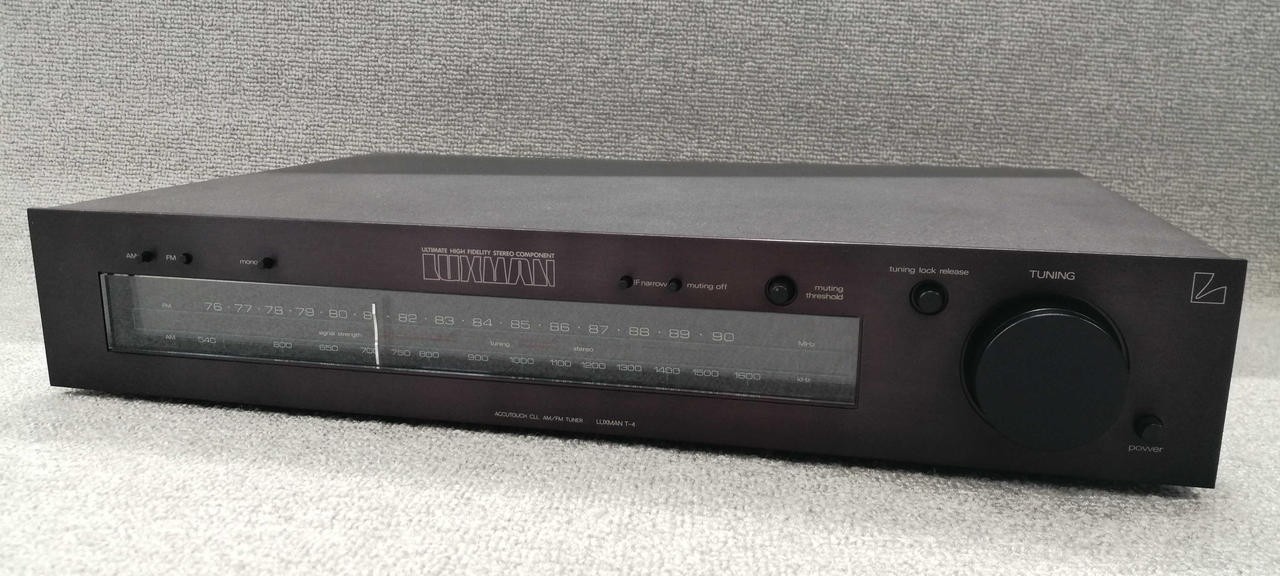
The Luxman T-4 isn’t flashy, but it’s serious—dead serious—about pulling in FM and AM signals with a precision that still turns heads decades later. Built between October 1978 and 1980, this AM/FM stereo tuner was part of Luxman’s “Ultimate High Fidelity Stereo Component” series, a lineup that aimed to deliver no-compromise performance during Japan’s golden era of analog audio. It came in two color variants: the silver T-4 and the black T-4B, both sharing the same internal architecture and engineering ethos. Priced at ¥58,500 at launch (about $247.50 at the time), it wasn’t cheap, but it wasn’t meant to be disposable either.
What sets the T-4 apart isn’t just its specs—it’s how it behaves. This is a tuner that grabs a station and keeps it, thanks to Luxman’s proprietary CLL (Closed Loop Locked) system, which synchronizes the front end, IF stage, and detector using a crystal-controlled reference. No drifting, no hunting—just lock-and-forget tuning. And when you do land on a frequency, the Accu-touch mechanism gives a subtle mechanical click, locking the knob in place for about a second so you know you’ve hit the sweet spot. It’s a tactile detail that feels almost obsessive, but once you’ve used it, you miss it on everything else.
It was built by SONIC, a contractor that also manufactured other respected Luxman models like the T-12 and T-50A, suggesting a consistent hand in construction. While not as legendary as the T-110, T-12, or T-510, the T-4 has been called “the best of the rest” among Luxman’s analog tuners—a solid-tier performer with top-tier engineering.
Specifications
| Manufacturer | Luxman |
| Model | T-4 / T-4B |
| Production years | October 1978 - 1980 |
| Original price | ¥58,500 |
| Product type | AM/FM stereo tuner |
| Practical sensitivity (FM, IHF) | 1.8 μV / 10.3 dBf |
| 50 dB quieting sensitivity (FM) | 3.3 μV / 15.6 dBf |
| Signal-to-noise ratio (FM) | 75dB |
| Frequency characteristic (FM) | 30 Hz to 15 kHz ± 0.5 dB; 50 Hz to 10 kHz ± 0.3 dB |
| Distortion factor (FM, wide) | mono: 0.07%(100Hz), 0.07%(1kHz), 0.15%(6kHz); stereo: 0.15%(100Hz), 0.1%(1kHz), 0.25%(6kHz) |
| Distortion factor (FM, narrow) | mono: 0.2%(1kHz); stereo: 0.5%(1kHz) |
| Capture ratio (FM) | wide: 0.9dB; narrow: 1.8dB |
| 2 signal selectivity (± 400 kHz) | wide: 40dB; narrow: 80dB |
| Spurious characteristic | 80dB |
| IF interference rejection ratio | 80dB |
| Image ratio (FM) | 55dB |
| Amplitude modulation suppression | 60dB |
| Stereo separation (FM) | wide: 45dB(100Hz), 50dB(1kHz), 40dB(10kHz); narrow: 30dB(1kHz) |
| Carrier leak rejection ratio | 65dB |
| Output Voltage / Impedance (FM) | 1V/100 Ω |
| Muting threshold (FM) | 10 μV ~ 300 μV |
| Practical sensitivity (AM, IHF) | 250 μV/m |
| Image ratio (AM) | 50dB |
| IF interference rejection ratio (AM) | 40dB |
| Signal-to-noise ratio (AM) | 50dB |
| Distortion factor (AM) | 0.6% |
| Output voltage (AM) | 0.3V |
| Power supply voltage | 100 VAC, 50Hz/60Hz |
| Power consumption | 8W |
| External dimensions | Width 438 x Height 84 x Depth 346 mm |
| Weight | 6.5kg |
Key Features
CLL (Closed Loop Locked) Tuning System
Luxman’s CLL system is the heart of the T-4’s performance. Unlike conventional tuners that rely on manual alignment or basic PLL circuits, the CLL system uses a crystal oscillator to control the transmission frequency reference, locking the entire signal path—from the front end through the IF stage and detector—into precise synchronization. This eliminates drift and dramatically improves stability, especially in weak signal areas. It’s a total control method that makes the T-4 feel less like a tuner and more like a receiver with a memory for frequencies.
Accu-Touch Tuning Mechanism
The moment you stop turning the knob and hit the exact center of a station, the Accu-touch system engages. Using the control voltage from the CLL circuit, it detects the peak signal point and mechanically locks the tuning knob in place for about one second. That tactile “click” isn’t just satisfying—it’s functional. It tells you, without looking at the meter, that you’ve nailed the tuning. It’s one of those rare features that feels like it was designed by someone who actually listened to the radio, not just measured it.
RF and IF Stage Design
The RF stage uses a MOS-type FET, chosen for its low noise and high input resistance—ideal for pulling in weak signals without adding hiss. The IF stage offers switchable bandwidth (wide/narrow), with two sets of ceramic filters in wide mode optimized for group delay characteristics, and an additional narrow band ceramic filter engaged in narrow mode. This dual-filter approach allows users to trade off bandwidth for improved selectivity in crowded band conditions.
MPX and Audio Stages
The MPX (stereo demodulator) stage employs carefully selected PLL-ICs to ensure accurate stereo decoding, while a 3-pole low-pass filter operates independently on left and right channels, reducing crosstalk and improving high-frequency clarity. The audio stage uses an operational amplifier IC, contributing to the unit’s low distortion and clean output. A beat prevention circuit is also included to eliminate heterodyne interference, a common annoyance in urban environments.
Front Panel and Indicators
The T-4 is equipped with a 5-level signal strength indicator and a center indicator to assist with tuning. It also includes an FM muting switch and muting level control, allowing users to adjust when the audio cuts out during weak reception. These aren’t just gimmicks—they’re tools for real-world listening, especially in fringe areas.
Historical Context
The T-4 arrived in 1978 as part of Luxman’s push to dominate the high-end tuner market with precision-engineered, no-compromise components. Built by contractor SONIC, it shared manufacturing DNA with other respected models like the T-12 and T-50A. While not positioned as the flagship—models like the T-110 and T-510 held that honor—it was clearly designed to deliver flagship-level engineering at a more accessible point in the lineup. It was intended to pair with contemporary components like the L-4 amplifier, forming a cohesive high-fidelity system for audiophiles who valued stability, clarity, and build quality over flash.
Collectibility & Value
The Luxman T-4 is not rare to the point of myth, but it’s not common either. On the used market, prices vary widely: one listing in 2024 showed a unit for $250, with a note that others have sold for up to $500. However, forum reports suggest a more typical range of $75–$100 for functional units, indicating that condition and provenance play a big role in pricing. A unit described as working fine but with “some deep scratches on top edge of front panel” sold for $250, suggesting cosmetic flaws don’t always kill value if the electronics are intact.
One common maintenance item mentioned by owners is dial light replacement—a minor issue, but worth noting for buyers. Beyond that, no widespread failure modes are documented in the available sources, though the age of these units means capacitors, switches, and potentiometers could eventually need attention. Given its solid construction and lack of active gain stages in critical paths, the T-4 is likely to survive in good working order if not abused.
eBay Listings



As an eBay Partner, we earn from qualifying purchases. This helps support our independent vintage technology research.
Related Models
- Luxman L-530 (1975)
- Luxman R-404 (1975)
- Luxman RV-371 (1975)
- Luxman SQ-38U (1975)
- Luxman T-14 (1972)
- Luxman T-530 (1975)
- Luxman TX-101 (1975)
- Denon DRA-800 (1985)
- Denon PMA-350Z (1980)
- Denon POA-1500 (1979)