Luxman T-300V (1976)
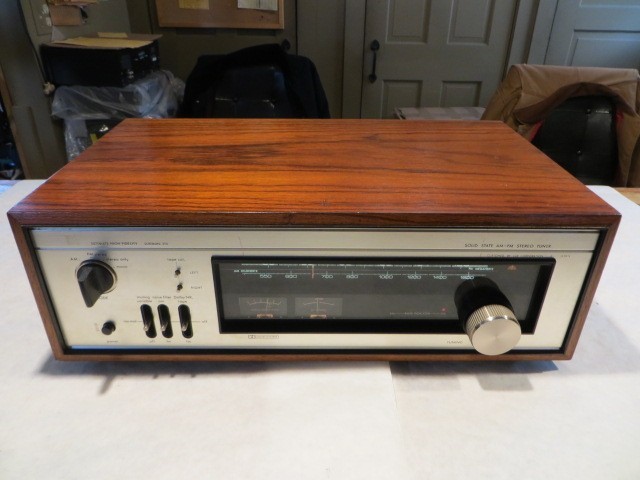
That warm, rich glow of the illuminated dial isn’t just for show—it’s the first hint you’re dealing with a tuner that treats FM like a sacred signal.
Overview
The Luxman T-300V isn’t just another vintage tuner you plug in and forget. From the moment you lay eyes on its wide, commanding face and catch the red-orange glow of its analog scale, you know this was built for a specific kind of listener—one who still believes FM broadcasting deserves reverence. Introduced in 1976, the T-300V was Luxman’s statement piece in the high-fidelity tuner game, designed not just to receive radio but to extract every last nuance from the broadcast band. It’s a stereo FM/AM tuner that sits at the top of its class, engineered with a level of care that makes modern mass-market receivers feel hollow by comparison. This isn’t background noise gear; it’s a front-and-center component for people who still chase that elusive, pristine FM signal on a clear night.
Specifications
| Type | Mono/Stereo Tuner |
| Tuning Bands | FM, AM |
| Tuning Scale | Analogue |
| FM Tuning Range | 88 to 108 MHz |
| AM Tuning Range | 525 to 1605 kHz |
| FM Sensitivity | 1.7uV |
| AM Sensitivity | 250uV |
| FM Signal to Noise Ratio | 75dB |
| AM Signal to Noise Ratio | 48dB |
| FM Distortion | 0.2% |
| AM Distortion | 0.6% |
| FM Selectivity | 75dB |
| FM Frequency response | 20Hz to 15kHz |
| AM Frequency response | 40Hz to 5kHz |
| FM Output | 1700mV |
| AM Output | 400mV |
| Dimensions (W x H x D) | 485 x 165 x 281 mm |
| Weight | 9.3 kg |
Key Features
Linear Phase Block Filter – The Heart of the Matter
Most tuners of the era leaned on ceramic or crystal filters to shape their signal path, but the T-300V went its own way with a linear phase block filter. That’s not just a spec sheet flourish—it’s a deliberate design choice aimed at preserving phase linearity and minimizing distortion across the frequency band. The result? A cleaner, more coherent stereo image that doesn’t collapse or smear when the music gets complex. It’s the kind of engineering detail that separates “good enough” from “I can hear the panning of the announcer’s footsteps in the studio.”
Discrete, No-IC Construction
Inside, the T-300V is pure analog—no integrated circuits, just discrete transistors and carefully laid-out circuitry. This isn’t nostalgia-bait; it’s a functional decision that gives the tuner a robust, repairable architecture. Everything is built to last, and because there are no proprietary ICs to fail or become obsolete, a skilled tech can keep one running indefinitely. The MPX circuit, for example, is built around individual transistors like the 2SC1000GR and 2SK-30-0, with dedicated transformers for pilot signal recovery and frequency doubling. It’s over-engineered in the best possible way.
Front-End Precision
Tuning accuracy starts at the front end, and here the T-300V doesn’t cut corners. It uses a 4-gang variable capacitor for FM and a 3-gang for AM—mechanical precision that ensures smooth tracking and tight station separation. You can feel the difference in the dial’s resistance, that satisfyingly damped glide as you hunt for a weak signal. Combined with the illuminated analog scale, it turns tuning into a tactile, almost meditative experience.
Smart Front Panel Controls
The front panel isn’t just about looks. It’s packed with thoughtful touches: an AM hi-cut switch (with strong/normal/medium settings) to tame noise on long-distance bands, an FM hi-blend switch (maximum/normal/moderate) to manage stereo separation in weak-signal areas, and a muting switch (variable/normal/off) that lets you silence interference without killing the whole signal. Even the dial pointer’s illumination changes color—red for FM, orange for AM—so you always know what you’re tuned to at a glance.
Back-Panel Flexibility
Flip it around and you’ll find a surprising amount of control: multipath output terminals (V, H), 4ch decoder output, FM/AM muting level adjustment VRs, an illumination brightness switch, and an antenna input attenuator. These aren’t just for show—they’re for users who want to fine-tune their reception, integrate with external processors, or optimize performance in high-signal environments. It’s a level of customization you rarely see outside of broadcast-grade gear.
Historical Context
The T-300V was developed at a time when FM broadcasting was hitting its stride—not just as a music delivery system, but as a high-fidelity medium in its own right. Luxman built the T-300V to honor that potential, treating the broadcast signal with the same seriousness as a vinyl pressing. It was positioned as the top-of-the-line tuner, an evolution of the T-300 with Dolby FM functionality added to reduce noise and improve dynamic range. This wasn’t a budget upgrade; it was a flagship statement. And it wasn’t meant to stand alone—it was designed to match the Luxman L-308, L-309, L-309V, L-309X, CL-350, M-1600, and M-150, forming a complete, cohesive system that looked and performed like a unified whole.
Collectibility & Value
The T-300V trades in a wide range these days, reflecting its condition, service history, and whether it’s been modified. Recent listings show prices as low as ¥810 on Yahoo Auctions, but that’s likely for non-working units. More representative working examples have sold for €300 to €350 on Subito, while a February 2026 listing on Yahoo Auctions asked ¥8,052—closer to what you’d expect for a fully functional, well-maintained model. One-off outliers like a €1,800 Marktplaats listing suggest rare, mint-condition, or fully restored units can command serious premiums, but those are exceptions.
Owners report a few recurring quirks. The mode selector switch is known to develop a loose, spinning feel due to a broken internal plastic part—often fixable with careful adhesive repair. More critically, some users note a persistent “zah” noise when receiving certain FM stations like NHK-FM or FM-Aichi, a problem traced to interference from FM multiplex broadcasting affecting the discrete MPX circuit. Interestingly, tuners with IC-based MPX circuits from 1975 onward don’t suffer this issue, which means the T-300V’s old-school design, while sonically pure, can be more susceptible to modern signal congestion.
Maintenance is possible, thanks to the availability of service manuals. One owner confirmed that the overseas T-300 manual is identical to the T-300V, complete with adjustment procedures for OSC, RF, IF, ratio detector, muting, separation, and AM stages. That’s a godsend for restorers—having documented alignment steps makes a huge difference in bringing one back to spec. Some units have been modified with LED lamps and other small upgrades, which can help reliability but may affect originality for purists.
eBay Listings



As an eBay Partner, we earn from qualifying purchases. This helps support our independent vintage technology research.
Related Models
- Luxman L-530 (1975)
- Luxman R-404 (1975)
- Luxman RV-371 (1975)
- Luxman SQ-38U (1975)
- Luxman T-14 (1972)
- Luxman T-530 (1975)
- Luxman TX-101 (1975)
- Denon DRA-800 (1985)
- Denon PMA-350Z (1980)
- Denon POA-1500 (1979)