Luxman T-12 (1977)
That satisfying click when the dial locks onto a station? The T-12 makes it feel like magic every time.
Overview
The Luxman T-12 isn’t flashy, but if you know what to listen for, it’s one of those quiet achievers that defined the golden era of FM tuning. Released in October 1977 by Luxman Corporation, this FM stereo tuner was built during a time when Japanese audio engineering was hitting its stride—delivering precision, reliability, and sound quality that could go toe-to-toe with the best from Europe and America. Priced at ¥96,000 at launch, it wasn’t cheap, but it wasn’t trying to be. It was built for listeners who wanted a no-compromise path to clear, stable, and musically engaging FM reception.
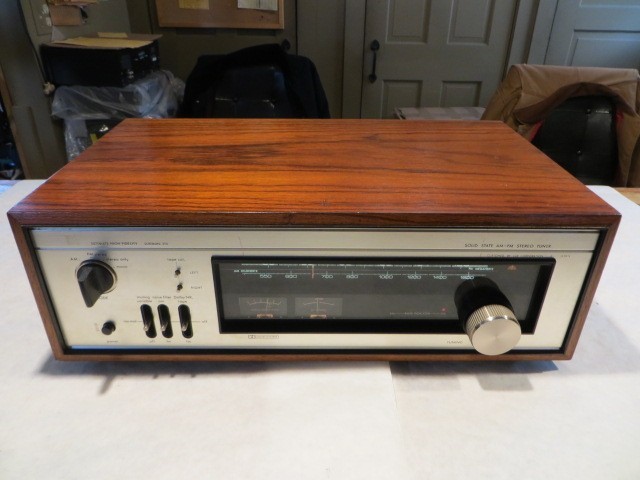
Unlike modern tuners buried in apps and streaming, the T-12 does one thing and does it exceptionally well: pull in FM broadcasts with remarkable sensitivity and lock onto them with mechanical confidence. It’s a book-shelf unit with a metal case, finished in a distinctive metallic dark brown with an aluminum front panel—classic late-’70s Japanese industrial design that ages gracefully. At 7.0 kg, it feels solid, deliberate, like it was made to sit on a rack and earn its keep for decades.
And for many, it still does. Owners describe it as a classic, very sensitive tuner that sounds great—no hyperbole, just honest performance. It’s not a powerhouse with flashy meters or digital readouts, but under the hood, it’s packed with thoughtful engineering that made a real difference in real-world listening.
Specifications
| Manufacturer | Luxman Corporation |
| Model | T-12 |
| Type | FM stereo tuner |
| Year of Introduction | October 1977 |
| Frequency range | 87.5 - 108 MHz |
| IF frequency | 10.7 MHz |
| Practical sensitivity (IHF) | 1.7 μV / 9.8 dBf |
| 50 dB quieting sensitivity | 3.2 μV / 15.2 dBf |
| IHF Usable Sensitivity | 10.7 dBf (1.8 µV) |
| Two signal selectivity | 90 dB (narrow, ± 400 kHz) |
| Alternate Channel Selectivity | 60 dB (narrow, ±300 kHz); 90 dB (narrow ±400 kHz); 30 dB (wide, ±400 kHz) |
| Adjacent Channel Selectivity | 12 dB (narrow ±200 kHz) |
| Signal-to-noise ratio | 80 dB |
| Frequency characteristic | 20 Hz to 17 kHz -0.5 dB (mono & stereo) |
| Distortion factor (Wide) | 0.05% (1 kHz, mono); 0.06% (1 kHz, stereo); 0.05% (100 Hz, mono); 0.07% (100 Hz, stereo); 0.07% (6 kHz, mono); 0.1% (6 kHz, stereo) |
| Capture ratio | wide: 0.8 dB; narrow: 2 dB |
| Spurious characteristic | 100 dB |
| IF interference rejection ratio | 100 dB |
| Image ratio | 100 dB |
| Amplitude modulation suppression | 62 dB |
| Stereo separation | 50 dB (wide, 1 kHz); 45 dB (wide, 100 Hz); 45 dB (wide, 6 kHz) |
| Output | 1 V (fixed) |
| Output impedance | 100 Ω (fixed) |
| Muting Threshold | 10 µV - 500 µV (variable) |
| Power supply | Alternating Current supply (AC) / 220 Volt |
| Power Consumption | 20 W |
| External dimensions | Width 438 x Height 78 x Depth 322 mm |
| Weight | 7.0 kg |
| Case material | Metal case |
| Shape | Book-shelf unit |
| Finish | Gehäuse Schwarzbraun metallic, Front Alu. |
| Semiconductors | 67 transistors, 45 diodes, 1 IC |
Key Features
Quartz Lock & Accutouch Tuning
The star of the show is Luxman’s quartz lock system paired with the “Accutouch” mechanism. This isn’t just a dial that turns—it’s a tactile experience. As you slowly rotate the tuning knob searching for a station, the control voltage from the quartz lock circuit detects the exact center of the signal and mechanically locks the knob in place for about two seconds. That subtle click and resistance tell you, without looking, that you’ve hit the sweet spot. It’s satisfying, precise, and eliminates the hunting and drifting common in analog tuners. Once locked, the station stays rock-solid.
Dynamic Kick System
One of those little luxuries that shows Luxman was thinking ahead: the Dynamic Kick System. If you power off the T-12 while a station is locked, it remembers that state. When you power it back on, it automatically returns to the locked condition—no need to re-tune. It’s a small thing, but in practice, it makes the tuner feel more alive, more responsive, like it’s paying attention.
Front-End & IF Design
The front end uses a 5-gang varicon dedicated to FM—this level of component specialization was not common at the time and contributed to excellent tracking and stability across the band. The IF stage features a 2-stage bandwidth switching function (Wide/Narrow), giving users control over selectivity. In wide mode, two sets of LC-type block filters deliver ultra-low-frequency distortion. In narrow mode, a hybrid setup—block filter plus ceramic filter—boosts selectivity to reject adjacent interference. A phase compensation circuit in the IF stage further refines performance, ensuring consistent behavior across frequencies.
Detection & Decoding
The T-12 uses a quad Racea detector circuit, a design known for its stability and low distortion. The detector circuit itself relies on “a new quadrature IC and a special detector transformer,” suggesting Luxman wasn’t just using off-the-shelf parts but optimizing the signal path. The multiplex circuit includes a pilot signal canceller, which improves the phase characteristics of the low-pass filter—critical for clean stereo imaging. And it uses a PLL MPX decoder, a more advanced method than simple ratio detectors, resulting in better stereo separation and reduced crosstalk.
Audio Stage & Signal Path
The audio stage employs a DC amplifier configuration, eliminating coupling capacitors from the signal path. This design choice reduces phase shift and avoids the sonic smearing that even high-quality caps can introduce, especially as they age. The result is a cleaner, more direct sound with better transient response. With a frequency response flat to 17 kHz and distortion figures as low as 0.05% at 1 kHz, the T-12 delivers a transparent window into the broadcast.
Collectibility & Value
The Luxman T-12 is seen as a classic by those who encounter it, and while not as widely collected as some of Luxman’s amplifiers, it holds a quiet reputation among tuner enthusiasts. Current market prices vary—listings have appeared around $225 to $400 USD, with higher prices in Europe (€489–575) and even CZK 17,999 in the Czech Republic, reflecting regional demand and condition. Owner’s manuals are occasionally available, which is a plus for restorers.
There’s no documented history of common failures or specific maintenance needs in the fact sheet, so long-term reliability appears to be a strength. The use of solid-state components—67 transistors, 45 diodes, and one IC—means no tubes to replace, but like any 1970s electronics, capacitors and mechanical switches may need attention after decades of use. Still, the build quality and thoughtful design suggest that a well-cared-for T-12 should continue performing for years.
It’s not just a tuner—it’s a statement. As one source puts it, the T-12 “represents the finest standards of design and craftsmanship, but the proof is in your handling and listening.” That says it all: this is gear that earns respect not through specs on paper, but through the experience of using it.
eBay Listings


As an eBay Partner, we earn from qualifying purchases. This helps support our independent vintage technology research.
Related Models
- Luxman L-530 (1975)
- Luxman R-404 (1975)
- Luxman RV-371 (1975)
- Luxman SQ-38U (1975)
- Luxman T-14 (1972)
- Luxman T-530 (1975)
- Luxman TX-101 (1975)
- Denon DRA-800 (1985)
- Denon PMA-350Z (1980)
- Denon POA-1500 (1979)