Luxman T-111 (1988–1990)
That warm, rich FM stereo sound you remember from late-night listening? This is where it came from.
Overview
The Luxman T-111 isn’t flashy, but it’s the kind of tuner that makes you forget you’re listening to electronics. Built between 1988 and 1990, this AM/FM stereo tuner represents the quiet confidence of Japanese high-fidelity engineering at the tail end of the analog era. It wasn’t trying to wow you with digital displays or synthesized tuning—instead, it focused on doing one thing exceptionally well: pulling in FM and AM signals with clarity, stability, and a smoothness that still holds up today.
Priced at approximately 498 Deutsche Mark in 1990, the T-111 was positioned as a serious component for discerning listeners, not a budget add-on. Made in Japan and finished in black, it carries the understated elegance Luxman is known for—clean lines, a functional layout, and a build quality that suggests it was meant to last. While it lacks the glowing VU meters or chrome accents of some contemporaries, its presence is undeniable once you power it up and hear how quietly and cleanly it delivers the broadcast signal.
This is a tuner of its time—fully analog, with an illuminated dial that, according to one owner, “loses a lot of its splendor” when the backlight fails. And yes, that dial matters. In a dark room, with the soft glow highlighting the frequency scale, the T-111 becomes more than a piece of gear—it becomes part of the listening ritual.
Specifications
| Manufacturer | Luxman |
| Model | T-111 |
| Type | AM/FM Stereo Tuner |
| Production Years | 1988–1990 |
| AM Frequency Range | 530 - 1620 kHz |
| FM Frequency Range | 87.5 - 108 MHz |
| FM Usable Sensitivity (IHF) Mono | 10.8 dBf |
| FM Sensitivity 50 dB Quieting Mono | 19.0 dBf |
| FM Sensitivity 50 dB Quieting Stereo | 38.0 dBf |
| FM Signal-to-Noise Ratio (IHF A) Mono | 75 dB |
| FM Signal-to-Noise Ratio (IHF A) Stereo | 70 dB |
| FM Total Harmonic Distortion (1 kHz) Mono | 0.15% |
| FM Total Harmonic Distortion (1 kHz) Stereo | 0.20% |
| FM Stereo Separation | 50 dB |
| Tuning Bands | FM, AM |
| Tuning Scale | Analogue |
| FM Sensitivity | 1.9 µV |
| AM Sensitivity | 220 µV |
| AM Signal to Noise Ratio | 50 dB |
| FM Selectivity | 75 dB |
| FM Frequency Response | 30 Hz to 15 kHz |
| FM Output | 700 mV |
| AM Distortion | 0.5% |
| Power Supply | 110 - 120, 220 - 240 V 50/60 Hz |
| Power Consumption | ~ 10 W |
| Made in | Japan |
| Color | Black |
| Dimensions (W x H x D) | 438 x 85 x 312 mm |
| Weight | 5.1 lbs |
Key Features
Computer-Analyzed Tuning
One of the T-111’s standout features is its “Computer-Analyzed Tuning” system, which continuously samples the incoming FM signal. This wasn’t just marketing fluff—it meant the tuner could dynamically assess signal quality and adjust accordingly, helping maintain a stable lock on stations even in fringe reception areas. In an era when many tuners would crackle or drift the moment you moved the antenna, the T-111 stayed put, quietly optimizing the connection.
Automatic High-Blend Switching
Closely tied to the above is its ability to automatically switch the audio output to “high-blend” mode when the FM signal drops below a usable level for noise-free stereo. This wasn’t a sudden drop to mono, but a smooth transition that preserved intelligibility while minimizing the harshness of stereo noise. For late-night listening or weak stations, this made a real difference—no sudden bursts of static, just a cleaner, more listenable signal.
Timer-Controlled Recording
The T-111 was designed with recording in mind. When paired with an external timer, it could automatically select up to five stations or programs and record them sequentially. This was a thoughtful touch for users who wanted to capture news broadcasts, classical programs, or favorite shows without babysitting the equipment. It reflects a time when tape recording was still a primary way to archive radio content, and manufacturers built in real functionality to support it.
The Illuminated Dial Quandary
A post on Audiovintage forum puts it plainly: “Obviously without the illuminated dial, it loses a lot of its splendor.” And they’re not wrong. The analogue tuning scale, backlit softly, was part of the experience—watching the needle glide across the frequency band, seeing the station names come into view. If the bulb has failed (a common issue over time), the tuner still works perfectly, but the magic dims a little. Replacement bulbs exist, but tracking one down and replacing it without damaging the dial requires patience.
Collectibility & Value
The Luxman T-111 trades in the €20 to €149 range on the secondary market, with listings on HifiShark showing a used unit at €65 as recently as January 2026. That’s a bargain for a made-in-Japan tuner of this quality, especially one with features like computer-analyzed tuning and automatic blending. Condition plays a big role—units described as “fully functional,” “great condition,” or “vintage HiFi classic” tend to sit at the higher end of the spectrum.
Owners report satisfaction: one eBay buyer noted their unit arrived “clean, well taken care of” and said, “I am very happy with my purchase.” That kind of feedback suggests the T-111, when properly maintained, still delivers a meaningful listening experience.
There’s also a niche market for original documentation. An authentic service manual sells for $24.97 USD, though collectors should expect wear and possibly previous owner’s notes inside. For restorers or tinkerers, that manual is gold—it includes a block diagram, labeled in four languages (“Block diagramme blockschaltbild diagramme de bloc diagrama sinoptico”), a rare touch that underscores Luxman’s international reach.
eBay Listings
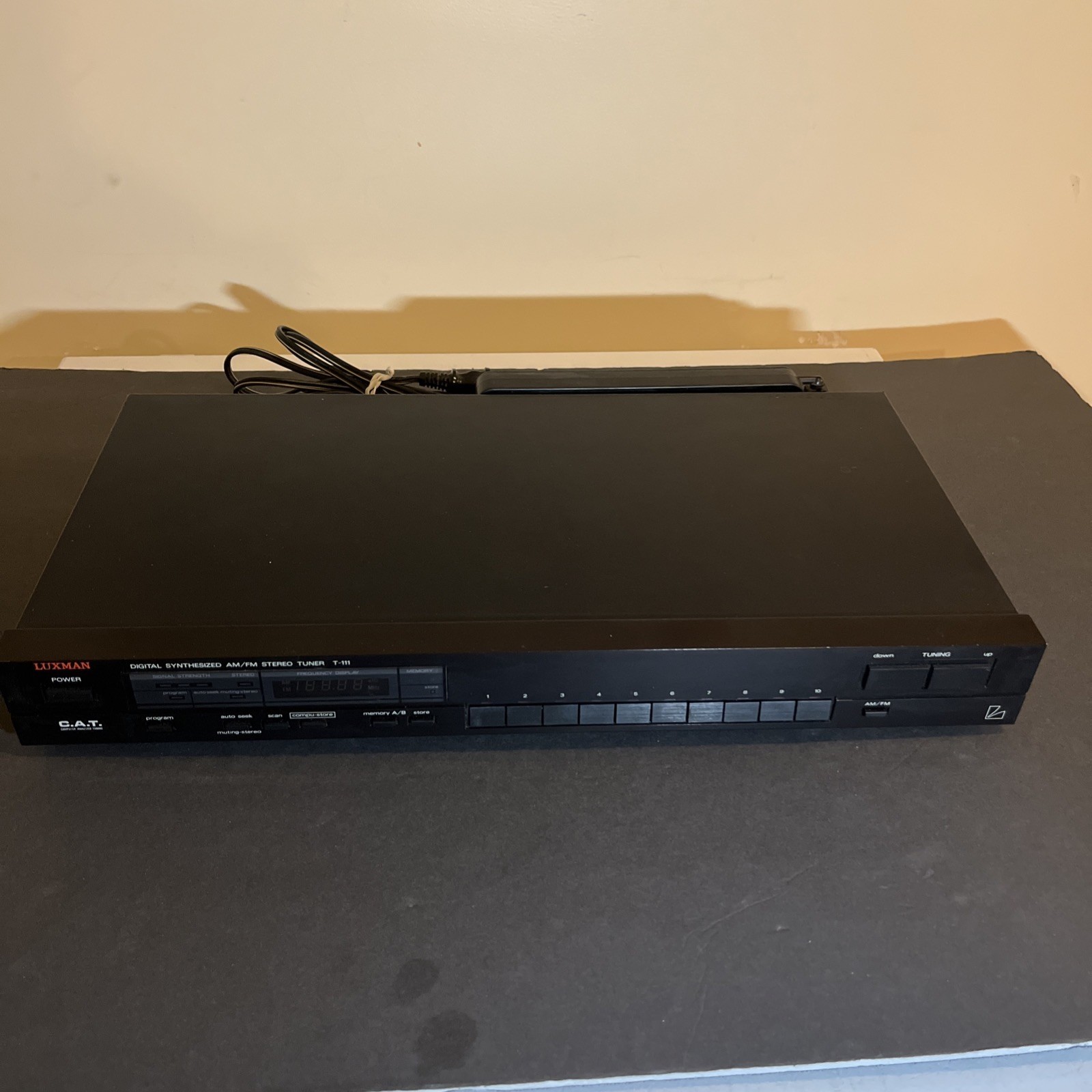

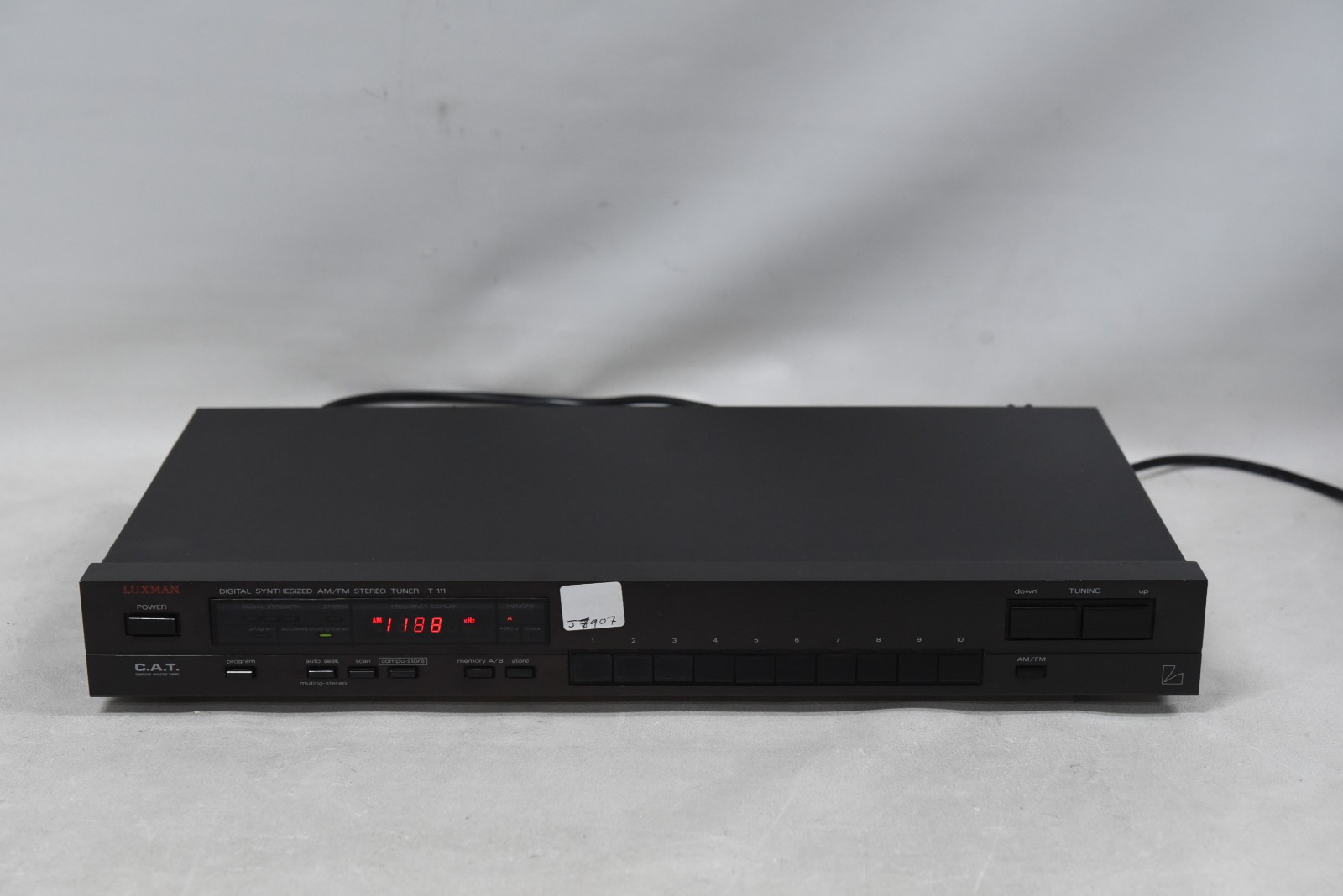

As an eBay Partner, we earn from qualifying purchases. This helps support our independent vintage technology research.
Related Models
- Luxman L-530 (1975)
- Luxman R-404 (1975)
- Luxman RV-371 (1975)
- Luxman SQ-38U (1975)
- Luxman T-14 (1972)
- Luxman T-530 (1975)
- Luxman TX-101 (1975)
- Denon DRA-800 (1985)
- Denon PMA-350Z (1980)
- Denon POA-1500 (1979)