Luxman T-100 (1986)
A no-frills digital tuner from the cable TV era that punches above its weight—if you can get it to behave
Overview
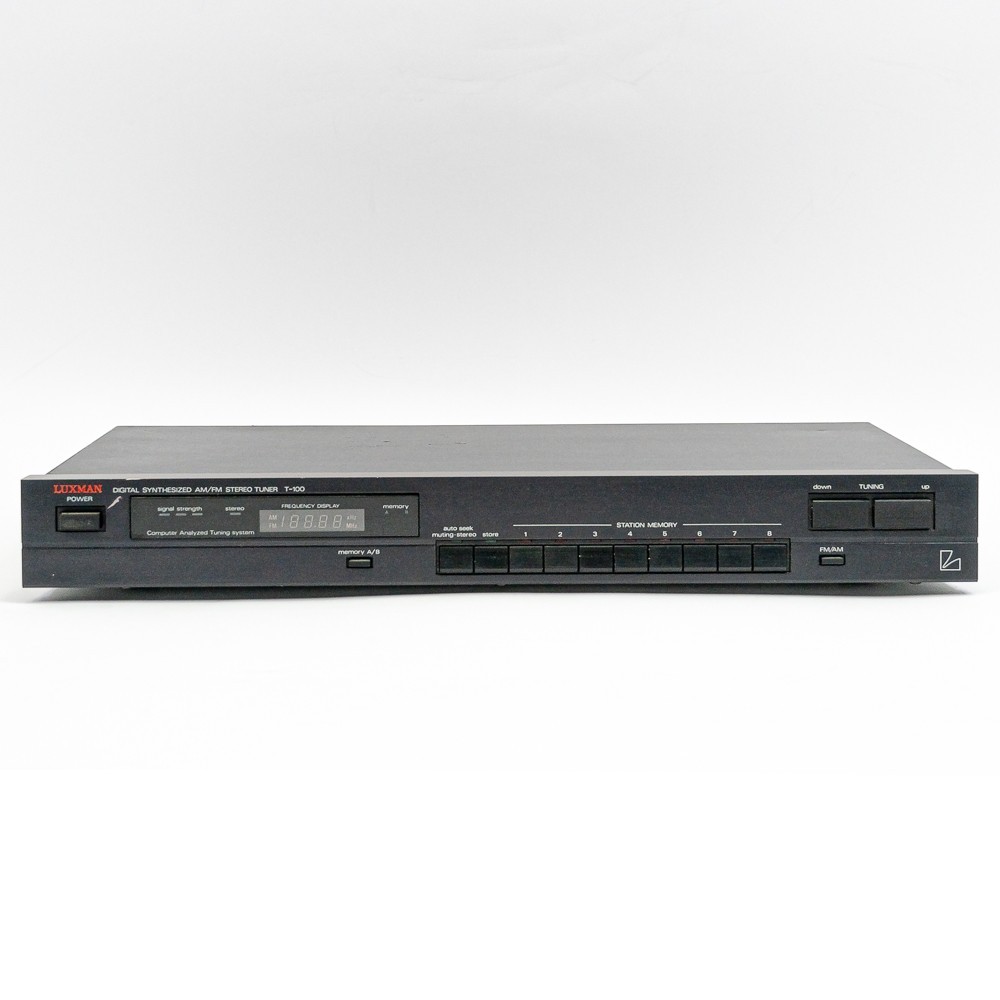
You don’t buy a Luxman T-100 because it’s rare, or hand-wired, or dripping with audiophile mystique. You buy it because it’s a solid, no-nonsense FM/AM tuner from the mid-80s that actually delivers clean reception and decent sound—assuming the solder joints haven’t cracked and the power supply hasn’t cooked itself. Introduced in 1986 and priced at $250, the T-100 wasn’t a flagship; it was a practical solution for people who wanted reliable stereo tuning without the fuss of roof antennas. And for that job, it was built to plug into the reality of the time: many users were pulling FM signals off their cable TV feed, and the T-100 was designed to handle that with composure.
It’s not glamorous. It’s not even particularly special under the hood. But it’s a product of its moment—digital tuning becoming standard, synthesis replacing analog dials, and Japanese brands like Luxman offering competent, affordable gear that didn’t pretend to be something it wasn’t. The T-100L variant may add LW (long wave) support, but otherwise, this is a tuner that does what it says, nothing more. Owners report mixed experiences: some call the sound and reception “ok,” while a seller at The Music Room boldly claims “outstanding” performance. That gap in perception? It probably comes down to whether the unit has been gone over with a soldering iron lately.
Specifications
| Type | FM stereo tuner |
| Type | Mono/Stereo Tuner |
| Supported Modes | AM, FM |
| Band | AM/FM |
| Tuning Bands | FM, MW |
| Tuning range | 87.5 to 108 MHz (FM) |
| Tuning Scale | Digital |
| THD | 0.08% (1 kHz) |
| Signal-to-Noise Ratio | 80 dB |
| Capture ratio | 1.5 dB |
| Alternate Channel Selectivity | 70 dB |
| Image rejection | 80 dB |
| IF rejection | 90 dB |
| Spurious response rejection | 90 dB |
| AM suppression | 60 dB |
| Stereo separation | 40 dB (1 kHz) |
| Muting threshold | 20 dBf |
| Output level | 650 mV |
| Audio Outputs | Stereo L/R RCA |
| Number of Outputs | 2 |
| Color | Black |
| Dimensions | 440 x 110 x 320 mm (width x height x depth) |
| Weight | 6.5 kg |
Key Features
Digital Synthesized Tuning
The T-100 uses digital synthesis for precise station locking, a standard feature by 1986 but still a step up from analog needle dials. The digital tuning scale makes station recall straightforward, and the 0.08% THD at 1 kHz suggests a clean signal path when reception is strong.
Designed for Cable FM
One of its underrated traits: the T-100 was built with cable TV-fed FM signals in mind. In an era when many urban listeners didn’t have roof antennas, this tuner could pull usable stereo from the cable line without excessive noise or crosstalk. That practicality made it a sensible choice for apartment dwellers or those in weak-signal areas.
Build Quality: Mixed Bag
Here’s where the story gets complicated. The tuner uses a PCB sourced from Alpine, described by one technician as a “cheap board” with a history of poor factory soldering due to misaligned machinery. That means intermittent connections are a known issue, not just a symptom of age. Owners are advised to inspect “highlighted sections” of the board for cold joints. And while the 78M12 voltage regulator in the power supply does its job, it runs hot—so checking its heatsink and applying fresh thermal compound isn’t optional maintenance, it’s preventative care.
Regional Voltage Issues
The T-100 cannot be internally switched to 240V, which means European users relying on step-down transformers may eventually see those transformers fail. One owner confirmed their transformer burned out over time—though replacement with a 12V unit is reportedly straightforward.
Collectibility & Value
The Luxman T-100 isn’t a collector’s darling, and that’s reflected in the prices: recent listings show units selling for as little as $40 on eBay, €25 on Marktplaats, and up to $50 on Canuck Audio Mart. A Reverb listing once asked $49.99, and a higher-end seller priced one at €55. There’s no premium for nostalgia here—this is functional gear trading at scrap-plus value.
But that low price comes with strings attached. Before you plug one in, assume the power supply capacitors need checking. Assume the PCB has sketchy solder joints. Assume the transformer might not survive long-term if you’re on 230V mains. It’s not a “plug and play” vintage piece; it’s a project unless recently serviced. That said, if you’re willing to go under the hood, the T-100 offers solid specs for the money—especially that 90 dB IF and spurious rejection, which means it can hold its own in electrically noisy environments.
eBay Listings


As an eBay Partner, we earn from qualifying purchases. This helps support our independent vintage technology research.
Related Models
- Luxman L-530 (1975)
- Luxman R-404 (1975)
- Luxman RV-371 (1975)
- Luxman SQ-38U (1975)
- Luxman T-14 (1972)
- Luxman T-530 (1975)
- Luxman TX-101 (1975)
- Denon DRA-800 (1985)
- Denon PMA-350Z (1980)
- Denon POA-1500 (1979)