Luxman T-03 (1987–1993)
That rare tuner that doesn’t just find stations—it reveals them, with a clarity that still stuns decades later.
Overview
The Luxman T-03 Digital Synthesized AM/FM Stereo Tuner isn’t just another box from the late '80s—it’s a precision instrument disguised as home audio gear. Built between 1987 and 1993, this bookshelf-sized tuner represents the peak of analog radio reception technology before digital broadcasting changed the game. It was designed for listeners who didn’t just want to hear the radio, but to hear *through* it—down to the quietest hiss, the faintest stereo separation, the cleanest capture of a distant signal.
Unlike many tuners of its era that prioritized flashy features over fidelity, the T-03 was engineered for performance. It’s a digital synthesized tuner, meaning it uses a phase-locked loop (PLL) system to lock onto frequencies with exceptional accuracy and stability. That precision, combined with a host of advanced circuitry choices, earned it a reputation that’s held up over time: the T-117 variant, functionally identical and sold in the US, ranked 16th out of 84 tuners tested on fmtunerinfo.com—a testament to its real-world performance.
Luxman didn’t cut corners here. The T-03 covers three wave bands: Broadcast (AM/MW), Long Wave (LW), and FM, making it a global traveler in terms of reception. It was built for serious listeners, whether they were chasing distant AM stations at night or pulling in weak FM signals with surgical clarity. And while it may not have had the marketing muscle of some European contemporaries, its build, spec sheet, and user praise place it firmly in the high-end category.
Specifications
| Manufacturer | Luxman (Luxman Corporation) |
| Model | T-03 |
| Type | Digital synthesized AM/FM stereo tuner |
| Production years | 1987–1993 |
| Dimensions (W×H×D) | 453 × 62 × 323 mm |
| Net weight | 3.6 kg |
| Power Consumption | 15 watts |
| Number of semiconductors | 57 |
| Main principle | PLL, Phase-locked loop |
| ZF/IF | 450/10700 kHz |
| Wave bands | Broadcast (AM/MW), Long Wave (LW), FM |
| Power type and voltage | Alternating Current supply (AC) / 120; 220; 240 Volt |
| Remote Control | Wired system remote capability (via remote BUS) |
| FM Tuner Section Frequency Range | 87.5 MHz – 108 MHz (87.9 MHz – 107.9 MHz for Canadian/UZ version) |
| FM Usable Sensivity (75Ω) | 8.8 dBf |
| FM 50dB Quieting Sensitivity (75Ω) | Mono 19 dBf, Stereo 38 dBf |
| FM Distortion at 65 dBf | Mono: 100Hz/1kHz: 0.04%/0.04%; 50Hz-10kHz: 0.09%. Stereo: 100Hz/1kHz: 0.05%/0.05%; 50Hz-10kHz: 0.1% |
| FM S/N Ratio at 65 dBf | Mono 88 dB, Stereo 78 dB |
| FM Frequency Response | 20 Hz - 15 kHz ±1.0 dB |
| FM Capture Ratio at 65 dBf (WIDE) | 1.0 dB |
| FM Alternate Channel Selectivity (75 kHz Dev.) | Wide/Narrow: 45 dB/80 dB (±400 kHz) |
| FM Alternate Channel Selectivity (40 kHz Dev.) | Wide/Narrow: 38 dB/70 dB (±300 kHz) |
| FM Adjacent Channel Selectivity (Narrow) | 20 dB (±200 kHz) |
| FM Image Response Ratio | 80 dB |
| FM IF Response Ratio | 110 dB |
| FM Spurious Response Ratio | 105 dB |
| FM AM Suppression Ratio | 70 dB |
| FM Subcarrier Suppression Ratio | 60 dB |
| FM Stereo Separation | 48 dB (100 Hz) / 58 dB (1 kHz) |
| FM Output Level/Impedance | 700 mV / 2 kΩ |
| MW (AM) Tuner Section Frequency Range | 522 kHz - 1,611 kHz (530 kHz - 1,620 kHz for UZ version) |
| MW (AM) Usable Sensitivity | 58 dB/m |
| MW (AM) Distortion | 0.5% |
| MW (AM) S/N Ratio | 50 dB |
| MW (AM) Output Level/Impedance | 210 mV / 2 kΩ |
| LW Tuner Section Frequency Range | 153 kHz - 281 kHz |
| LW Usable Sensitivity | 68 dB/m |
| LW Distortion | 0.5% |
| LW S/N Ratio | 50 dB |
| LW Output Level/Impedance | 210 mV / 2 kΩ |
| Versions/Power Requirements | SD, EK Models / 220-240V AC 50Hz; UZ Model / 120V AC 60Hz |
Key Features
Champagne Finish and Precision Build
Housed in a champagne-colored metal case with a brushed aluminum faceplate, the T-03 looks like it belongs on a lab bench as much as a stereo rack. It’s a bookshelf unit—compact, but dense with engineering. The front panel features a clear digital frequency display with a signal strength indicator, giving immediate feedback on reception quality. Every control feels deliberate, every switch solidly built.
Optimum Twin Detector System
One of the T-03’s standout features is its "Optimum Twin Detector" system for FM reception. It uses two detection methods: pulse counting for strong signals and PLL for weak ones. This hybrid approach ensures accurate demodulation across a wide range of signal strengths, reducing distortion and improving stereo stability when signals are marginal.
Low Noise Front End
The tuner employs a low-noise dual gate MOS-FET varactor front end, a design choice that minimizes interference at the earliest stage of signal processing. This contributes directly to its excellent sensitivity and quiet background—critical for pulling in weak stations without amplifying noise.
24-Station Memory and Fine Tuning
With 24 random-access AM/FM station memories, the T-03 was ahead of many contemporaries in usability. You could store your favorite stations and recall them instantly. The Memory/Normal switch on the back toggles between saved presets and manual tuning. For fine control, a 25–200 kHz tuning increment switch allows precise adjustments, including 25 kHz steps for cable radio compatibility.
Computer Analyzed Tuning (C.A.T.)
Luxman’s Computer Analyzed Tuning (C.A.T.) system wasn’t just marketing fluff—it was a real engineering feature that improved calibration accuracy. Combined with record calibration and an unattended program recording timer, it made the T-03 a practical tool for taping broadcasts, a common use case in the pre-digital era.
IF Count Tuning
The IF Count Tuning system measures the intermediate frequency to confirm tuning accuracy down to 10 kHz. This ensures the displayed frequency matches the actual received signal, reducing drift and misalignment—especially useful for weak or adjacent-channel stations.
Back Panel Connectivity
The rear panel is packed with thoughtful options: an adjustable clip-on AM loop antenna, an input jack for it, a terminal for an external AM antenna, and a 75 ohm 'F' connector for FM. RCA phono line outputs feed your preamp or receiver, while serial remote in/out jacks enable wired remote control via Luxman’s remote BUS system.
Historical Context
The Luxman T-03 was introduced in the late 1980s, around 1987, during a period when digital synthesis was revolutionizing tuner design. It replaced older analog tuning systems with microprocessor-controlled precision, offering greater stability and easier station recall. The T-03 was part of a family: the T-117 was its US-market counterpart, typically housed in a black case. The "L" suffix—used on models like the T-03L and T-117L—denoted the inclusion of Long Wave (LW) reception, a feature valued in Europe and parts of Asia. The champagne finish is associated with the T-03(L) models, while the T-117 variants were black.
Collectibility & Value
The Luxman T-03 has developed a quiet but steady following among vintage audio enthusiasts. Current market prices, based on expired eBay listings from 2014 to 2025, typically range from €70 to €250, with most units selling between €100 and €150. Condition plays a big role—cosmetic issues like scratches are common, but the real concern lies under the hood.
A known issue, mentioned in a repair thread on diyAudio, involves two capacitors: C001 in the main power supply and C007, which provides 5V backup for memory. These can degrade over time, potentially leading to power instability or loss of station presets. Replacing them is a common restoration step and can significantly improve reliability.
Owners consistently praise the T-03’s sound quality, with one user exclaiming, "for sound…man does it make FM sound fantastic." It’s frequently described in listings as a "reference tuner," "high-end," and "top-notch," with excellent reception and audio fidelity. While not as widely collected as some tube gear or power amps, the T-03 is respected for what it does—and does exceptionally well.
eBay Listings
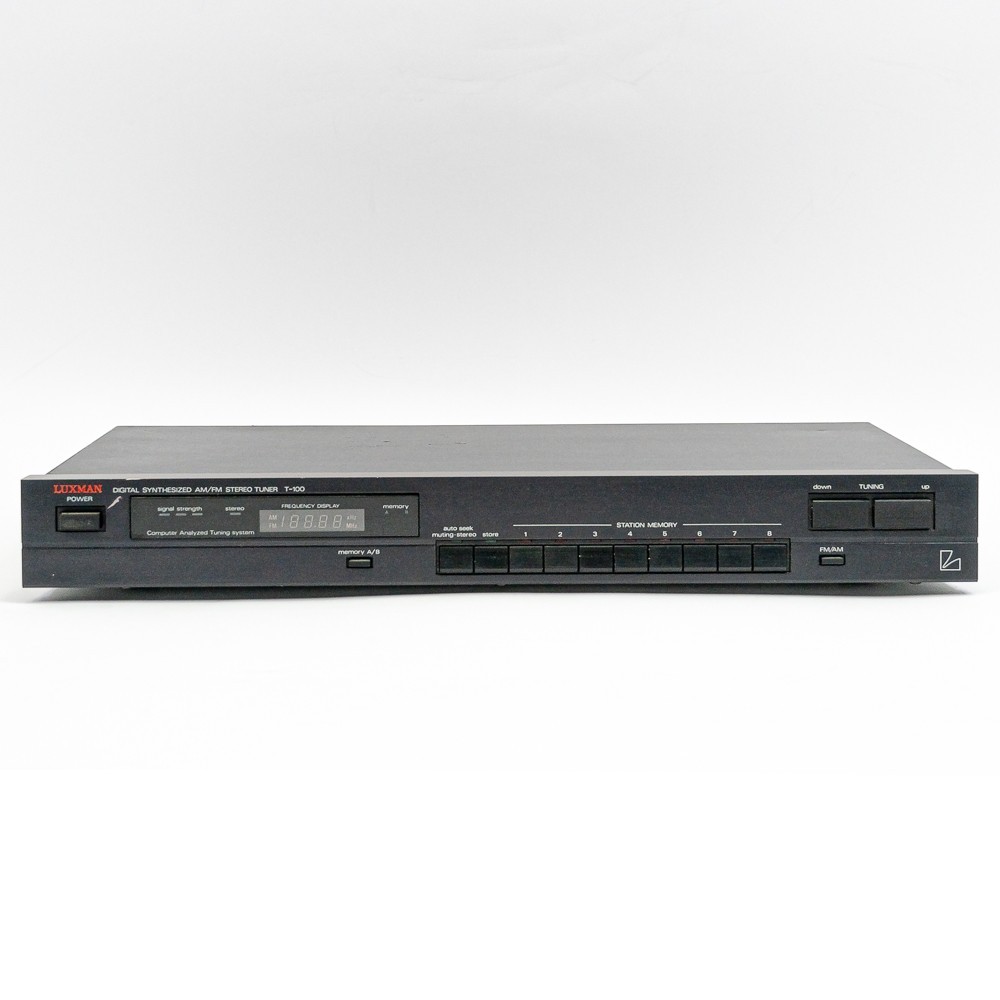

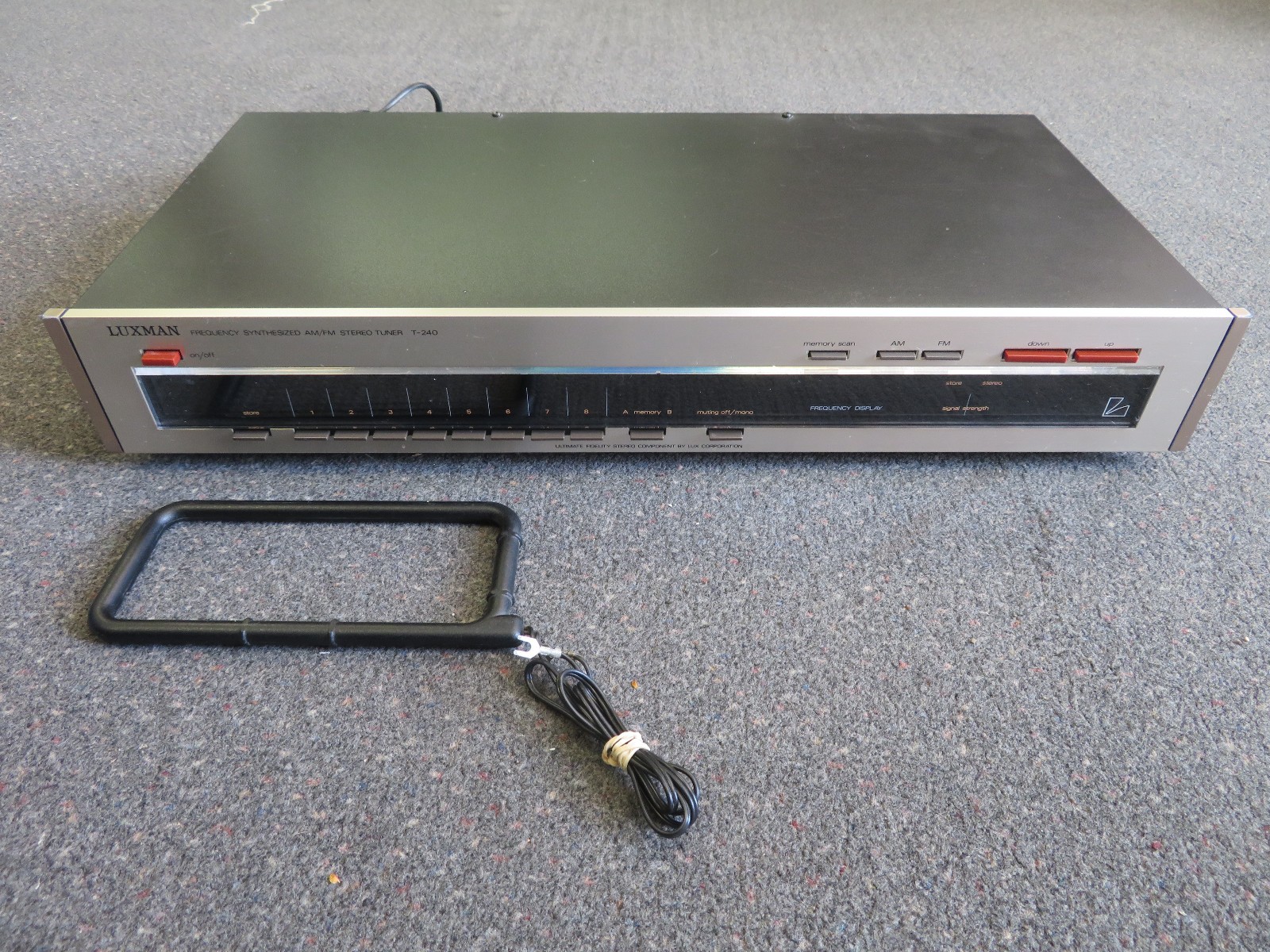

As an eBay Partner, we earn from qualifying purchases. This helps support our independent vintage technology research.
Related Models
- Luxman L-530 (1975)
- Luxman R-404 (1975)
- Luxman RV-371 (1975)
- Luxman SQ-38U (1975)
- Luxman T-14 (1972)
- Luxman T-530 (1975)
- Luxman TX-101 (1975)
- Denon DRA-800 (1985)
- Denon PMA-350Z (1980)
- Denon POA-1500 (1979)