Luxman RX-103 (1982)
It looks like a spaceship landed on your rack—and it just might be the most audacious receiver Luxman ever built.
Overview
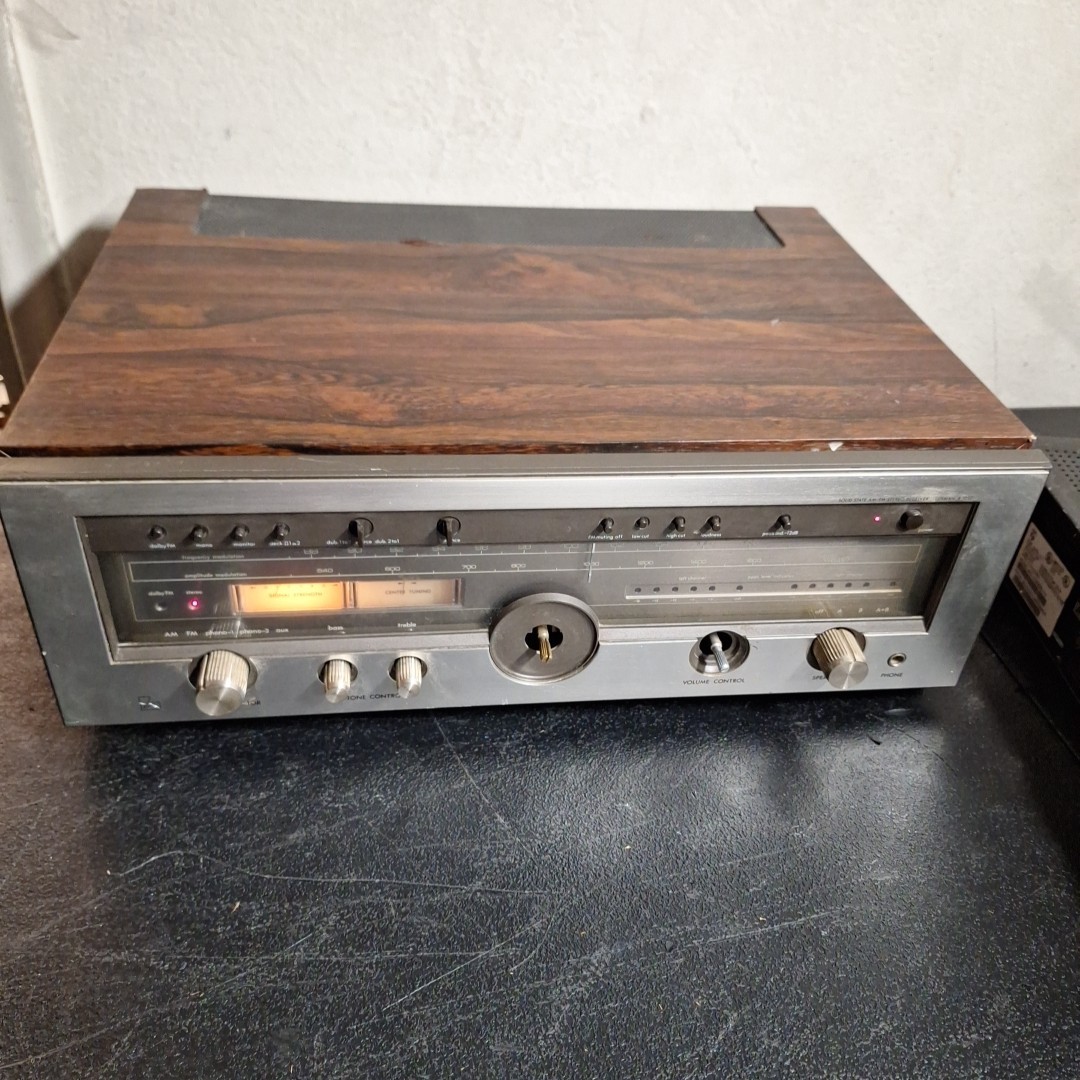
The Luxman RX-103 isn’t just another receiver from the early '80s—it’s a statement. Introduced in 1982 as the Luxman RX-103 Digital Synthesized Receiver, this was a machine designed to turn heads and challenge expectations. Built exclusively for the American market and sold only through high-end audio salons, it marked a radical departure from Luxman’s traditionally refined, understated aesthetic. This wasn’t your father’s Japanese receiver. With glowing lucite buttons, a motorized front panel, and digital tuning displays, the RX-103 embraced the flashy, tech-forward "yuppy" era with both hands.
And yet, beneath the theatrical exterior lived serious engineering. Priced at about $1000 at launch—equivalent to a high-end system at the time—it packed 90 watts per channel, a sophisticated Duo-Beta amplifier circuit, and a host of digital conveniences that were cutting-edge for 1982. It was Luxman’s first foray into digital control systems, and while traditionalists raised eyebrows at its looks, owners quickly discovered that the sound was anything but compromised. This was still Luxman: meticulous build quality, low distortion, and a dynamic, engaging presentation. But now, it came wrapped in a futuristic package that screamed "the future is here."
Specifications
| Manufacturer | Luxman Corporation of Japan / Luxman |
| Model | RX-103 |
| Type | receiver |
| Year of Release | 1982 |
| Power output | 90 watts per channel (20 Hz - 20 kHz, 8 ohms) |
| Total harmonic distortion | 0.018% |
| Dynamic headroom | 1.7dB |
| Short-term peak power | 133 watts per channel |
| Can handle speaker impedance down to | 2 ohms |
| FM tuner memory | stores up to 24 preset stations (8 AM and 16 FM) |
| IMD | < 0.018% |
| Frequency response | 10 Hz - 70 kHz (± 1 dB) |
| Inputs | Phono MM (2.5 mV / 47 kOhm), Phono MC (125µV), Aux, Monitor (150 mV / 30 kOhm) |
| Max. phono input | > 200 mV (1 kHz) |
| S/N ratio | > 80 dB (Phono, 5 mV input), > 102 dB (line) |
| Bass control | +7 dB ... -10 dB at 100 Hz |
| Treble control | +7 dB ... -10 dB at 10 kHz |
| Subsonic filter | 6 dB / octave below 30 Hz |
| High filter | 6 dB / octave above 7 kHz |
| Loudness switch | +8 dB / 100 Hz +7.5 dB / 10 kHz |
| Tuner Sensitivity | 0.9µV (75 Ohm) |
| Tuner S/N ratio | > 78 dB (at 65dBf) |
| Tuner THD | < 0.06% (mono, 1 kHz), < 0.08% (stereo, 1 kHz) |
| Tuner Alt. frequency suppression | > 70 dB |
| Tuner Pilot suppression | > 60 dB |
| Tuner Selectivity | > 80 dB (± 400 kHz) |
| Dimensions | 45.3 x 45.5 x 14.7 cm |
| Weight | 15.3 kg |
Key Features
The ServoFace: Theater First, Function Second
The most jaw-dropping feature of the RX-103 is its ServoFace—a motor-driven silver panel that glides forward to cover the volume, tone, and input knobs when the unit is powered off, then retracts dramatically when turned on. It’s a gimmick, yes, but a beautifully executed one. Described as "expensive, sometimes mechanically problematic and really not a necessity in the end," the ServoFace was pure theater. But it also served a purpose: protecting the controls and giving the unit a sleek, minimalist profile when idle. When it works, it’s mesmerizing. When it doesn’t—well, that’s where the fun begins for tinkerers.
Digital Control & Memory
The RX-103 was Luxman’s first receiver to feature digital tuning and memory presets, storing up to 24 stations (16 FM, 8 AM) using a CMOS IC. The front panel includes an LCD display for frequency readout and fluorescent wattage meters—futuristic touches in 1982. The system also includes Computer Analyzed Tuning (C.A.T.), which automatically adjusts the IF bandwidth, antenna attenuator, high-blend circuit, and an anti-"birdie" filter to optimize reception. It’s a fully synthesized tuner, offering stability and precision that analog dials of the era couldn’t match.
Wireless Remote Control
Luxman included the RC-103 infrared remote, a rare luxury at the time. It controls power, volume, muting, input selection, FM A/B band switching, tape monitoring, and preset scanning. Even more impressively, it can control a Luxman PX-101 turntable and KX-101 or KX-102 cassette decks when connected via special rear-panel sockets. This level of system integration was ahead of its time, foreshadowing the smart home ecosystems of decades later.
Duo-Beta Amplifier Circuit
Under the hood, the RX-103 uses Luxman’s Duo-Beta amplifier design, which employs minimal overall loop feedback in the audio range but adds a second subsonic feedback loop. This reduces output impedance at near-DC frequencies and helps suppress intermodulation distortion. The result? A receiver that delivers 90 watts per channel into 8 ohms (and handles loads down to 2 ohms), with a dynamic punch and clarity that reviewers describe as “high-end.” It’s not just powerful—it’s stable, composed, and capable of driving demanding speakers with authority.
Input Flexibility and Build
The RX-103 includes both MM and MC phono inputs, a rarity even among high-end receivers. It also features a monitor input, preamp output, and main amp input, allowing for system expansion. The rear panel has two sets of speaker terminals, four AC outlets, and dedicated jacks for remote control cabling. The chassis is robust, with wooden side panels adding both visual warmth and structural rigidity. Inside, the layout is dense—“lots of hectic cabling back and forth”—but typical of the era’s complex, feature-laden designs.
Historical Context
The RX-103 was part of an export-only series designed specifically for the American market, a bold move by Luxman USA to capture the attention of a new generation of audiophiles. It represented a clear shift from Luxman’s traditionally “sculptured” and sedate designs toward something more modern, flashy, and aligned with the “yuppy” aesthetic of the early 1980s. The RX line was a hit among those who appreciated its panache, though some longtime Luxman fans were skeptical, fearing that the flashy looks signaled a decline in sonic integrity.
It’s probable that the entire RX/CX/TX/GX/KX series was custom-commissioned by Luxman USA from Alpine, rather than being developed in-house by Luxman Japan. This explains the RX-103’s unique styling and the use of shared chassis across models like the TX-101 tuner and GX-101 equalizer. The series was designed to accommodate the “New Wave” of music—emphasizing punch, attack, and rhythmic drive—while still retaining Luxman’s core engineering heritage. As one reviewer put it, “considerable heritage remained in its Duo-Beta genes. Panache did not compromise sound or build quality.”
Collectibility & Value
The Luxman RX-103 is a rare and polarizing collectible. Its current market value is modest: a recent listing on Canuck Audio Mart asked $100.00, reflecting both its condition-dependent functionality and the challenges of ownership. The most common failure point is the ServoFace—many units suffer from failed motors or worn belts, and repairing it is “not a job for the fainthearted.” However, even if the ServoFace is stuck in the extended position, the controls can still be used with “mild difficulty,” and the receiver remains fully functional.
Other reported issues include phono stage failures, bad solder joints, and corrosion-related connection problems. Despite its rarity, replacement parts like knobs and buttons are often available on eBay, which helps keep restorations feasible.
eBay Listings


As an eBay Partner, we earn from qualifying purchases. This helps support our independent vintage technology research.
Related Models
- Luxman L-530 (1975)
- Luxman R-404 (1975)
- Luxman RV-371 (1975)
- Luxman SQ-38U (1975)
- Luxman T-14 (1972)
- Luxman T-530 (1975)
- Luxman TX-101 (1975)
- Denon DRA-800 (1985)
- Denon PMA-350Z (1980)
- Denon POA-1500 (1979)