Luxman PX-99 (1982)
When the needle drops and the motor locks dead on speed, you forget the machine even exists—this is one of those turntables.
Overview
The Luxman PX-99 isn’t flashy, but it doesn’t need to be. Introduced in 1982, this semi-automatic direct-drive turntable was built for people who wanted precision without fuss. At a retail price of $230, it wasn’t a budget deck, but it wasn’t trying to compete with the high-end giants either. Instead, it carved out a quiet reputation as a solid, no-nonsense performer—engineered with care, finished with restraint, and built to hold its own in a serious system.
Luxman didn’t overcomplicate things here. The PX-99 uses a quartz-locked direct drive motor, which means no belts to stretch or slip, and no mechanical noise creeping into your records. That kind of stability wasn’t universal in 1982, especially at this price point. You could fire it up, cue the record, and trust that it would spin exactly at 33⅓ or 45 RPM without drifting. For listeners who hated speed wobble or motor hum, that was a quiet victory.
It’s the kind of turntable that doesn’t draw attention to itself. No glowing meters, no exotic plinth materials, no wild industrial design. Just a clean face, a solid feel, and a design that prioritizes function. And yet, owners note that it delivers a sound that’s smooth, detailed, and remarkably free of rumble—so much so that one source flatly states, “Rumble is inaudible.” That’s not something you can say about every direct-drive deck from this era.
Marketed as a “Classic Model” in the Luxman lineup, the PX-99 sits in a tier below the fully automatic PX-100 and PD-291, which shared its quartz-locked direct-drive architecture but added full auto-start and stop functionality. This makes the PX-99 the semi-automatic sibling—ideal for those who wanted the precision of quartz speed control and the reliability of direct drive but preferred to cue the record themselves. It was positioned as a well-built entry-level turntable, often compared by users to contemporaries like the Sansui SR-1050 and Marantz 6150, models that occupied a similar performance and price bracket.
Specifications
| Manufacturer | Luxman |
| Model | PX-99 |
| Year Introduced | 1982 |
| Type | Semi-Automatic Direct-Drive Turntable |
| Drive Type | Direct Drive |
| Motor Type | Quartz Direct Drive |
| Speed Settings | 33, 45 |
| Tonearm Type | Statically Balanced |
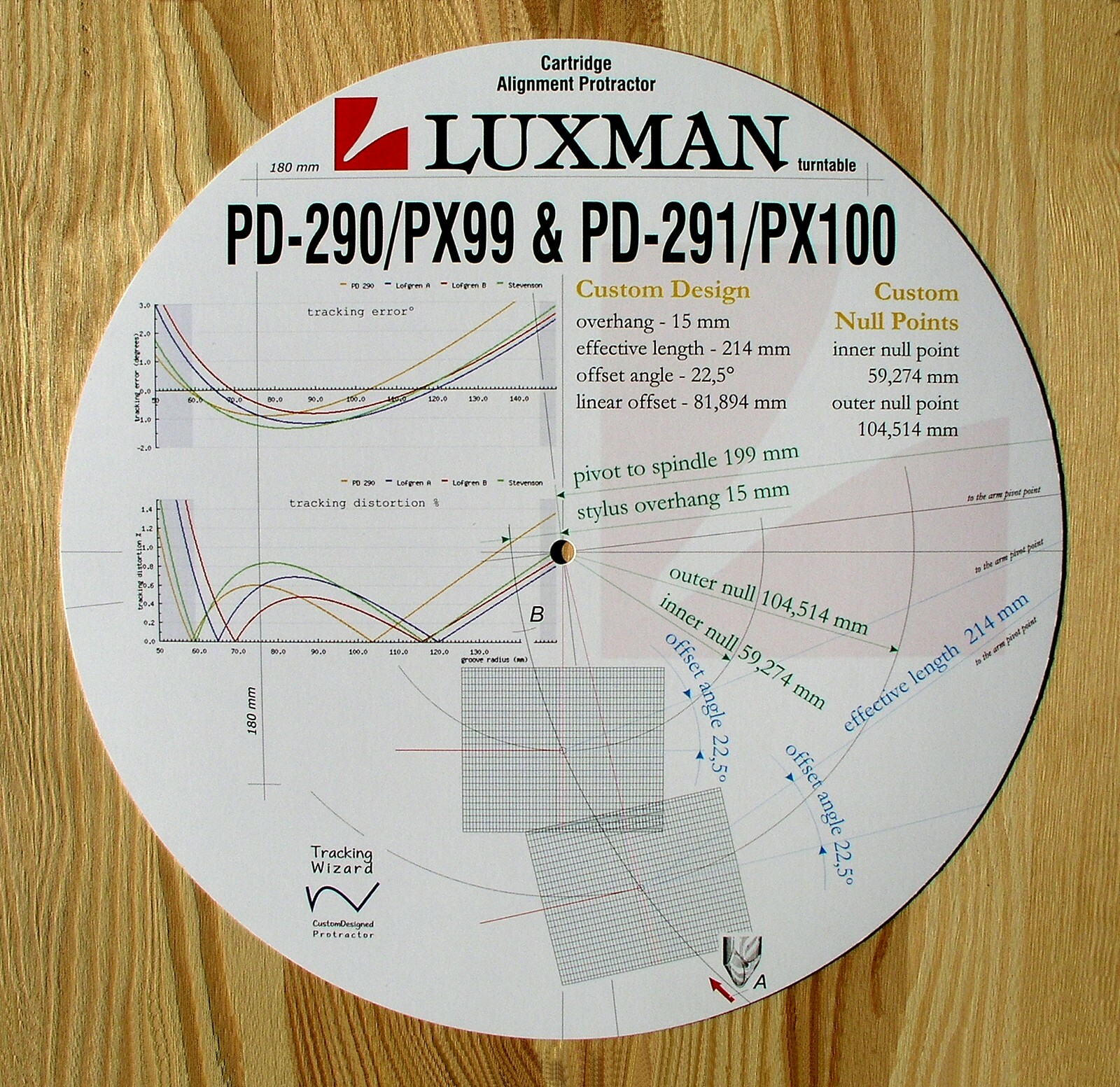
| Tonearm Effective Length | 214mm |
| Tonearm Characteristics | New generation of low-mass, low-friction Luxman design |
| Headshell | Low in mass, rigid, and removable |
| Wow and Flutter | 0.03% wrms |
| Signal to Noise Ratio | 70dB |
| Dimensions (W x H x D) | 430 x 112 x 310 mm |
| Weight | 5.5 kg |
Key Features
Statically Balanced Tonearm
The PX-99 features a statically balanced straight tube tonearm with an effective length of 214mm. This means the tracking force is set purely by counterweight adjustment until the arm floats level—no springs, no levers, no added compliance to muddle the setup. It’s a simple, time-tested method that allows for exceptional accuracy in alignment and tracking force. Combined with its low-mass, low-friction design, the arm tracks cleanly through complex passages without excess inertia or resonance, helping preserve high-frequency detail and reduce record wear. It’s not a fancy gimbal or unipivot, but it’s honest, effective, and well-executed.
Quartz-Locked Direct Drive
The heart of the PX-99 is its quartz-locked direct drive motor. Unlike belt drives, there’s no rubber to degrade or stretch over time. Unlike cheaper direct-drive systems, this one uses a crystal reference to lock the platter speed with high accuracy—delivering a measured 0.03% wow and flutter (wrms), a figure that rivals far more expensive decks. There are no noisy gears or resonance-prone mechanical linkages; the motor spins the platter directly and silently. The result is rock-solid speed stability, whether you’re playing a side of jazz or a dense classical recording. Owners consistently report that the motor is accurate, the arm tracks reliably, and the lifter operates spot-on—no surprises, just consistent performance.
Removable, Rigid Headshell
The headshell is designed to be both rigid and low in mass—a deliberate engineering choice. Rigidity prevents flexing that can smear high-frequency transients, while low mass helps the arm respond quickly to groove modulations without overshoot. The fact that it’s removable makes cartridge swaps straightforward, though the tonearm is optimized for the moving magnet or moving coil cartridges typical of the early 1980s. It’s not a platform for exotic aftermarket arms, but within its intended ecosystem, it performs with precision and neutrality.
Auto Pause Output
One of the more distinctive features is the “Auto Pause Output,” a small but clever signal sent to compatible Luxman KX-Series cassette decks. When the record finishes playing and the tonearm lifts, the PX-99 sends a signal that automatically puts the cassette deck into pause mode. It’s the kind of integrated thinking that made Luxman systems feel cohesive. If you were running a full Luxman stack, this small automation meant you didn’t have to jump up to stop your tape recorder every time a side ended. It’s a detail that speaks to Luxman’s attention to real-world use, not just specs.
Historical Context
The PX-99 was introduced in 1982, a time when quartz-locked direct drive was still a premium feature, especially outside the flagship models. While some sources list production activity as late as 1986, the model was launched in the early '80s as part of Luxman’s push into precision-engineered, user-friendly turntables. It served as the semi-automatic counterpart to the fully automatic PX-100 and PD-291, offering the same core technology—quartz speed regulation, low-rumble design, and refined tonearm engineering—but with manual cueing for listeners who preferred a bit more control.
Though Luxman doesn’t explicitly state who manufactured the PX-99, forum discussions suggest a connection to Micro Seiki, a company known for building high-precision turntables for other brands. If true, that lineage would explain the PX-99’s exceptional build quality and measured performance. One user noted that Luxman—and by implication, its manufacturing partners—were traditionally conservative in quoting specs, meaning the PX-99 likely outperforms its official numbers. A review of the related PD-291, for example, reportedly achieved the best rumble measurement ever recorded by an Australian hi-fi lab at the time, beating professional decks costing five times as much. While the PX-99 lacks those accolades, it shares enough DNA to suggest similar engineering rigor.
Collectibility & Value
The Luxman PX-99 has quietly gained attention among collectors of vintage Japanese turntables. While not as rare as some boutique decks, it’s not common either. A recent listing on Reverb priced a working PX-99 at $425, reflecting its reputation for reliability and performance. That kind of aftermarket support is a quiet endorsement of the PX-99’s longevity.
One thing working in its favor: a service manual is available for download from multiple sources, including Audio-High-Store and Turntableneedles.com. That makes maintenance and repair far more accessible than many vintage turntables, where documentation has vanished. You won’t find schematics for every subcomponent, but having the official guide means you’re not flying blind when it’s time to clean the motor or realign the arm.
Owners consistently praise its build quality and out-of-the-box readiness. One seller noted, “This 'table needed no work from us which is a testament to the brand, just a calibration and testing.” Another described it as “a well built entry level TT,” suggesting it was designed to last with minimal intervention. Replacement parts are still available, too—like a full dust cover hinge kit recently listed for £32, indicating an active, if niche, support ecosystem.
Still, no common failure points are documented in the available sources. There’s no mention of failing capacitors, worn motor brushes, or tonearm bearing wear—common issues on other vintage decks. Whether that’s because the PX-99 is truly bulletproof or because failures are rare enough not to be reported, the silence speaks volumes. For buyers today, that means a low-risk entry into high-quality vintage analog playback, assuming the unit has been stored properly and calibrated.
eBay Listings



As an eBay Partner, we earn from qualifying purchases. This helps support our independent vintage technology research.
Related Models
- Luxman L-530 (1975)
- Luxman R-404 (1975)
- Luxman RV-371 (1975)
- Luxman SQ-38U (1975)
- Luxman T-14 (1972)
- Luxman T-530 (1975)
- Luxman TX-101 (1975)
- Denon DRA-800 (1985)
- Denon PMA-350Z (1980)
- Denon POA-1500 (1979)