Luxman PX-101 (1982–1985)
It doesn’t swing in an arc—it glides in a straight line, tracing the groove exactly as the mastering lathe cut it.
Overview
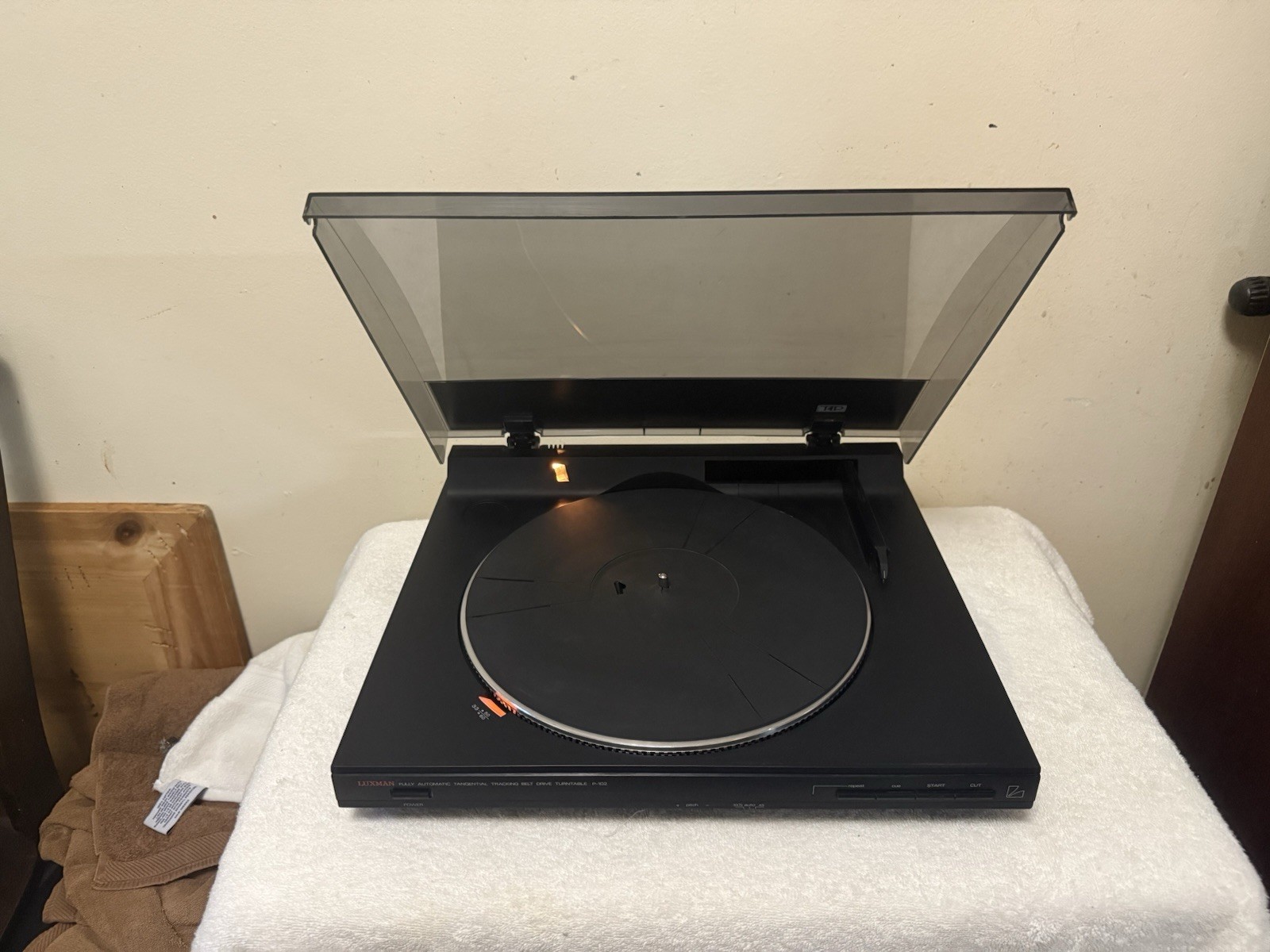
The Luxman PX-101 isn’t your typical turntable, and that’s the entire point. Built between 1982 and 1985 in Japan, this direct-drive, fully automatic turntable stands apart from the radial-tracking norm with its tangential tonearm—a design that moves in a straight line across the record, eliminating tracking error altogether. While most turntables pivot on a fixed bearing, the PX-101’s arm rides on a precision rail, driven by a wire belt connected to a DD DC servo motor. It’s a rare breed: a high-spec, microcomputer-controlled linear tracker that actually made it into limited production, rather than remaining a prototype or engineering exercise.
Owners report it was part of a short-lived “100” system intended primarily for the U.S. market—think CX-100, MX-100, TX-101, GX-101—and was likely an export-only item, possibly driven by Luxman USA’s demands. It’s not to be confused with the lower-end PX-99 or PX-100, which are conventional radial-tracking models. The PX-101 was a different animal entirely: a quiet technological statement wrapped in understated industrial design.
Despite its sophistication, it wasn’t a flagship in name or luxury finishes. One source notes, “No high-end here and a none-too-Luxman design but decent specs,” which suggests it prioritized function over flash. But for those who value engineering purity, the PX-101 delivers. It plays back records exactly as they were cut—linearly, cleanly, and with remarkable precision.
Specifications
| Manufacturer | Luxman |
| Type | Direct-Drive |
| Speeds | 33 1/3 & 45rpm |
| Pitch control | ± 3% |
| Wow & flutter | 0,045% DIN-B |
| S/N ratio | 70 dB |
| Platter | 0,8 kg / 30 cm diecast aluminium |
| Arm effective length | 16,5 cm |
| Cartridge weight | 4...8g |
| Tracking force | 0...3g |
| Dimensions | 44 x 11,5 x 40,5 cm |
| Weight | 7,4 kg |
| Power consumption | 12 W |
| Tonearm headshell material | aluminium |
Key Features
Tangential Tracking: The Core Innovation
The PX-101’s defining feature is its fully automatic tangential tracking system. Unlike conventional tonearms that swing in an arc and introduce tracking distortion, the PX-101’s arm moves in a perfectly straight line across the record. This eliminates angular error and ensures the stylus follows the groove as it was originally cut on the mastering lathe. As one source puts it: “The PX-101 plays back records exactly as they were cut: in a straight line.”
Microcomputer-Controlled Operation
This isn’t just mechanical—it’s intelligent. The PX-101 incorporates a “Micro Computer” that manages the entire playback sequence. From auto-start to cueing and return, the system uses a suite of circuits: a “Tracking Error Detecting Circuit,” “Stopping Circuit,” “Forwarding Sw Limited Circuit,” “Cue Signal Handling Circuit,” and “Solenoid Operation Circuit.” These ensure precise, repeatable operation without user intervention.
Drive and Construction
The platter is driven by a DD DC servo motor, providing stable rotation with minimal wow and flutter—rated at just 0.045% DIN-B, a figure so low it’s effectively inaudible. The tonearm itself is belt (wire) driven along its rail, and both the arm and headshell are constructed from improved aluminium alloy, chosen for resonance control and damping. The 30 cm diecast aluminium platter weighs 0.8 kg, contributing to speed stability.
Integration and Automation
The PX-101 was designed to work within a system. A built-in circuit can automatically place a connected Luxman KX-101 or KX-102 cassette deck into pause mode when the record finishes playing—ideal for vinyl-to-tape transfers. It also features a mirror reflex stroboscope for accurate speed calibration, and tonearm lift is controlled via jog keys.
Historical Context
The PX-101 was an extra-rare export-only model, likely developed for the U.S. market as part of Luxman’s “100” system lineup. While primarily aimed at North America, it saw some distribution in Europe. Its origins trace back to NEC, which produced a similar model, the P580LE, around the same time. Luxman took that design and gave it a slight visual redesign—cleverly adapting it under their own branding. NEC also rebadged the same platform for SABA as the RSP 450 in their Sigma series (1981/82), again with minor cosmetic changes. This shared lineage highlights the collaborative engineering landscape of the early 1980s, where high-end mechanisms were sometimes cross-branded across multiple manufacturers.
Collectibility & Value
The PX-101 is a rare find, and its value reflects both its scarcity and mechanical complexity. Original pricing was approximately $400 USD, a significant sum in the early 1980s. Recent listings show a wide range: a non-working unit appeared on eBay for $45.00, while functional examples have been listed at €370 (March 18, 2026, Catawiki) and DKK 4,000 (February 23, 2026, Den Blå Avis). Replacement parts are available—specifically, the tonearm drive belt, which sells for $12.90 USD—but mechanical issues are common.
The most frequently reported problem is a failure of the linear arm to move despite the motor running. Forum reports indicate this is often due to a slipped or worn belt, requiring removal of the platter and access to a plastic cover underneath for replacement. Cleaning and lubrication of the rail are also recommended for smooth operation. Given its reliance on precision mechanics and aging rubber components, a working PX-101 in good condition is a prize for collectors who appreciate its unique engineering.
eBay Listings



As an eBay Partner, we earn from qualifying purchases. This helps support our independent vintage technology research.
Related Models
- Luxman L-530 (1975)
- Luxman R-404 (1975)
- Luxman RV-371 (1975)
- Luxman SQ-38U (1975)
- Luxman T-14 (1972)
- Luxman T-530 (1975)
- Luxman TX-101 (1975)
- Denon DRA-800 (1985)
- Denon PMA-350Z (1980)
- Denon POA-1500 (1979)