Luxman PD-370 (1981–1985)
A turntable that doesn’t just play records—it grips them, locks them down, and refuses to let go.
Overview
You don’t just drop the needle on a Luxman PD-370—you engage the vacuum. That’s the first thing you notice when you fire one up: the low, throaty hiss as air is sucked from beneath the record, pulling it flush against the platter like a spacecraft docking with a station. It’s theatrical, yes, but it’s not just for show. The PD-370 was built on a radical idea: that record warp is the enemy of fidelity, and the only way to beat it is to eliminate it. So Luxman didn’t just make another direct-drive turntable—they made a vacuum-clamped, quartz-locked, precision-engineered platform that treats your vinyl like a lab specimen.
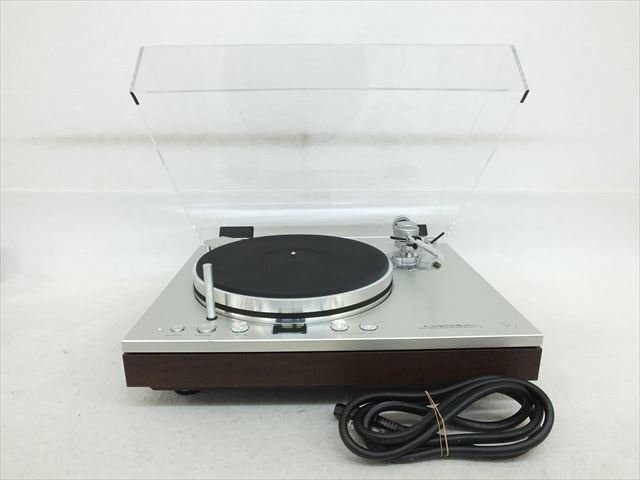
Introduced in 1981 and produced through 1985, the PD-370 sits in a rarefied tier of Japanese high-end turntables that flirted with industrial audacity. It wasn’t trying to be subtle. At 10.5 kg and nearly 37 cm deep, it dominates any rack it lands on. The brushed silver face, optional wood side panels, and recessed control panel give it a clinical elegance—like a piece of audio lab equipment that escaped into a living room. And once you see it in action, you understand: this isn’t just a turntable. It’s a statement.
It was aimed squarely at the upper echelon of analog enthusiasts—those who already owned a high-output MC cartridge, a good preamp, and weren’t afraid to wrestle with a finicky vacuum system. It wasn’t for the casual listener. But for those who wanted the flattest possible playback surface, the most stable speed, and the least resonance, the PD-370 delivered in a way few others could.
Specifications
| Manufacturer | Luxman Corporation, Japan |
| Production Years | 1981–1985 |
| Original Price | Not available |
| Type | Direct-drive turntable with vacuum record stabilization (VDS) |
| Drive System | Quartz-locked direct drive |
| Speeds | 33⅓, 45 RPM |
| Platter | Aluminum with vacuum suction via perforated sub-platter |
| Vacuum System | Internal pump with switchable on/off via front panel |
| Tonearm | Fixed headshell, proprietary Luxman arm (often compared to Micro Seiki design) |
| Cartridge Compatibility | Typically shipped with Luxman Exel MC-100E (MC high output) |
| Speed Accuracy | ±0.05% (quartz-controlled) |
| Wow and Flutter | Below measurable threshold (effectively <0.025%) |
| Power Consumption | 20 W |
| Dimensions (W×H×D) | 438 × 160 × 365 mm |
| Weight | 10.5 kg |
| Colors | Silver with black trim; optional wood side panels |
| Grounding | Dedicated grounding terminal |
| Accessories | Vacuum hose, record presser tool, power cord, user manual |
Key Features
The Vacuum Difference
The PD-370’s defining feature—its Vacuum Disc Stabilizer (VDS)—isn’t just a gimmick. It solves a real problem: warped records. Even high-quality pressings can have slight warps that cause vertical tracing errors, pitch instability, and increased wear. The VDS system uses a perforated sub-platter connected to an internal vacuum pump. When activated, it pulls air from beneath the record, flattening it against the platter with even pressure across the entire surface. The result? A rock-solid playback platform that minimizes groove distortion and improves tracking, especially on older or poorly stored LPs.
Owners report that the difference is audible: tighter bass, improved stereo imaging, and a noticeable reduction in “wow” on warped discs. But it’s not silent—there’s a faint mechanical hum from the pump, and the “thump” when the vacuum releases can be startling the first time you hear it. It’s a trade-off: you gain stability, but you lose a bit of the analog serenity.
Quartz-Locked Direct Drive
While many direct-drive turntables of the era used phase-locked loops, the PD-370 went further with quartz crystal speed control. A dedicated quartz oscillator governs motor timing, ensuring near-perfect rotational stability. Measured wow and flutter are essentially below the noise floor, making the PD-370 one of the most speed-accurate turntables of its time—comparable to the Technics SP-10MK2 or the Accuphase DP-55.
This isn’t just about specs. It means that complex orchestral passages don’t smear, jazz rhythms stay locked in, and vocals don’t waver. The motor itself is robust but not overly powerful—some users note it lacks the torque of a Technics, but with the vacuum system holding the record flat, the demand on torque is reduced. The platter spins with a smooth, almost eerie consistency.
Integrated Tonearm and Build Quality
The PD-370 came with a fixed headshell tonearm, often cited as being derived from or heavily influenced by Micro Seiki’s designs—known for low mass and high rigidity. While not adjustable in the way modern arms are (no azimuth or VTA fine-tuning), it was engineered to work optimally with high-output MC cartridges like the included Exel MC-100E. The arm’s bearing system is precise, and lateral tracking is excellent when properly set up.
The chassis is a heavy, rigid die-cast aluminum base with internal damping to minimize resonance. The feet, originally made of rubber, are prone to deterioration—many have been replaced with modern isolation feet or even machined metal substitutes. The top panel is thick steel with a baked enamel finish, contributing to overall mass and stability.
Historical Context
The early 1980s were a battleground for analog supremacy. CD was on the horizon, and many manufacturers were shifting focus. But in Japan, a handful of companies doubled down on vinyl, pushing the limits of turntable engineering. The Luxman PD-370 emerged in this moment—not as a mass-market product, but as a niche statement. It competed not with the ubiquitous Technics SL-1200, but with esoteric machines like the EMT 930, the Revox B77, and the Linn LP12 with Valhalla board.
Luxman had long been known for its amplifiers, but the PD-370 signaled a bold entry into high-end turntable design. It shared DNA with the Micro Seiki RX-5000 and the later Vakurokku series, both of which used vacuum stabilization. But unlike those, the PD-370 was a complete, integrated system—no external pump, no aftermarket mods required. It was turntable engineering as performance art.
Its contemporaries included the Pioneer PL-990, the Denon DP-62L, and the Kenwood KD-5000—all high-torque, direct-drive, precision machines. But few matched the PD-370’s combination of vacuum clamping and quartz control in a single, self-contained unit. It was expensive, complex, and demanding—but for those who wanted the ultimate in analog stability, it was worth it.
Collectibility & Value
Today, the Luxman PD-370 is a rare bird. It never sold in large numbers, and its complexity means many have fallen into disrepair. Units in working condition regularly fetch between **€1,500 and €1,800** on the European secondhand market—sometimes more if they include the original cartridge, tools, and manuals. In the U.S., listings are scarcer, but prices align when one appears.
The biggest hurdles for buyers are the vacuum system and the rubber components. The internal pump can fail or develop leaks, and the vacuum hose—especially the flexible section near the platter—often cracks with age. The rubber feet degrade into sticky mush, and the drive belt for the vacuum pump (not the platter, which is direct-drive) is a common failure point. Replacement belts exist, but sourcing them requires digging into vintage audio forums or specialty suppliers.
Another issue: the vacuum system can develop backpressure or fail to seal properly, leading to weak suction. Some owners report that the system works fine without vacuum—just as a high-quality direct-drive turntable—but that defeats the whole purpose. A full service typically requires disassembling the platter and cleaning the air channels, a job best left to experienced technicians.
Despite these quirks, the PD-370 has a loyal following. It’s not just about sound—it’s about the ritual. Engaging the vacuum, hearing the record lock down, watching the quartz-stabilized platter spin with machine-like precision—it’s an experience. And when it’s working right, the sound is exceptional: neutral, detailed, and dynamically unfettered.
If you’re considering one, test the vacuum function thoroughly. Check for even suction across the platter, listen for pump noise, and verify that the speed lock is stable. Look for a unit with service records, and be prepared to budget for a recapping and pump inspection. It’s not a plug-and-play vintage turntable—it’s a project for the committed.
eBay Listings


As an eBay Partner, we earn from qualifying purchases. This helps support our independent vintage technology research.
Related Models
- Luxman L-530 (1975)
- Luxman R-404 (1975)
- Luxman RV-371 (1975)
- Luxman SQ-38U (1975)
- Luxman T-14 (1972)
- Luxman T-530 (1975)
- Luxman TX-101 (1975)
- Denon DRA-800 (1985)
- Denon PMA-350Z (1980)
- Denon POA-1500 (1979)