Luxman PD-290: The Quiet Masterpiece of Japanese Turntable Craftsmanship
In the early 1980s, Japanese high-end audio reached a golden age. Brands like Accuphase, Denon, and Sony were pushing the boundaries of fidelity, but few matched the understated elegance and meticulous engineering of Luxman. Among their analog offerings, the PD-290 stands as a refined, often overlooked gem—a belt-drive turntable that embodies the Japanese philosophy of monozukuri: the art of making things with precision, care, and soul.
Released in 1983, the Luxman PD-290 was positioned as a high-end turntable during a time when vinyl still reigned supreme and audiophiles demanded both technical excellence and musicality. While Luxman is perhaps better known today for its vacuum tube amplifiers and preamplifiers, the PD-290 remains a testament to the company’s holistic approach to audio reproduction—where every component, from power supply to platter, is engineered to serve the music.
Unlike the flashier, mass-market turntables of the era, the PD-290 was built for discerning listeners who valued subtlety, build quality, and long-term reliability. It wasn’t designed to be flashy, but rather to disappear into the background—letting the record, not the machine, take center stage.
Technical Specifications
| Specification | Detail |
| Model | Luxman PD-290 |
| Year of Release | 1983 |
| Turntable Type | Belt-drive, manual operation |
| Platter | Dual-layer acrylic/resin composite |
| Motor | Precision AC synchronous motor |
| Speeds | 33⅓, 45 RPM (quartz-locked) |
| Speed Accuracy | ±0.05% |
| Wow and Flutter | < 0.025% (WRMS) |
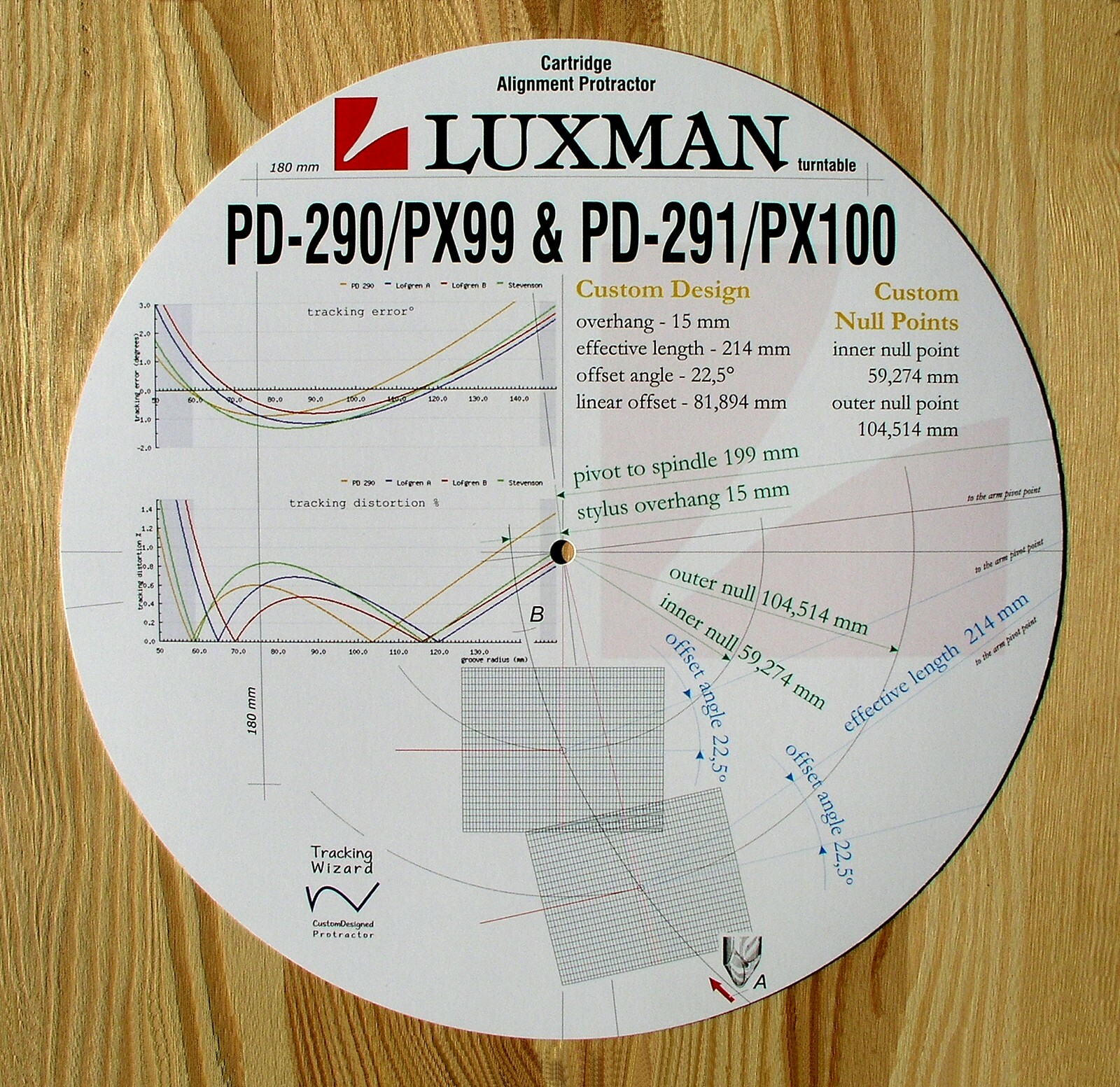
| Tonearm | 9" straight aluminum, gimbal bearing |
| Effective Length | 232 mm |
| Overhang | 18 mm |
| Mounting Distance | 214 mm |
| Tracking Force Range | 0–3 grams (adjustable) |
| Anti-Skate | Continuously variable |
| Power Supply | External AC unit with quartz control |
| Dimensions (W×H×D) | 445 × 145 × 360 mm |
| Weight | 10.5 kg (approx.) |
| Finish Options | Black or wood veneer (walnut or rosewood) |
The PD-290’s design emphasizes isolation and stability. Its heavy composite platter combines acrylic and resin to dampen resonances while providing excellent inertia for stable rotation. The precision AC motor, housed in a separate compartment and driven by an external quartz-controlled power supply, ensures rock-solid speed stability—critical for minimizing pitch wobble and preserving the integrity of the musical signal.
The 9-inch straight aluminum tonearm is a no-frills but well-executed design. With a low-mass aluminum tube, precision gimbal bearings, and continuously adjustable anti-skate and tracking force, it strikes a balance between rigidity and compliance. While not as advanced as the S-shaped arms found on some contemporaries, it performs admirably with a wide range of moving magnet (MM) and low-output moving coil (MC) cartridges.
Sound Characteristics and Performance
The Luxman PD-290 doesn’t shout; it whispers with clarity. Its sonic signature is best described as neutral with a touch of warmth—a hallmark of Luxman’s design philosophy. It delivers a smooth, organic midrange that brings vocals and acoustic instruments to life, while maintaining excellent detail retrieval in the highs and a tight, controlled bass response.
Thanks to its quartz-locked speed control, the PD-290 exhibits exceptional pitch stability. This translates into a coherent soundstage with precise imaging and excellent instrument separation. Records spin with a sense of ease and authority, free from the jitter or warble that plagues lesser turntables.
The belt-drive system contributes to a low noise floor, minimizing motor-induced vibrations. Combined with the massive platter and damped chassis, the result is a turntable that extracts maximum detail from the groove without adding coloration. It’s particularly well-suited to jazz, classical, and vocal recordings—genres where timbral accuracy and spatial realism are paramount.
Notable Features and Innovations
While the PD-290 may appear conservative compared to some of its contemporaries, it incorporates several thoughtful design elements:
- External Quartz-Locked Power Supply: This separates the motor control circuitry from the turntable itself, reducing electromagnetic interference and allowing for precise speed regulation. The power supply includes a quartz crystal oscillator, ensuring long-term speed accuracy.
- Damped Subchassis Design: The turntable uses a sprung suspension system with adjustable feet to isolate the platter and tonearm from external vibrations. This was a common feature in high-end turntables of the era, but Luxman executed it with exceptional care.
- Interchangeable Headshell: The tonearm accepts standard SME-style headshells, making it easy to swap cartridges or upgrade to higher-end models.
- Elegant Aesthetic: Available in black or luxurious wood veneer finishes, the PD-290 blends into high-end audio racks with quiet dignity. The minimalist front panel—featuring only speed selection buttons and a power indicator—reflects Luxman’s focus on function over form.
Common Issues and Maintenance
Like any vintage turntable, the Luxman PD-290 requires periodic maintenance to perform at its best:
- Belt Replacement: The rubber drive belt can dry out and crack over time. Replacing it with a high-quality silicone belt (such as those from The Analog Outlet or Mobile Fidelity) is recommended every 10–15 years.
- Bearing Lubrication: The main platter bearing may require cleaning and relubrication if the platter feels stiff or wobbly. Use only high-purity turntable oil to avoid contamination.
- Tonearm Wiring: Over decades, the internal tonearm wiring can become brittle. If channel imbalance or dropouts occur, inspect or replace the wiring with care.
- Motor Issues: While rare, the AC motor can degrade. A failing motor may cause speed fluctuations or humming. The external power supply is generally reliable but should be checked for capacitor aging if the unit has been stored for years.
With proper care, however, the PD-290 is remarkably durable. Its all-metal construction and high-quality components have allowed many units to remain in daily use for over four decades.
Current Market Value and Collectibility
The Luxman PD-290 is not as widely recognized as some of its competitors—like the Technics SP-10 or the Linn LP12—but it has developed a loyal following among vintage audio enthusiasts. In recent years, interest in Japanese high-end gear has surged, and the PD-290 has begun to receive more attention.
On the secondary market, a fully functional PD-290 in good cosmetic condition typically sells for $600–$1,000, depending on finish, included accessories, and overall condition. Units with original packaging, manuals, and the rare wood veneer finish command premiums, especially in Japan and Europe.
While not yet a “blue chip” collectible like certain Denon or Yamaha turntables, the PD-290 represents excellent value for money. It offers performance that rivals more famous models at a fraction of the price—making it a smart choice for both audiophiles and collectors seeking under-the-radar excellence.
Conclusion and Legacy
The Luxman PD-290 is not a turntable that demands attention. It doesn’t have a gimbal suspension, a unipivot arm, or a futuristic plinth. But what it lacks in flash, it more than makes up for in refinement, consistency, and musical truth.
In an era when many manufacturers prioritized features over finesse, Luxman stayed true to its core values: precision engineering, analog purity, and a deep respect for the listening experience. The PD-290 is a quiet masterpiece—a turntable built not for showrooms, but for the serious listener who values what’s on the record more than what’s on the spec sheet.
Today, as vinyl enjoys a global resurgence, the PD-290 stands as a reminder that great audio gear doesn’t need to be loud to be impactful. It just needs to play the music—faithfully, beautifully, and without distraction. And in that, the Luxman PD-290 excels.
eBay Listings


As an eBay Partner, we earn from qualifying purchases. This helps support our independent vintage technology research.
Related Models
- Luxman PD-272 (1983)
- Luxman JPX-10000-R (1985)
- Luxman PD-121 (1979)
- Luxman PD-131 (1978)
- Luxman PD-262 (1983)
- Garrard 2025tc (1968)
- Onkyo CP-1010 (1976)
- Pioneer PL-15R (1975)
- Pioneer PL-250 (1979)
- Pioneer PL-40 (1977)