Luxman PD-270: The Quiet Masterpiece of Japanese Turntable Craftsmanship
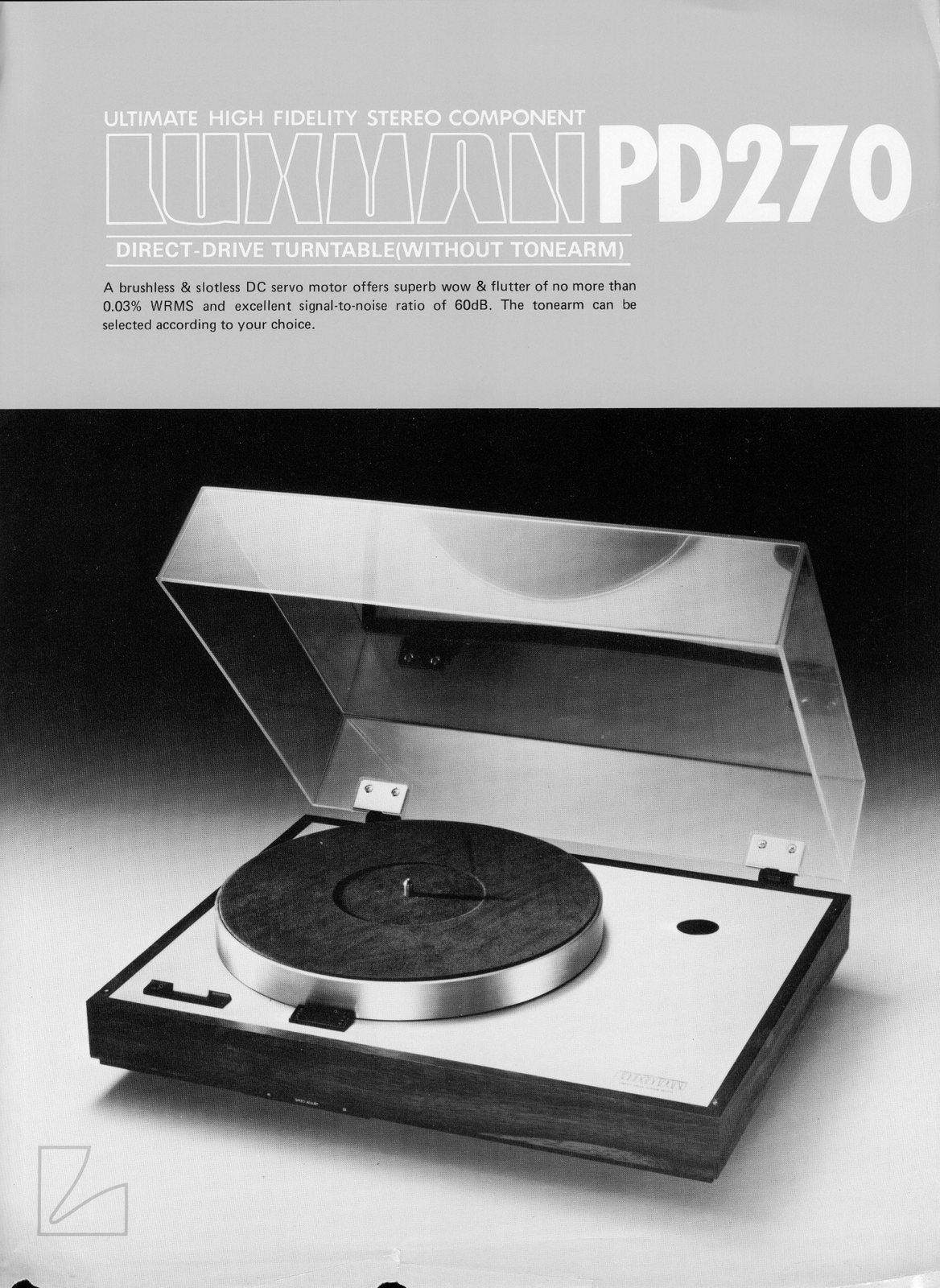
In the golden age of analog audio during the early 1980s, Japanese manufacturers like Denon, Technics, and Sony were pushing the boundaries of turntable design with advanced engineering and mass-market appeal. Yet, nestled among these giants was Luxman, a brand renowned for its understated elegance and obsessive attention to sonic purity. Among their analog offerings, the Luxman PD-270, introduced in 1984, stands as a refined example of Japanese high-end turntable design—less flashy than its competitors, but deeply respected by audiophiles for its musicality, build quality, and thoughtful engineering.
Though not as widely documented as the Technics SL-1200 or the Denon DP-47F, the PD-270 emerged during a period when Luxman was consolidating its reputation for crafting components that balanced technical excellence with natural, engaging sound. As a belt-drive turntable, the PD-270 represented Luxman’s commitment to minimizing vibration and motor noise—hallmarks of high-end analog playback.
Technical Specifications
The PD-270 was engineered with precision and longevity in mind. While Luxman never positioned it as a direct competitor to the ultra-high-end L-1000 series turntables, the PD-270 occupied a respected middle ground—offering many of the sonic virtues of its costlier siblings at a more accessible price point.
| Specification | Detail |
| Model | PD-270 |
| Manufacturer | Luxman Corporation, Japan |
| Year Introduced | 1984 |
| Turntable Type | Belt-drive |
| Platter | 300 mm die-cast aluminum |
| Motor | AC synchronous motor |
| Speeds | 33⅓, 45 RPM |
| Speed Accuracy | ±0.3% |
| Wow and Flutter | < 0.025% (WRMS) |
| Tonearm Compatibility | Dual 9-inch SME-style mounting |
| Plinth Construction | Multi-layer MDF with vibration-damping finish |
| Dimensions (W×H×D) | 445 × 145 × 360 mm |
| Weight | 10.5 kg |
| Power Supply | External AC power unit |
| Cartridge Compatibility | MM/MC (user-installed) |
The use of a die-cast aluminum platter helped ensure rotational stability and low resonance, while the belt-drive system isolated the platter from motor vibrations—critical for preserving low-level detail and minimizing background noise. The external power supply was a notable feature for its class, reducing electromagnetic interference and contributing to a quieter noise floor.
Luxman also paid close attention to isolation. The multi-layer plinth combined dense MDF with damping materials to resist external vibrations, a design philosophy that would later become standard in high-end turntables. The inclusion of SME-style tonearm mounting meant users could easily upgrade to high-performance arms like the SME 3009 or Grace G-707, enhancing the turntable’s long-term value.
Sound Characteristics and Performance
The Luxman PD-270 doesn’t shout—it sings. Its sonic signature is one of clarity, neutrality, and musical coherence, hallmarks of Luxman’s design philosophy. Unlike some turntables of the era that leaned toward brightness or analytical precision, the PD-270 delivers a balanced, organic presentation that favors timbral accuracy and spatial realism.
Bass response is tight and well-controlled, with excellent pitch definition—thanks in part to the stable platter and low wow and flutter. Midrange is where the PD-270 truly shines: instruments and vocals are rendered with lifelike texture and presence, making it ideal for acoustic, jazz, and vocal recordings. Treble is smooth and extended, avoiding the harshness that sometimes plagues lesser turntables.
When paired with a high-quality cartridge—such as the Shure V15 Type IV, Ortofon 2M Black, or Denon DL-103—the PD-270 reveals a surprising level of micro-detail and soundstage depth. It doesn’t force the music forward; instead, it steps aside and lets the recording speak for itself.
Notable Features and Innovations
While the PD-270 may appear conservative compared to more exotic turntables of the era, its design is full of intelligent touches:
- External Power Supply: By removing the power transformer and motor control circuitry from the main chassis, Luxman minimized electrical noise and mechanical vibration—rare in mid-tier turntables at the time.
- Precision Speed Control: The AC synchronous motor with regulated power delivery ensures stable rotation, critical for pitch accuracy and rhythmic integrity.
- Upgrade-Friendly Design: The SME-style armboard allows for easy tonearm swaps, making the PD-270 a great platform for audiophiles who want to experiment with different cartridges and arms.
- Low-Resonance Plinth: The layered construction absorbs external vibrations and internal resonances, contributing to a blacker background and improved dynamics.
Luxman also paid attention to aesthetics. The PD-270 features a sleek, minimalist design—typically finished in black or walnut veneer—with clean lines and understated branding. It doesn’t scream “high-end,” but it exudes quiet confidence, fitting seamlessly into refined audio setups.
Common Issues and Maintenance
Like any vintage turntable, the PD-270 requires care to perform at its best. Over time, the most common issues include:
- Belt Degradation: The rubber belt can dry out, crack, or stretch after 30+ years. Replacement with a high-quality silicone belt (e.g., from The Funk Firm or Groovetracer) is recommended.
- Motor Lubrication: The AC motor may require cleaning and re-lubrication if it begins to hum or run unevenly.
- Dust and Grime: The platter, spindle, and tonearm bearings can accumulate dust, affecting performance. Regular cleaning with appropriate tools is essential.
- Tonearm Wiring: Older tonearm wiring can become brittle. If channels become unbalanced or drop out, inspect the internal wiring.
Fortunately, the PD-270 is relatively simple to service. Its modular design and widespread use of standard components make repairs and upgrades straightforward for experienced technicians or DIY enthusiasts.
Current Market Value and Collectibility
The Luxman PD-270 is not a rare find, but it’s also not commonly seen in top-tier condition. In recent years, interest in vintage Japanese audio has surged, and Luxman’s reputation for quality has driven up demand for well-preserved models.
As of 2024, a fully serviced PD-270 in excellent cosmetic and mechanical condition typically sells for $400–$700 USD, depending on included accessories, original packaging, and tonearm configuration. Units with rare factory arms or upgraded components (e.g., Rega or SME arms) may command higher prices.
While not yet a “blue-chip” collectible like the Technics SP-10 or Linn LP12, the PD-270 is increasingly recognized as a sleeper hit—a turntable that delivers performance beyond its original price point. Its value is likely to appreciate slowly but steadily as analog enthusiasts seek out well-engineered, musically satisfying alternatives to more hyped models.
Conclusion and Legacy
The Luxman PD-270 may not have the fame of a Technics or the cult following of a Linn, but it embodies the essence of what makes vintage Japanese audio so beloved: precision engineering, understated elegance, and a deep commitment to musical truth.
It’s a turntable for listeners who value coherence over flash, and longevity over trendiness. In an era where analog is once again celebrated for its emotional connection to music, the PD-270 remains a compelling choice—especially for those building a vintage system with integrity and soul.
If you’re lucky enough to find one in good condition, consider restoring it. With a new belt, a quality cartridge, and a little care, the Luxman PD-270 can deliver a listening experience that rivals far more expensive modern turntables. It’s not just a relic of the past—it’s a quiet master still speaking in clear, beautiful tones.
eBay Listings



As an eBay Partner, we earn from qualifying purchases. This helps support our independent vintage technology research.
Related Models
- Luxman PD-272 (1983)
- Luxman JPX-10000-R (1985)
- Luxman PD-121 (1979)
- Luxman PD-131 (1978)
- Luxman PD-262 (1983)
- Garrard 2025tc (1968)
- Onkyo CP-1010 (1976)
- Pioneer PL-15R (1975)
- Pioneer PL-250 (1979)
- Pioneer PL-40 (1977)