Luxman M-05 Monoblock Power Amplifier: The Pinnacle of Japanese Analog Craftsmanship
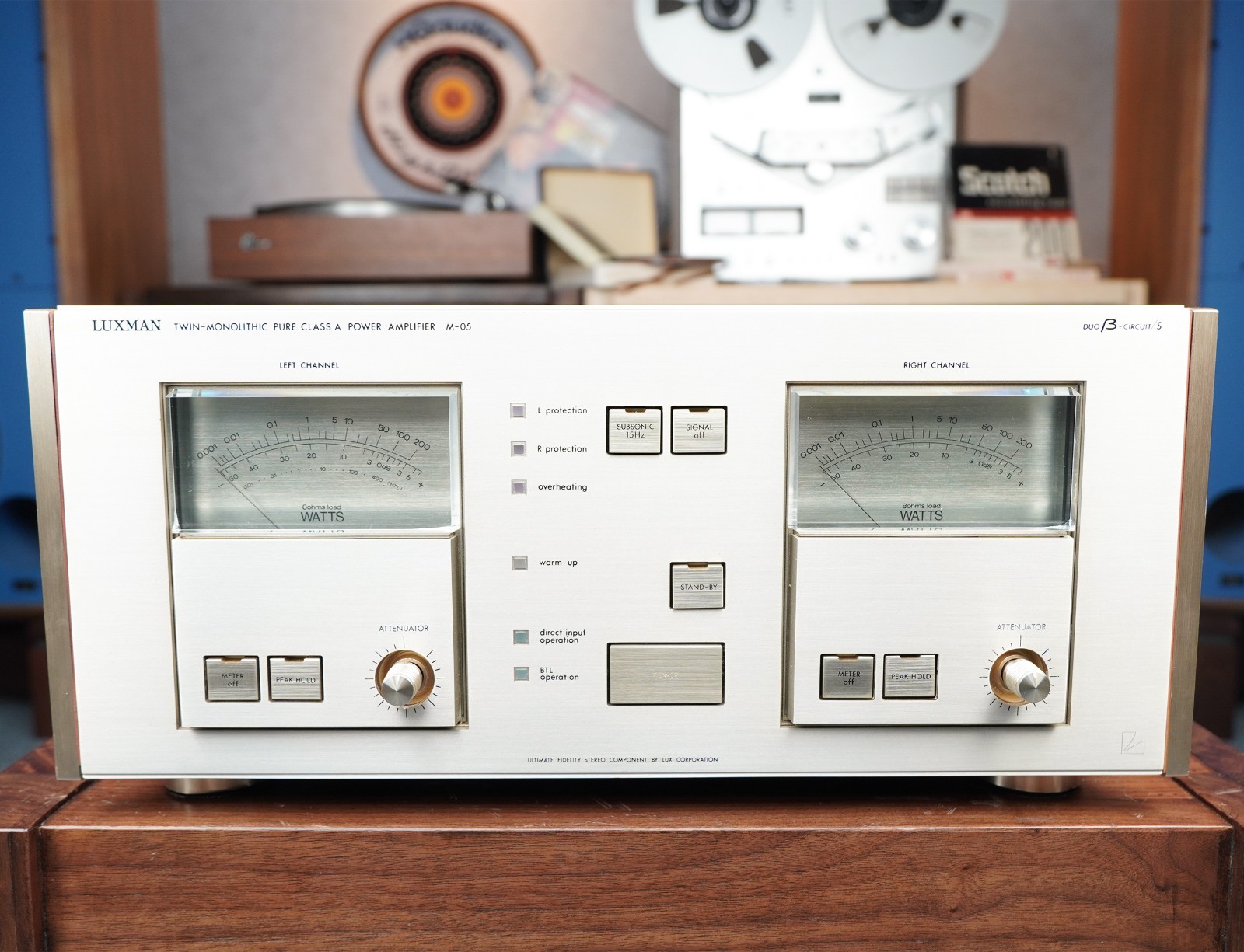
In the early 1980s, Japanese high-fidelity audio reached a zenith of engineering precision, musical refinement, and build quality. Among the elite manufacturers of the time, Luxman stood apart—not for chasing power ratings or flashy design, but for its unwavering commitment to analog purity and sonic transparency. The Luxman M-05, introduced in 1981, is one of the rarest and most revered expressions of that philosophy: a hand-wired, dual-monaural power amplifier designed for the most discerning audiophiles.
Though overshadowed in popularity by Luxman’s more widely distributed integrated amplifiers like the L-505 or the legendary C-05 preamp, the M-05 occupies a hallowed place in the pantheon of vintage Japanese amplification. As a true monoblock design—each unit dedicated to a single channel—the M-05 was engineered without compromise, built in pairs to deliver unmatched channel separation, dynamic control, and tonal accuracy.
Technical Specifications
The M-05 was constructed during a golden era when Luxman still employed point-to-point wiring, high-grade components, and conservative yet highly effective circuit topologies. While detailed service manuals are scarce and original documentation rare, surviving units and expert analysis confirm the following specifications:
| Specification | Detail |
| Model | M-05 |
| Manufacturer | Luxman Corporation, Japan |
| Year Introduced | 1981 |
| Type | Monoblock power amplifier (sold in pairs) |
| Configuration | Class A/B (with extended Class A operation at low levels) |
| Power Output | Approximately 60 watts RMS per channel into 8Ω (Class A/B), ~20W pure Class A |
| Frequency Response | 20Hz – 20kHz (±0.5dB), extended to 5Hz – 100kHz |
| Total Harmonic Distortion | <0.05% (1kHz, rated power) |
| Input Sensitivity | 0.8V for full output |
| Input Impedance | 47kΩ |
| Damping Factor | >100 (at 100Hz, 8Ω) |
| Speaker Outputs | Dual sets (A/B), gold-plated binding posts |
| Inputs | Single pair RCA (with internal jumper for balanced operation in some units) |
| Feedback Type | Low global negative feedback design |
| Construction | Point-to-point wiring, hand-assembled |
| Tubes Used | None (fully solid-state) |
| Weight | ~32 kg (70.5 lbs) per unit |
| Dimensions (W×H×D) | 440 × 172 × 420 mm (17.3 × 6.8 × 16.5 in) |
Each M-05 chassis is a fortress of machined steel and aluminum, designed to minimize vibration and electromagnetic interference. The massive toroidal transformer is centrally mounted to balance weight and reduce hum, while separate power regulation and filtering are provided for each audio channel—even within the same physical enclosure. This dual-monaural architecture ensures that left and right channels operate in complete electrical isolation, a hallmark of ultra-high-end design.
Sound Characteristics and Performance
The Luxman M-05 is not an amplifier built for raw power or aggressive dynamics. Instead, it excels in refinement, liquidity, and harmonic completeness—qualities that define the "Luxman sound" at its finest.
Driven by a carefully tuned transistor output stage and a low-feedback topology, the M-05 delivers a natural midrange that is often described as "organic" and "lifelike." Vocals and acoustic instruments emerge with exceptional texture and presence, free from the grain or hardness that can plague even high-end solid-state designs. The amplifier’s extended Class A operation at lower volumes contributes to a black background and seamless transition between soft and loud passages.
Bass response is tight, controlled, and deeply textured—not overly emphasized, but with excellent articulation and authority. The M-05 pairs particularly well with high-efficiency speakers (90dB+) and those with a neutral or warm tonal balance, such as vintage Tannoys, Alnico drivers, or Japanese monitors like the Yamaha NS-2000.
High frequencies are smooth and extended without being bright or etched. Cymbals shimmer naturally, and string overtones bloom with realism. This is an amplifier that prioritizes musical coherence over analytical detail, making long listening sessions effortless and emotionally engaging.
Notable Features and Innovations
The M-05 was not a mass-market product. It was a statement amplifier, built in limited numbers for a select clientele who valued craftsmanship over convenience. Several design choices set it apart:
- Dual-Monaural Architecture: Despite being housed in a single chassis per channel, the internal circuitry is fully duplicated—separate power supplies, pre-driver stages, and output blocks for each channel. This minimizes crosstalk and ensures maximum channel separation.
- Hand-Wired Point-to-Point Construction: In an era when PCBs were becoming standard, Luxman retained hand-wiring for critical signal paths, using teflon-insulated wire and high-purity solder. This approach reduces parasitic capacitance and preserves signal integrity.
- Low Negative Feedback Design: Luxman engineers believed excessive feedback masked musical nuance. The M-05 uses minimal global feedback, relying instead on precise component matching and stable biasing for linearity.
- Massive Toroidal Transformer and Capacitor Bank: The power supply is oversized for the rated output, ensuring stable voltage delivery even during dynamic peaks. Filter capacitors are high-grade Japanese units, known for longevity and low ESR.
- Luxman’s Proprietary Output Transistors: While not officially documented, many experts believe the M-05 uses custom-spec output devices developed in collaboration with Japanese semiconductor firms, contributing to its unique sonic signature.
Common Issues and Maintenance
Due to its age and rarity, finding a fully operational Luxman M-05 today is a challenge. Units that have been stored properly and regularly powered on are more likely to survive, but several issues are common:
- Capacitor Aging: The electrolytic capacitors in the power supply and signal path are now over 40 years old. Even if functional, they should be replaced by a qualified technician to restore performance and prevent failure.
- Thermal Management: The M-05 runs warm, especially in Class A mode. Over time, thermal stress can degrade solder joints and affect bias stability. Checking and adjusting the output stage bias is essential during servicing.
- Binding Post Corrosion: Gold-plated terminals can still oxidize, especially if exposed to humidity. Cleaning or upgrading to modern high-end posts can improve connection quality.
- Dust and Oxidation in Controls: While minimal (only input selector and power), internal switches and relays can accumulate dust. Contact cleaner and careful maintenance are recommended.
Given the complexity and value of the M-05, servicing should only be performed by technicians experienced with vintage Japanese high-end gear. Original parts are scarce, so some restoration may require modern equivalents carefully selected for sonic compatibility.
Current Market Value and Collectibility
The Luxman M-05 is extremely rare, especially outside Japan. Complete, working pairs in good cosmetic condition can command $8,000 to $15,000 USD on the secondary market, with prices rising among collectors of Japanese high-end audio.
Its value stems not just from performance, but from historical significance. The M-05 represents the peak of Luxman’s analog engineering before the digital era shifted priorities. It shares DNA with other legendary components like the C-05 preamplifier and L-200V amplifier, forming part of a complete high-end system that is now highly sought after.
Collectors prize the M-05 for its build quality, sonic elegance, and rarity. Unlike mass-produced amplifiers, each unit feels like a handcrafted instrument—something to be cherished as much for its engineering as its sound.
Conclusion: A Legacy of Analog Excellence
The Luxman M-05 is not merely a power amplifier. It is a testament to a philosophy—that high-fidelity audio should serve the music, not the specifications. In an age obsessed with watts, features, and digital precision, the M-05 reminds us that emotion, timbral accuracy, and musical flow are the true measures of greatness.
For the collector, the M-05 is a crown jewel. For the listener, it is a gateway to a more intimate, immersive experience with recorded music. While challenging to acquire and maintain, those who own or hear the M-05 often speak of it in reverent terms—not as equipment, but as art.
In the quiet hum of its power supply and the effortless grace of its sound, the Luxman M-05 endures as one of Japan’s finest analog achievements.
eBay Listings


As an eBay Partner, we earn from qualifying purchases. This helps support our independent vintage technology research.
Related Models
- Luxman L-530 (1975)
- Luxman R-404 (1975)
- Luxman RV-371 (1975)
- Luxman SQ-38U (1975)
- Luxman T-14 (1972)
- Luxman T-530 (1975)
- Luxman TX-101 (1975)
- Denon DRA-800 (1985)
- Denon PMA-350Z (1980)
- Denon POA-1500 (1979)