Luxman LV-103
A 12.6kg integrated amplifier that bridges the gap between solid-state precision and tube warmth — without pretending to be anything it isn't.
Overview
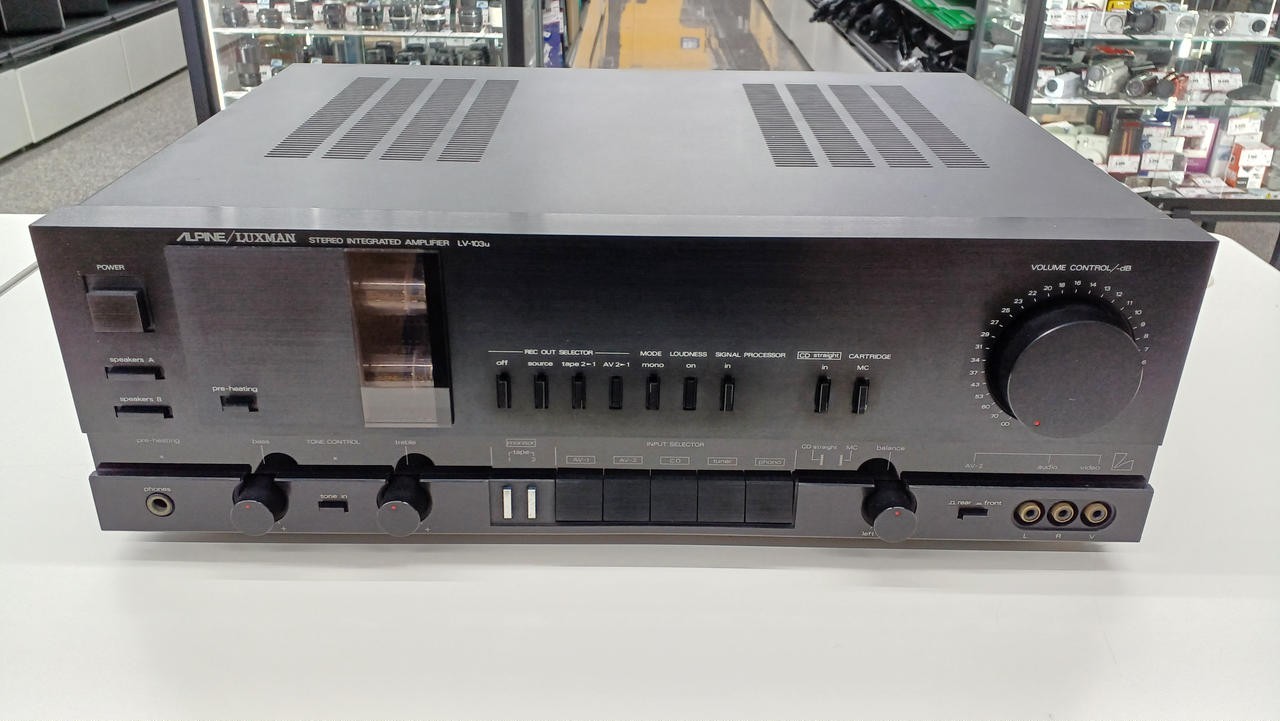
The Luxman LV-103 is a stereo integrated amplifier that sits directly below the LV-105 in Luxman's LV series lineup. It's a solid-state design, but one that carries itself with the kind of gravitas usually reserved for the company's more exotic offerings. At 12.6kg and 440 x 163 x 384mm, it's a substantial piece of engineering that demands respect on any shelf.
This is the amplifier Luxman built for people who wanted the LV-105 experience without the flagship price tag — though "budget" is hardly the right word for a unit that originally sold for ¥135,000 in Japan. The LV-103 delivers 100W+100W into 8Ω and 130W+130W into 4Ω, with a bridged mono mode that pushes 300W into 8Ω. Those figures alone would be impressive, but what really sets this amplifier apart is how it achieves them.
Luxman's approach here was deliberately conservative on paper and aggressive in execution. The 0.005% THD at 1kHz into 8Ω is genuinely excellent for the era, and the 0.009% figure across the full 20Hz–20kHz band tells you the designers weren't just chasing a single favorable measurement point. The signal-to-noise ratio of 100dB means the noise floor is essentially inaudible in practical use.
Key Features
Dual Toroidal Transformers
Open one of these up and the first thing you notice is the iron. Owners report dual toroidal transformers that are genuinely large — not the skimpy units found in lesser integrateds of the period. This isn't just about bragging rights; it's about current delivery. The 4Ω rating of 130W per channel suggests an amplifier that doesn't roll over when faced with difficult loads, and that kind of headroom comes directly from the power supply. The separate power supply for the preamplifier stage further isolates sensitive circuitry from the demands of the output section.
OPC (Optimum Playing Curve) Selection
Luxman's OPC system is one of those features that sounds like marketing jargon until you actually use it. The idea is straightforward: different listening situations call for different amplifier behaviors, and OPC lets you tailor the response without resorting to crude tone controls. It's a selectable curve that adjusts the amplifier's operating characteristics to match the source material or your listening preferences. Audiokarma owners describe it as genuinely useful rather than gimmicky — a rare compliment for any proprietary switching system.
Line Direct Switch
For purists who want the shortest possible signal path, the Line Direct switch bypasses unnecessary circuitry in the line stage. This is a feature that acknowledges the amplifier's own tone controls and processing can color the sound, and gives you the option to strip them out entirely. Combined with the pre-out jacks, it makes the LV-103 flexible enough to serve as a standalone preamp feeding a larger power amplifier if you ever feel the need.
4-Gang Volume Potentiometer
Luxman fitted the LV-103 with the company's standard 4-gang volume potentiometer — a component that maintains channel tracking accuracy across the entire rotation range. This matters more than most specs suggest; a poorly matched volume pot causes the stereo image to shift as you turn it down. The 4-gang design keeps left and right channels locked together, which is one of those details that contributes to the LV-103's reputation for rock-solid imaging. It's also, unfortunately, one of the components that ages poorly — more on that in the collectibility section.
Complete Input Flexibility
The rear panel offers PHONO (MM), TUNER, CD, AUX, TAPE 1, and TAPE 2 inputs, with TAPE 1 and TAPE 2 outputs plus PRE OUT jacks. That means two tape loops with full monitor capability, a dedicated phono stage that owners consistently praise as excellent, and enough line-level inputs for a complete system. The input sensitivity of 150mV into 50kΩ is standard for the era and plays nicely with virtually any source component you'd pair with it. Speaker A/B selection buttons round out the package for multi-room or bi-wiring setups.
Sound Character
The LV-103 has developed a following among owners who describe it in terms that sound contradictory on paper: warm, musical, and detailed all at once. The phono stage is repeatedly singled out as a highlight — not just acceptable, but genuinely excellent, which is rare for an integrated amplifier where phono stages are often afterthoughts. Forum owners call it "one of the best integrated amps I've owned" and describe it as a "giant killer," suggesting the 100W rating undersells its real-world authority. The build quality is superb, with the aluminum front panel and substantial chassis inspiring confidence that this was built to last decades — which, given the surviving examples, it has.
One criticism does surface repeatedly: the tone controls remain in the signal path even when set to flat. For some users this is a non-issue; for purists who want the absolute cleanest path, it's a reason to engage the Line Direct switch and never look back. It's a legitimate design decision that Luxman made, and whether it bothers you depends entirely on your philosophy about signal purity versus convenience.
HiFi-Stereo (September 1986, p.43) described Luxman's approach with the LV-103 and its sibling as engineers rediscovering the vacuum tube in an effort to push past conventional amplification boundaries — a hybrid philosophy that informed the LV-103's design character even in its solid-state implementation. The same publication noted in January 1985 (p.62) that both the LV-105 at $495 and the LV-103 at $330 were hybrid tube/transistor designs, with two small vacuum tubes visibly mounted flush on the front panel of each amplifier.
Collectibility & Value
The LV-103 originally sold for ¥135,000 in Japan, which placed it firmly in the serious-audiophile category rather than the mass market. Today, a clean example with documentation commands around $699 USD on the dealer market — a price that reflects both the amplifier's reputation and its relative scarcity in excellent condition.
There are two things to know before buying. First, the volume potentiometer is a known trouble spot. Units that have sat unused for years often arrive with scratchy volume pots, and the Luxman-specific 4-gang potentiometer is now hard to source as a replacement. A proper cleaning with DeoxIT treatment usually resolves the issue, but it's worth factoring into your offer if you're buying one that hasn't been serviced. Second, the best-preserved examples have typically been recapped — one dealer listing notes a unit recapped in November 2023 with Elna Silmic II capacitors, which is exactly the kind of proactive maintenance these amplifiers deserve.
When you find one that's been cared for, the consensus from owners is unambiguous: the LV-103 is an "excellent quality amplifier with very good specs" that delivers "clean and detailed sound." The frequency response holds from 30Hz to 20kHz within ±0.5dB in the audio band, with Luxman's own published spec extending to 5Hz–100kHz at +0dB/–1dB for the wideband response — figures that explain why these amplifiers still command respect decades after they left the factory.
eBay Listings



As an eBay Partner, we earn from qualifying purchases. This helps support our independent vintage technology research.
Related Models
- Luxman MS-11 (1974)
- Luxman 5L15
- Luxman 5T-50 (1977)
- Luxman C-03 (1978)
- Luxman C-9II (1979)
- Eico 3150 (1967)
- Fisher CUSTOM-ELECTRA-I (K-14/K-15) (1957)
- Fisher CUSTOM-ELECTRA IV (E33/E44) (1960)
- Akai AM-2400 (1978)
- Akai AM-2600 (1977)