Luxman L-80: The Quiet Masterpiece of Japanese Preamplifier Design
In the pantheon of vintage high-fidelity audio equipment, few brands command the respect and reverence that Luxman does. Hailing from Japan and founded in 1925, Luxman has long been synonymous with meticulous engineering, understated elegance, and a sonic signature that balances precision with musicality. Among its esteemed lineup from the 1970s, the Luxman L-80 stands as a quiet yet formidable representative of the brand’s golden era—an era when Japanese manufacturers were redefining the global audiophile landscape.
Released in 1975, the Luxman L-80 is a preamplifier that embodies the design philosophy of its time: discrete component construction, minimal feedback, and an unwavering commitment to signal purity. Unlike the flashier receivers or powerful amplifiers of the period, the L-80 operates behind the scenes, shaping the tonal character and dynamics of an entire system with grace and authority. Though not as widely documented as some of its contemporaries, the L-80 has earned a loyal following among vintage audio enthusiasts for its refined sound, build quality, and rarity.
Technical Specifications
The Luxman L-80 was engineered during a transitional period in audio design—before the full digital revolution, when analog circuitry was still king and manufacturers competed on the subtleties of tone, channel separation, and signal-to-noise performance. As a preamplifier, the L-80 was designed to pair seamlessly with high-quality power amplifiers and source components of the era, such as turntables, reel-to-reel decks, and FM tuners.
| Specification | Detail |
| Model | L-80 |
| Manufacturer | Luxman Corporation, Japan |
| Year of Release | 1975 |
| Type | Stereo Preamplifier |
| Gain | Approximately 26 dB (line stage) |
| Frequency Response | 10 Hz – 100 kHz (+0, -1 dB) |
| Total Harmonic Distortion | < 0.05% (1 kHz, rated output) |
| Signal-to-Noise Ratio | > 90 dB (A-weighted) |
| Input Sensitivity | 200 mV (for rated output) |
| Output Level | 2 V (maximum) |
| Input Impedance | 47 kΩ |
| Output Impedance | 600 Ω |
| Inputs | 4 line-level (RCA), 1 MM phono |
| Outputs | 1 main out (RCA), 1 tape loop (bi-wired) |
| Power Supply | Internal linear transformer |
| Power Consumption | 30 watts |
| Dimensions (W×H×D) | 430 × 145 × 345 mm |
| Weight | 11.5 kg (approx. 25.3 lbs) |
| Finish Options | Black or silver faceplate |
Notably, the L-80 features a discrete transistor design—meaning it avoids integrated circuits in favor of individual transistors and passive components. This approach was typical of high-end gear from Luxman, Accuphase, and Sansui during the 1970s and is often credited with delivering a more organic, "analog" sound. The preamp also includes a dedicated MM phono stage, allowing direct connection to moving magnet cartridges without the need for an external phono preamp.
Sound Characteristics and Performance
The sonic signature of the Luxman L-80 is often described as warm, smooth, and highly musical—a hallmark of Luxman’s design ethos. It avoids the clinical precision of some Western equipment in favor of a more engaging, lifelike presentation. Midrange clarity is exceptional, making it ideal for vocal and acoustic recordings, while the bass remains tight and well-controlled, never bloated or loose.
One of the L-80’s most praised attributes is its spacious soundstage and excellent instrument separation. Even by modern standards, the preamp renders complex passages with coherence and grace. Its high-frequency response is extended but never harsh, avoiding the sibilance or glare that can plague lesser designs. This balance makes it particularly well-suited for long listening sessions, where listener fatigue becomes a concern with brighter equipment.
When paired with complementary power amplifiers—such as the Luxman M-8000 or contemporary offerings from Yamaha, Kenwood, or Harman Kardon—the L-80 reveals its full potential as a system cornerstone. It imparts a subtle richness to the sound, often likened to the warmth of tube gear, despite being entirely solid-state.
Notable Features and Innovations
While the L-80 may appear conservative in design, it incorporates several thoughtful engineering choices that reflect Luxman’s attention to detail:
- Discrete DC Amplifier Circuitry: The use of discrete transistors throughout the signal path minimizes phase distortion and preserves signal integrity.
- High-Quality Passive Components: Luxman employed premium capacitors and resistors, many of which are still revered today for their reliability and sonic performance.
- Dual-Gang Precision Potentiometer: The volume control is a high-grade Alps or equivalent dual-gang unit, known for smooth operation and excellent channel tracking.
- Tape Loop with Switchable Monitoring: Allows for recording source material while maintaining signal integrity.
- Selectable Input Loading: Some units feature adjustable loading for optimizing phono stage performance with different cartridges.
- Heavy-Duty Chassis and Damping: The thick steel chassis reduces vibration and electromagnetic interference, contributing to a quieter background.
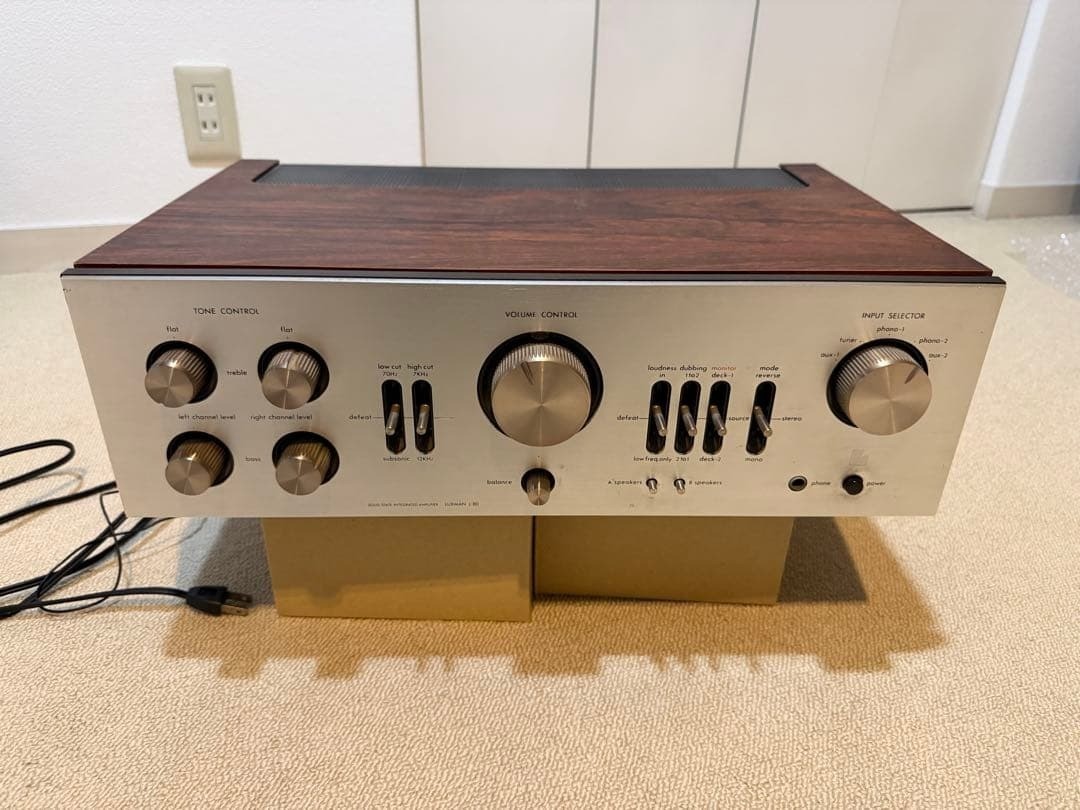
The front panel is minimalist yet elegant, featuring a large central volume knob, input selector, and small VU-style meters (on certain variants) for level monitoring. The overall aesthetic is understated—no flashing lights or excessive labeling—emphasizing function and longevity over trendiness.
Common Issues and Maintenance
As with any vintage electronic equipment, the Luxman L-80 requires careful attention to remain in optimal condition. Common issues include:
- Dried-up electrolytic capacitors: The power supply and signal path capacitors may need replacement after 40+ years. This is especially critical for the phono stage, where degraded caps can cause hum or loss of bass.
- Noisy potentiometers: The volume and balance controls can develop crackling or channel imbalance. Cleaning with contact cleaner may help, but replacement with modern equivalents is often recommended.
- Oxidized RCA jacks: Input/output jacks may require cleaning or resoldering to maintain solid connections.
- Worn selector switch contacts: The rotary input selector can accumulate dirt, leading to intermittent signals. Regular cleaning with DeoxIT is advised.
A full recap (capacitor replacement) by a qualified technician is strongly recommended before extended use. Additionally, ensuring the unit is stored in a dry, temperature-stable environment will help preserve its longevity.
Current Market Value and Collectibility
The Luxman L-80 is rarely seen on the market, especially in fully functional condition. When it does appear, prices typically range from $600 to $1,200 USD, depending on cosmetic condition, functionality, and whether it has been restored. Fully serviced units with original packaging and documentation can command even higher prices among collectors.
Its collectibility stems not only from its performance but also from its historical significance. The mid-1970s marked a high point for Japanese hi-fi, and the L-80 represents Luxman’s commitment to quality during that era. While overshadowed by more famous models like the C-05 or later L-505 series, the L-80 is increasingly recognized as a sleeper classic—a hidden gem for those who value subtlety over spectacle.
Conclusion and Legacy
The Luxman L-80 may not have the name recognition of some of its peers, but it stands as a testament to the quiet excellence of Japanese high-end audio engineering in the 1970s. It is a preamplifier built not for show, but for enduring musical satisfaction. With its warm, detailed sound, robust construction, and timeless design, the L-80 continues to earn admiration from audiophiles who appreciate gear that ages with grace.
For those building a vintage system centered on musicality and refinement, the Luxman L-80 is more than just a component—it’s a conductor of emotion, a bridge between the analog past and the timeless joy of listening. In a world of ever-changing audio trends, the L-80 reminds us that true quality never goes out of style.
eBay Listings


As an eBay Partner, we earn from qualifying purchases. This helps support our independent vintage technology research.
Related Models
- Luxman L-530 (1975)
- Luxman R-404 (1975)
- Luxman RV-371 (1975)
- Luxman SQ-38U (1975)
- Luxman T-14 (1972)
- Luxman T-530 (1975)
- Luxman TX-101 (1975)
- Denon DRA-800 (1985)
- Denon PMA-350Z (1980)
- Denon POA-1500 (1979)