Luxman L-550AII: The Pinnacle of Japanese Preamplifier Craftsmanship
In the pantheon of high-end vintage audio, few names command as much respect as Luxman. Renowned for their meticulous engineering, elegant design, and unwavering commitment to sonic purity, the Japanese manufacturer reached a creative zenith in the 1980s. Among the standout models from this golden era is the Luxman L-550AII, a dual-monaural preamplifier that exemplifies the brand’s philosophy of combining cutting-edge technology with audiophile-grade refinement.
Released in 1984, the L-550AII was positioned as the flagship preamplifier in Luxman’s lineup, succeeding the original L-550A. It was crafted during a period when Japanese high-fidelity manufacturers were pushing the boundaries of analog performance, and Luxman stood at the forefront with its focus on discrete circuitry, premium components, and thoughtful signal path design. The L-550AII wasn’t just an upgrade—it was a statement of intent: to deliver a preamplifier that could serve as the heart of the most discerning audio systems.
Technical Specifications
The L-550AII was engineered with a dual-monaural architecture, meaning that the left and right audio channels are completely separate from input to output, minimizing crosstalk and preserving stereo imaging. This design philosophy, typically reserved for the most expensive electronics, underscores Luxman’s commitment to performance.
| Specification | Detail |
| Model | L-550AII |
| Year of Release | 1984 |
| Type | Dual-Monaural Preamplifier |
| Gain (Line) | Approximately 26 dB |
| Frequency Response | 5 Hz – 100 kHz (+0, -1 dB) |
| Total Harmonic Distortion | Less than 0.01% (1 kHz, rated output) |
| Input Impedance | 47 kΩ (all line inputs) |
| Output Impedance | 100 Ω |
| Inputs | 4 Line (RCA), 1 Moving Magnet (MM) Phono |
| Outputs | 1 Main (RCA), 1 Tape (RCA) |
| Power Supply | Discrete regulated power for each channel |
| Dimensions | 435 mm (W) × 147 mm (H) × 385 mm (D) |
| Weight | Approx. 14.5 kg |
| Finish Options | Silver or Black Metallic |
Notably, the L-550AII features a discrete transistor-based design—no ICs in the audio path—ensuring a pure, analog signal flow. The phono stage is tailored for moving magnet (MM) cartridges and includes switchable equalization for 47 kΩ or 100 kΩ loading, allowing users to fine-tune the cartridge match. The power supply is robust and fully regulated, with independent regulation for each channel to maintain signal integrity.
Sound Characteristics and Performance
The sonic signature of the Luxman L-550AII is best described as transparent, balanced, and dynamically expressive. It doesn’t impose a coloration on the music; instead, it acts as a neutral conduit, revealing the true character of the source material and downstream components.
Listeners often praise the L-550AII for its exceptional clarity and detail retrieval, particularly in the midrange where vocals and acoustic instruments are rendered with lifelike presence. The bass is tight and well-controlled, while the treble remains smooth and extended without becoming harsh or fatiguing. Its wide frequency response and low distortion contribute to a soundstage that is both expansive and precisely layered.
Thanks to its dual-monaural construction, stereo imaging is outstanding—pinpoint accurate with excellent depth and separation. Whether playing classical recordings with complex orchestral arrangements or intimate jazz trios, the L-550AII delivers a cohesive and immersive listening experience.
Notable Features and Innovations
Several design elements set the L-550AII apart from its contemporaries:
- Dual-Monaural Circuitry: Complete physical and electrical separation of left and right channels reduces interference and enhances channel isolation.
- Discrete Component Design: Luxman avoided integrated circuits in favor of discrete transistors and premium resistors/capacitors, ensuring the highest fidelity.
- High-Quality Relays: Input selection is handled by sealed relays, which offer superior longevity and signal integrity compared to mechanical switches.
- Precision Volume Control: A stepped attenuator provides precise, repeatable volume adjustment without the degradation associated with potentiometers.
- Sophisticated Power Supply: Each channel benefits from its own regulated power supply, minimizing interaction and noise.
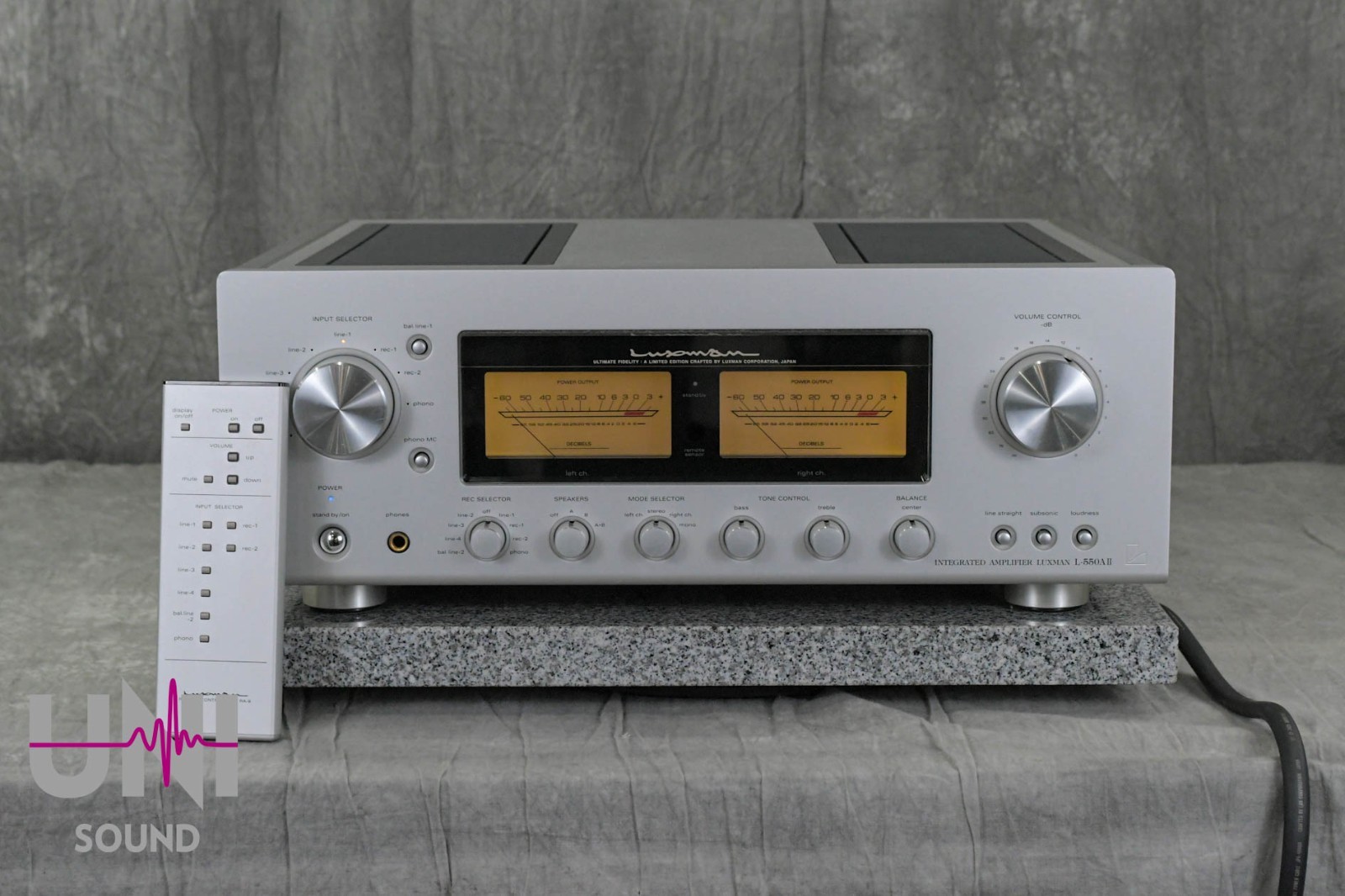
The front panel features a minimalist aesthetic with a large central volume knob, input selector, and essential function buttons (mute, balance, tape monitor). The build quality is exceptional—thick aluminum faceplate, heavy chassis, and high-grade internal wiring reflect Luxman’s dedication to durability and performance.
Common Issues and Maintenance
As with any vintage high-end equipment, the L-550AII requires careful attention to maintain optimal performance. While generally reliable, aging components can introduce issues over time:
- Capacitor Aging: Electrolytic capacitors in the power supply and signal path may degrade after decades, leading to hum, noise, or reduced performance. A full recapping by a qualified technician is often recommended for units that haven’t been serviced.
- Relay Contact Oxidation: The input relays, while high-quality, can develop resistance over time. Cleaning or replacement may be necessary if input switching becomes erratic.
- Volume Control Wear: Although the stepped attenuator is robust, contact wear can occur. Servicing may involve cleaning or replacing resistors in the attenuator ladder.
- Phono Stage Sensitivity: The MM stage remains capable, but users with modern low-output cartridges may find it insufficient—pairing with a separate phono preamp is advisable.
Regular cleaning of connectors and proper ventilation will help preserve the unit. Given its collectible status, finding a well-maintained L-550AII is key to enjoying its full potential.
Current Market Value and Collectibility
The Luxman L-550AII has become a highly sought-after collector’s item among vintage audio enthusiasts. Its combination of flagship status, elegant design, and superb sound quality ensures strong demand in the secondhand market.
Units in excellent cosmetic and working condition typically sell between $1,800 and $2,800 USD, with prices influenced by provenance, service history, and included accessories. Fully serviced examples with recapped power supplies and cleaned controls command premiums, especially in North America and Europe where Luxman’s reputation has grown significantly in recent years.
Its collectibility is bolstered by its rarity—Luxman produced relatively small numbers of flagship models—and its place in the brand’s legacy. The L-550AII represents the culmination of 1980s Japanese high-end audio engineering, making it a prized centerpiece for vintage systems.
Conclusion and Legacy
The Luxman L-550AII stands as a testament to what is possible when engineering excellence meets artistic vision. More than four decades after its release, it remains a benchmark for preamplifier design—offering a listening experience that is both technically impressive and emotionally engaging.
It embodies the golden age of Japanese hi-fi: a time when manufacturers like Luxman, Accuphase, and Audio Research were redefining the limits of analog reproduction. For today’s audiophiles, the L-550AII is not just a vintage component—it’s a bridge to a bygone era of craftsmanship and sonic purity.
Whether you're building a classic system or seeking a preamplifier with timeless performance, the Luxman L-550AII delivers with grace, authority, and enduring quality. It’s not merely a piece of equipment—it’s a legacy in a chassis.
eBay Listings


As an eBay Partner, we earn from qualifying purchases. This helps support our independent vintage technology research.
Related Models
- Luxman L-530 (1975)
- Luxman R-404 (1975)
- Luxman RV-371 (1975)
- Luxman SQ-38U (1975)
- Luxman T-14 (1972)
- Luxman T-530 (1975)
- Luxman TX-101 (1975)
- Denon DRA-800 (1985)
- Denon PMA-350Z (1980)
- Denon POA-1500 (1979)