Luxman L-509X: The Pinnacle of Modern Japanese High-End Amplification
When discussing the upper echelon of Japanese high-fidelity audio equipment, few names command as much respect as Luxman. Known for their meticulous engineering, elegant design, and a long-standing commitment to sonic purity, Luxman has consistently delivered amplifiers that blend tradition with innovation. The L-509X, introduced in 2017, stands as a flagship integrated amplifier in Luxman’s modern catalog—a masterful synthesis of decades of analog expertise and cutting-edge technology. While not a vintage model in the traditional sense, the L-509X is already regarded as a future classic, embodying the spirit of vintage audio excellence with contemporary performance.
Introduction and Historical Context
Luxman, founded in 1925, has long been a benchmark for high-end audio in Japan and beyond. The company’s golden era in the 1970s and 1980s produced legendary models like the M-05 monoblocks and the C-05 preamplifier, which remain highly sought after today. In the 2010s, Luxman reasserted its position at the forefront of audio design with a new generation of products that honor their heritage while embracing modern advancements.
The L-509X was launched as the successor to the acclaimed L-507u and L-509, serving as the centerpiece of Luxman’s integrated amplifier lineup. Positioned above the L-507u and below the fully balanced, dual-monaural L-590aII, the L-509X was designed for audiophiles who demand reference-level performance without the complexity of separates. It reflects Luxman’s philosophy of “Less is More” — a focus on signal purity, minimal circuitry, and premium components.
Technical Specifications
| Specification | Detail |
| Model | L-509X |
| Type | Integrated Amplifier |
| Year Introduced | 2017 |
| Output Power | 80 watts per channel (8Ω) |
| 120 watts per channel (4Ω) | |
| Frequency Response | 10 Hz – 100 kHz (+0, -1 dB) |
| Total Harmonic Distortion | < 0.05% (1 kHz, rated output) |
| Input Sensitivity | 250 mV (MM), 2.5 mV (MC), 200 mV (Line) |
| Input Impedance | 47 kΩ (MM), 100 Ω (MC), 47 kΩ (Line) |
| Output Impedance | 0.13 Ω |
| Signal-to-Noise Ratio | 103 dB (IHF-A weighted) |
| Phono Equalization | RIAA (adjustable gain and load) |
| Inputs | 3 Line (RCA), 1 MM, 1 MC |
| Outputs | 1 Pre-out, 1 Headphone (6.3mm) |
| Speaker Outputs | A/B terminals, gold-plated binding posts |
| Power Supply | Custom toroidal transformer |
| Dimensions (W×H×D) | 440 × 145 × 432 mm |
| Weight | 22.5 kg (49.6 lbs) |
| Finish Options | Black, Silver |
Sound Characteristics and Performance
The Luxman L-509X delivers a sound that is at once richly textured and dynamically precise—a hallmark of the Luxman aesthetic. It strikes a rare balance between warmth and clarity, avoiding the clinical sterility sometimes found in modern solid-state designs while maintaining exceptional detail retrieval.
Powered by a discrete Class A/B amplification stage and driven by a massive toroidal transformer, the L-509X offers tight control over speakers, with deep, articulate bass and a spacious, three-dimensional soundstage. Its midrange is particularly captivating—natural and expressive, ideal for vocal and acoustic recordings. High frequencies are smooth and extended, never harsh or fatiguing, making long listening sessions a pleasure.
One of the L-509X’s standout features is its built-in phono stage, which supports both Moving Magnet (MM) and Moving Coil (MC) cartridges with adjustable gain and impedance loading. This level of flexibility is uncommon in integrated amplifiers at any price, and Luxman’s implementation is exceptional—quiet, dynamic, and musically engaging. Vinyl enthusiasts will appreciate the ability to connect a turntable directly without needing an external phono preamp.
The amplifier’s circuitry is designed with a short signal path and minimal feedback, contributing to its transparent and organic sound. Luxman’s proprietary O.C.D. (Optimum Class Damping) circuit helps maintain control over speaker drivers, especially in the bass region, resulting in tight, well-defined low frequencies even with complex musical passages.
Notable Features and Innovations
The L-509X is packed with thoughtful engineering touches that elevate it beyond typical integrated amplifiers:
- Discrete Buffer Circuitry: Instead of using op-amps, Luxman employs discrete transistors in the preamplifier stage, reducing coloration and improving transient response.
- Variable Gain Function: Allows users to adjust the output level for different sources or speaker sensitivities, enhancing system compatibility.
- High-Purity Materials: Internal wiring uses oxygen-free copper, and critical components are hand-selected for performance and longevity.
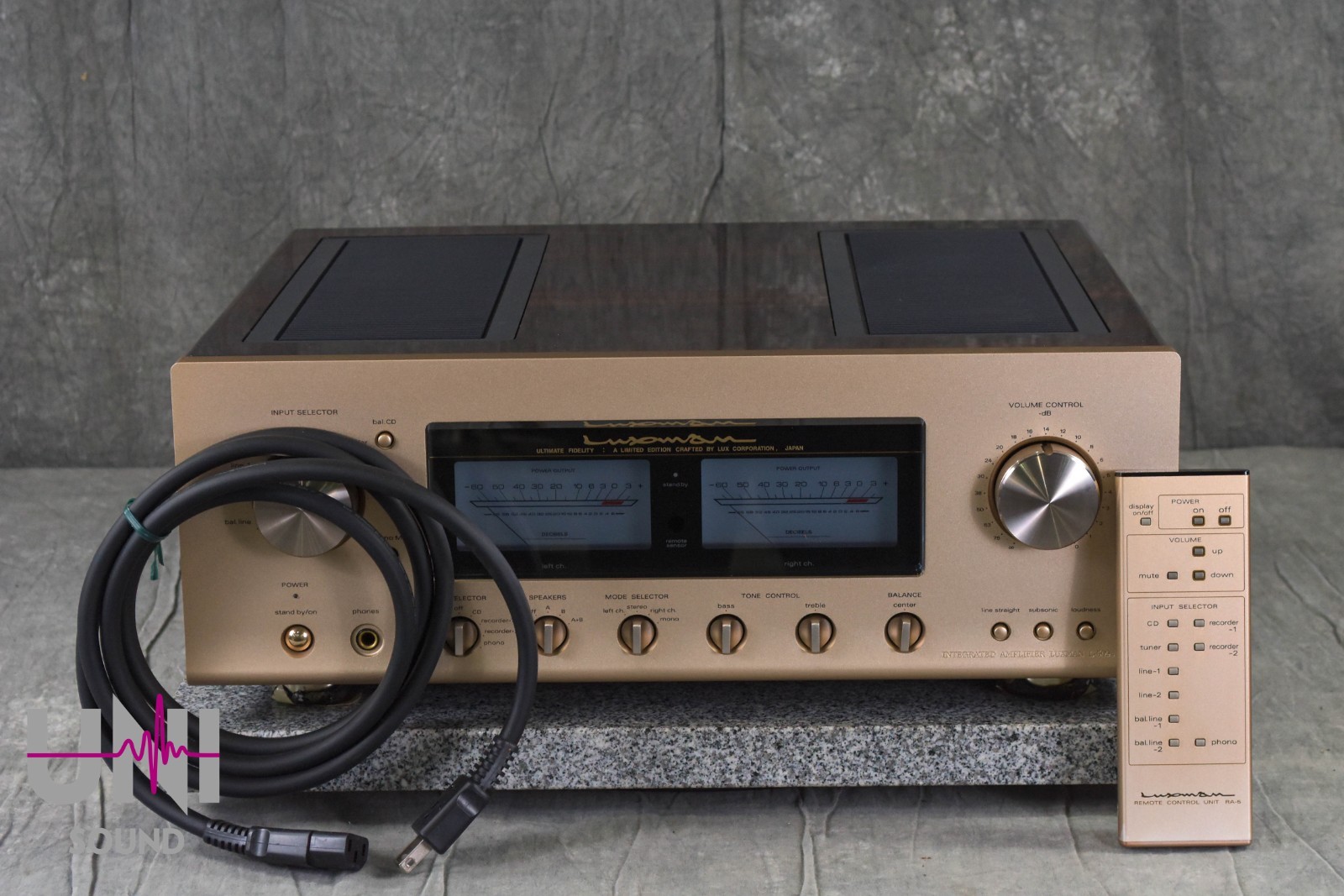
- Luxman’s Classic Design Language: The front panel features a large central VU meter (with input selection display), flanked by polished aluminum knobs. The build quality is superb, with a rigid chassis designed to minimize vibration and electromagnetic interference.
- Headphone Amplifier: A dedicated headphone output on the front panel drives high-impedance headphones with authority and detail, making the L-509X a true all-in-one solution.
Common Issues and Maintenance
The L-509X is a robustly built amplifier with a reputation for reliability. However, as with any high-performance electronic device, proper care is essential:
- Ventilation: Due to its high-quality internal components and substantial power supply, the L-509X should be placed in a well-ventilated area. Avoid enclosing it in tight cabinets.
- Cleaning: The front panel and knobs can be cleaned with a soft, dry cloth. Avoid chemical cleaners that may damage the finish.
- Phono Stage Sensitivity: While the MC input is highly sensitive, users should ensure their cartridge impedance and output voltage are within compatible ranges to avoid noise or distortion.
- Firmware Updates: Luxman occasionally releases firmware updates for digital functions (if applicable via optional modules), so checking with an authorized dealer periodically is recommended.
No widespread reliability issues have been reported, and the L-509X benefits from Luxman’s excellent customer support and parts availability.
Current Market Value and Collectibility
As a relatively recent high-end model, the L-509X is not yet “vintage” in the chronological sense, but it is already considered a modern classic. New units originally retailed for around $7,000–$8,000 USD, and the secondary market reflects strong demand, with used examples typically selling for $4,500–$6,000, depending on condition and accessories.
Its collectibility stems from several factors:
- Luxman’s resurgence in global prestige
- Limited production runs of flagship models
- The L-509X’s role as a technological bridge between classic and modern Luxman design
- Strong resale value compared to other integrated amplifiers
Owners often hold onto these units for years, which limits availability and supports long-term value retention.
Conclusion and Legacy
The Luxman L-509X is more than just an integrated amplifier—it’s a statement of audiophile values. It combines the warmth and musicality associated with vintage Japanese gear with the precision and build quality of modern high-end audio. For those seeking a single-box solution without compromise, the L-509X delivers performance that rivals separates, wrapped in a design that honors Luxman’s storied legacy.
While it may not yet have the decades-old pedigree of a 1970s Luxman, the L-509X is undoubtedly on a path to becoming a future classic. It represents the best of what modern Japanese audio engineering can achieve: thoughtful design, meticulous craftsmanship, and above all, a deep respect for the music. For the discerning listener, the Luxman L-509X isn’t just an amplifier—it’s an heirloom in the making.
eBay Listings


As an eBay Partner, we earn from qualifying purchases. This helps support our independent vintage technology research.
Related Models
- Luxman L-530 (1975)
- Luxman R-404 (1975)
- Luxman RV-371 (1975)
- Luxman SQ-38U (1975)
- Luxman T-14 (1972)
- Luxman T-530 (1975)
- Luxman TX-101 (1975)
- Denon DRA-800 (1985)
- Denon PMA-350Z (1980)
- Denon POA-1500 (1979)