Luxman L-509S: The Pinnacle of Analog Refinement
In the pantheon of high-fidelity audio, few names command the reverence of Luxman, the Japanese manufacturer renowned for its meticulous craftsmanship, musical transparency, and enduring build quality. Among its distinguished lineup of vintage components, the Luxman L-509S stands as a quiet masterpiece—a preamplifier that embodies the brand’s philosophy of harmonic richness, analog purity, and understated elegance. Released in 1995, during Luxman’s golden era of analog design, the L-509S was not merely a preamp; it was a statement of intent—an heirloom-grade component built for discerning audiophiles who valued tonal accuracy and emotional engagement over flashy features.
Though not as widely known as some of its contemporaries from brands like Accuphase or Marantz, the L-509S has cultivated a devoted following among vintage audio connoisseurs. It represents a transitional moment in Luxman’s history—bridging the warm, tube-influenced sound of earlier models with the more refined, technically advanced solid-state designs that would follow. The “S” in its model number denotes a special or upgraded version, suggesting that the L-509S was more than just a standard iteration—it was a refinement of the already excellent L-509, with improved circuitry, better power supply regulation, and enhanced component selection.
Technical Specifications
The L-509S is a dual-mono, fully discrete, solid-state preamplifier designed with audiophile-grade components throughout. It features a symmetrical signal path, high-quality volume control, and a carefully regulated power supply to ensure minimal noise and maximum signal integrity. While Luxman never published exhaustive technical documentation for the L-509S, its design principles align with the brand’s known engineering practices of the era.
| Specification | Detail |
| Model | L-509S |
| Year of Release | 1995 |
| Type | Solid-state stereo preamplifier |
| Gain | Approx. 10 dB (line stage) |
| Frequency Response | 5 Hz – 100 kHz (+0, -1 dB) |
| Total Harmonic Distortion | < 0.01% (1 kHz, rated output) |
| Signal-to-Noise Ratio | > 100 dB (A-weighted) |
| Input Impedance | 47 kΩ |
| Output Impedance | 100 Ω |
| Inputs | 4 line-level (RCA), 1 tape loop |
| Outputs | Main out, tape out, subwoofer (variable) |
| Volume Control | High-precision stepped attenuator |
| Power Supply | Dual toroidal transformers, discrete regulation |
| Power Consumption | 60 W |
| Dimensions (W×H×D) | 440 × 148 × 385 mm |
| Weight | 14.5 kg |
| Finish Options | Silver, Black |
One of the standout features of the L-509S is its dual-mono architecture, meaning that the left and right channels are completely isolated from each other, both electrically and physically, to prevent crosstalk and maintain stereo imaging precision. This design choice was relatively rare in preamplifiers of the 1990s and underscores Luxman’s commitment to high-end performance.
Sound Characteristics and Performance
The Luxman L-509S is often described as having a "luxurious" sound—smooth, detailed, and effortlessly musical. It doesn’t shout its presence; instead, it invites the listener into the recording with a natural tonal balance and exceptional midrange clarity. Vocals are rendered with lifelike presence, strings possess body and texture, and acoustic instruments bloom with a sense of space and air.
Unlike some solid-state preamps that can sound clinical or overly analytical, the L-509S retains a subtle warmth reminiscent of tube designs—without sacrificing speed or control. This is partly due to Luxman’s use of discrete transistor circuits rather than op-amps, which allows for greater linearity and a more organic transient response. The stepped attenuator volume control contributes to channel balance accuracy and eliminates the channel drift common in potentiometer-based designs.
Bass response is tight and well-defined, never bloated, while the treble is extended but never harsh. The preamp’s low noise floor ensures that even at high gain settings, there is no audible hiss—making it an excellent match for low-output moving coil phono stages or sensitive power amplifiers.
Notable Features and Innovations
The L-509S incorporates several design elements that set it apart from its peers:
- Dual Toroidal Power Supplies: One for each channel, minimizing interference and ensuring stable voltage delivery.
- Discrete Regulation: Instead of using IC regulators, Luxman employed discrete transistor-based regulation for cleaner power and better transient response.
- High-Quality Relays: Signal switching is handled by premium relays, preserving signal integrity over time.
- Subwoofer Output: A rare feature for its time, allowing integration with modern multi-channel systems or subwoofers without compromising stereo purity.
- Tape Loop with Monitor Function: Enables easy A/B comparison between source and recorded signal.
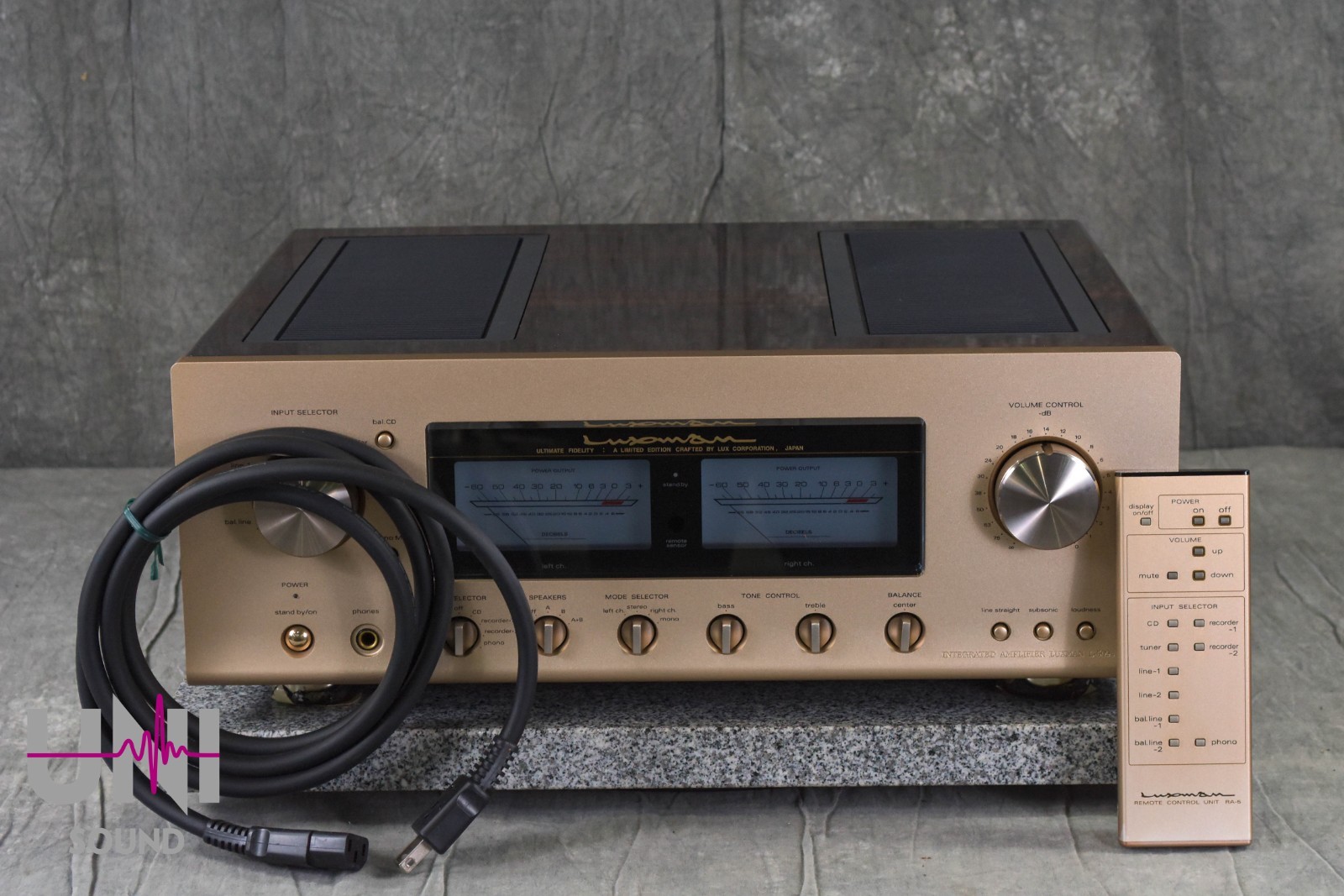
The front panel is minimalist yet elegant—featuring a large central volume knob, input selector, and essential function buttons. The build quality is exceptional: thick aluminum faceplate, precision-machined knobs, and a heavy chassis that resists vibration and resonance. It’s a component that feels as premium as it sounds.
Common Issues and Maintenance
As with any 30-year-old high-end electronics, the Luxman L-509S may require some attention to remain in top condition. While generally reliable, potential issues include:
- Capacitor Aging: Electrolytic capacitors in the power supply and signal path may degrade over time, leading to increased noise or channel imbalance. A full recapping by a qualified technician is recommended for units that haven’t been serviced.
- Relay Contact Oxidation: The signal relays can develop resistance over decades of use, affecting channel balance. Cleaning or replacement may be necessary.
- Volume Control Wear: Although the stepped attenuator is robust, mechanical wear or dust accumulation can cause crackling. Contact cleaning or disassembly may be required.
- Tuner Circuit (if present): Some variants included a built-in FM tuner, which is largely obsolete today but can be a source of noise if malfunctioning.
Fortunately, Luxman used high-quality, long-life components, and many L-509S units still operate flawlessly today. The company’s service documentation, while not always publicly available, is well-regarded among technicians familiar with vintage Japanese gear.
Current Market Value and Collectibility
The Luxman L-509S is not a common sight on the secondhand market, but when it does appear, it attracts serious interest. Units in excellent condition typically sell for $800 to $1,500, depending on provenance, finish, and whether they’ve been recently serviced. Fully restored examples with upgraded capacitors or modified power supplies can command even higher prices.
Its collectibility stems from several factors: Luxman’s reputation for build quality, the L-509S’s dual-mono design, and its role in the brand’s evolution. While not as flashy as some of its contemporaries, it appeals to purists who value musicality over specifications.
Conclusion and Legacy
The Luxman L-509S is more than a preamplifier—it’s a testament to a time when audio components were built to last, designed with care, and voiced with musicality as the highest priority. In an age of digital streaming and integrated systems, the L-509S reminds us of the beauty of analog signal paths, meticulous engineering, and the emotional impact of well-reproduced music.
It may not have the name recognition of a Marantz 2270 or a Sansui 9090, but for those in the know, the L-509S represents the quiet excellence that defines Luxman’s legacy. Whether anchoring a vintage Japanese stack or serving as the linchpin of a modern high-end system, the L-509S continues to deliver a listening experience that is, above all, deeply satisfying.
For the audiophile who values refinement, reliability, and soulful sound, the Luxman L-509S remains a hidden gem—one that deserves a place among the greats of vintage audio.
eBay Listings



As an eBay Partner, we earn from qualifying purchases. This helps support our independent vintage technology research.
Related Models
- Luxman L-530 (1975)
- Luxman R-404 (1975)
- Luxman RV-371 (1975)
- Luxman SQ-38U (1975)
- Luxman T-14 (1972)
- Luxman T-530 (1975)
- Luxman TX-101 (1975)
- Denon DRA-800 (1985)
- Denon PMA-350Z (1980)
- Denon POA-1500 (1979)