Luxman L-509 Preamplifier: The Quiet Masterpiece of Japanese High-End Audio
In the late 1980s, Japanese audio engineering reached a creative zenith. Brands like Accuphase, Marantz, and Luxman were crafting components that balanced technical excellence with musical soul. Among these, the Luxman L-509 stands as a quiet but profound achievement—a preamplifier that embodies the philosophy of less is more, where refinement, transparency, and natural tonality take precedence over flashy features.
Introduced in 1989, the L-509 was positioned as a flagship preamplifier in Luxman’s lineup, sitting above the L-507 and previewing the design language and circuit philosophy that would influence later models like the L-550 and L-590. Though not as widely known as some of its contemporaries, the L-509 has earned a devoted following among vintage audio enthusiasts for its elegant sound, minimalist control layout, and exceptional build quality.
Technical Specifications
The L-509 is a stereo solid-state preamplifier designed with discrete circuitry and a focus on signal purity. It features a dual-mono design with independent power supplies for the left and right channels, a rare and sophisticated approach at the time—especially in preamplifiers. This architecture minimizes crosstalk and preserves stereo imaging with remarkable precision.
| Specification | Detail |
| Model | Luxman L-509 |
| Year Introduced | 1989 |
| Type | Solid-state stereo preamplifier |
| Gain | 26 dB (line), 56 dB (MM) |
| Frequency Response | 5 Hz – 100 kHz (-3 dB) |
| Total Harmonic Distortion | <0.01% (1 kHz, rated output) |
| Input Impedance | 47 kΩ (line), 47 kΩ / 100 pF (MM) |
| Output Impedance | 100 Ω |
| Inputs | 4 line-level, 1 MM phono |
| Outputs | 1 main out, 1 tape out |
| Power Supply | Dual independent regulated supplies |
| Power Consumption | 30 W |
| Dimensions (W×H×D) | 440 × 145 × 385 mm |
| Weight | 13.5 kg (approx.) |
| Finish | Silver or black (brushed aluminum face) |
Notably, the L-509 includes a high-quality moving magnet (MM) phono stage—a rarity in high-end preamps of the era, where phono stages were often relegated to separate components. This integration reflects Luxman’s commitment to vinyl enthusiasts and the belief that the preamplifier should serve as the central hub of an analog system.
Sound Characteristics and Performance
The Luxman L-509 is often described as having a “tube-like” warmth without the maintenance or fragility of vacuum tubes. This sonic signature stems from Luxman’s meticulous component selection and circuit topology, which emphasizes smooth harmonic reproduction and low noise.
The midrange is lush and expressive—ideal for vocal and acoustic recordings. Instruments like piano, cello, and voice are rendered with a natural timbre and palpable presence. The treble is extended but never harsh, avoiding the sibilance or glare that can plague lesser solid-state designs. Bass response is tight and well-controlled, with excellent pitch definition that pairs beautifully with high-efficiency speakers.
One of the L-509’s most admired qualities is its spacious soundstage. Imaging is precise, with instruments placed in a three-dimensional space that feels both realistic and immersive. The dual-mono power supply plays a key role here, contributing to a black background and exceptional dynamic contrast.
When paired with compatible power amplifiers—such as Luxman’s M-05 or contemporary models from Accuphase or Audio Research—the L-509 reveals its full potential as a transparent signal conductor, adding coloration only where the music intends it.
Notable Features and Innovations
The L-509 showcases several design hallmarks that set it apart from its peers:
- Discrete Class A Circuitry: Unlike many preamps that rely on op-amps, the L-509 uses discrete transistors operating in Class A, ensuring linearity and low distortion.
- Dual-Mono Power Supply: Each channel has its own rectifier and filtering, minimizing interference and enhancing channel separation.
- High-Quality Potentiometer: The volume control uses a precision Alps RK27 stepped attenuator, known for its durability and channel-matching accuracy.
- Phono Stage with Adjustable Load: Though designed for MM cartridges, the phono input includes selectable loading (via internal jumpers), allowing fine-tuning for different cartridges.
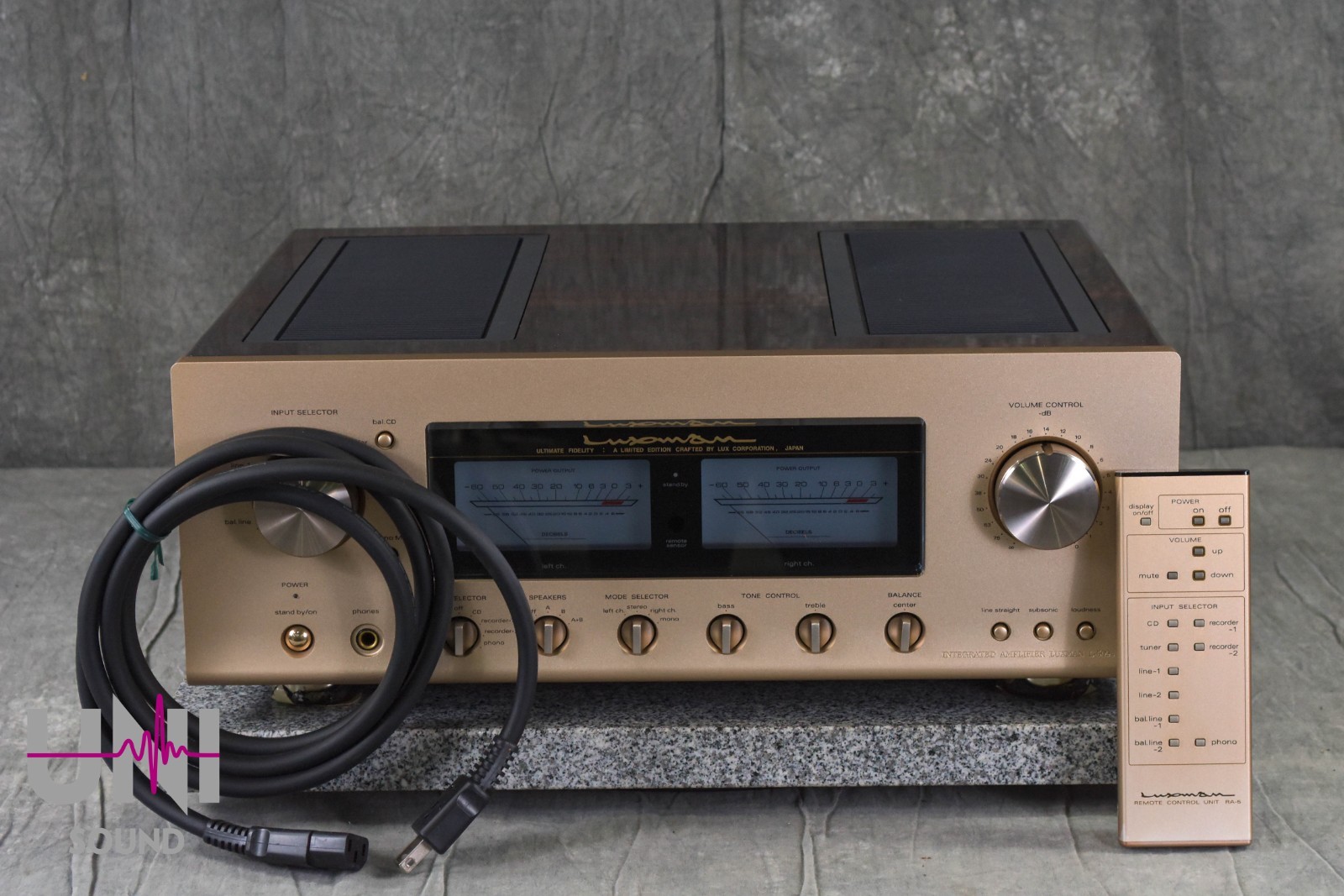
- Minimalist Front Panel: The clean layout—volume knob, input selector, mute, and tape monitor—reflects Luxman’s belief in user-focused design. No remote control was offered, emphasizing tactile interaction and simplicity.
Luxman also paid close attention to mechanical design. The chassis is rigid and heavily damped, with a thick aluminum front panel and internal steel sub-chassis to reduce vibration and electromagnetic interference. Internally, point-to-point wiring and high-grade capacitors (including proprietary Luxman film and electrolytic types) ensure signal integrity.
Common Issues and Maintenance
While the L-509 is renowned for its reliability, age-related issues can arise after more than three decades of service:
- Capacitor Aging: The electrolytic capacitors in the power supply and signal path may degrade over time, leading to increased noise or channel imbalance. Replacing these with modern equivalents (a process known as recapping) can restore original performance.
- Potentiometer Wear: The Alps volume pot, while robust, can develop crackling or channel imbalance. Cleaning with contact cleaner may help, but replacement is often recommended for long-term reliability.
- Phono Stage Sensitivity: The MM stage, while excellent for its time, may struggle with low-output cartridges. Users with moving coil (MC) cartridges will likely need an external step-up transformer or MC preamp.
- Tape Monitor Relay: The internal relay for tape monitoring can stick or fail, resulting in no output. This is typically repairable by a qualified technician.
Regular maintenance—such as cleaning connectors, checking solder joints, and ensuring proper ventilation—can extend the life of the L-509 indefinitely. Given its build quality, many units from the late 1980s remain fully functional today with minimal servicing.
Current Market Value and Collectibility
The Luxman L-509 is not as widely collected as some of its flashier contemporaries, but it is increasingly recognized as a sleeper classic. In recent years, well-maintained units have fetched between $800 and $1,500 on the secondary market, depending on condition, originality, and whether they’ve been serviced.
Its value is driven by several factors:
- Growing appreciation for Luxman’s understated engineering
- Rising interest in vintage Japanese high-end gear
- The resurgence of vinyl, which highlights the quality of its phono stage
Collectors favor units with original packaging, manuals, and unmodified internals. Silver finishes are slightly more common than black, but both are equally sought after.
Conclusion and Legacy
The Luxman L-509 is not a showstopper. It doesn’t boast glowing tubes, a remote control, or a forest of buttons. Instead, it represents a philosophy: that high-fidelity audio should be invisible, allowing the music to speak without interference.
In an era when many manufacturers chased power ratings and feature counts, Luxman stayed true to its roots—crafting components that prioritize musicality, longevity, and elegance. The L-509 is a testament to that vision.
Today, it remains a compelling choice for audiophiles building a vintage Japanese system or seeking a preamplifier with a natural, engaging sound. Whether driving classic speakers like the Tannoy Westminster or paired with modern high-efficiency designs, the L-509 continues to deliver a listening experience that is as emotionally satisfying as it is technically impressive.
For those who value substance over spectacle, the Luxman L-509 is not just a preamplifier—it’s a quiet masterpiece.
eBay Listings



As an eBay Partner, we earn from qualifying purchases. This helps support our independent vintage technology research.
Related Models
- Luxman L-530 (1975)
- Luxman R-404 (1975)
- Luxman RV-371 (1975)
- Luxman SQ-38U (1975)
- Luxman T-14 (1972)
- Luxman T-530 (1975)
- Luxman TX-101 (1975)
- Denon DRA-800 (1985)
- Denon PMA-350Z (1980)
- Denon POA-1500 (1979)