Luxman L-508 Preamplifier: Elegance, Precision, and the Soul of Analog
In the pantheon of high-end Japanese audio equipment from the late 1970s and early 1980s, few names command as much respect as Luxman. Renowned for their meticulous craftsmanship, understated elegance, and an unwavering commitment to analog purity, Luxman created components that were not just functional—they were heirlooms. Among these, the L-508 preamplifier, introduced around 1980, stands as a quiet masterpiece. Though not as widely discussed as some of its contemporaries, the L-508 embodies the philosophy that defined Luxman’s golden era: a balance of technical precision and musical soul.
Historical Context: The Rise of Japanese High-Fidelity
The late 1970s saw a surge in demand for high-quality home audio systems, particularly in North America and Europe. Japanese manufacturers like Luxman, Accuphase, and Sansui rose to prominence by offering equipment that combined cutting-edge engineering with exceptional build quality—often at competitive prices compared to their European counterparts. Luxman, founded in 1925, had already established a reputation for vacuum tube excellence in the 1950s and 60s. By the 1980s, they had seamlessly transitioned into solid-state design while retaining their core values: transparency, natural tonality, and long-term reliability.
The L-508 emerged during this pivotal time—a preamplifier designed for the discerning listener who valued subtlety over flash. It was part of a broader ecosystem of Luxman components, often paired with power amplifiers like the M-05 or M-15, and source units such as the D-500 series CD players or the legendary PD-201 turntable. While not a flagship model, the L-508 occupied a sweet spot in Luxman’s lineup: offering near-reference performance with a more accessible price point.
Technical Specifications
The L-508 is a solid-state, dual-mono preamplifier with a fully discrete circuit design—meaning it avoids integrated circuits (ICs) in favor of individual transistors and resistors, a hallmark of high-end audio design. Its circuit topology emphasizes low feedback, wide bandwidth, and minimal signal path degradation.
| Specification | Detail |
| Model | L-508 |
| Year Introduced | 1980 |
| Type | Solid-state Preamplifier |
| Gain | Line: ~10 dB, Phono (MM): ~40 dB |
| Frequency Response | 10 Hz – 100 kHz (±1 dB) |
| Total Harmonic Distortion | < 0.03% (1 kHz, rated output) |
| Input Impedance | 47 kΩ (Line), 47 kΩ / 1.5 nF (Phono MM) |
| Output Impedance | 100 Ω |
| Inputs | 4 Line, 1 Phono (MM) |
| Outputs | 1 Main Out, 1 Tape Out |
| Power Supply | Dual-mono regulated power supply |
| Power Consumption | 25W |
| Dimensions (W×H×D) | 430 × 146 × 360 mm |
| Weight | 10.5 kg |
| Finish | Silver or Black (brushed aluminum front panel) |
One of the L-508’s standout features is its separately powered phono stage, which uses a dedicated power supply section to minimize crosstalk and noise—uncommon in mid-tier preamps of the era. The layout follows a symmetrical dual-mono design, with left and right channels physically separated on the circuit board to preserve stereo imaging.
Sound Characteristics and Performance
The Luxman L-508 delivers a sound that is best described as refined, neutral, and deeply musical. It doesn’t impose its own character aggressively; instead, it acts as a transparent window into the recording. Bass is tight and well-controlled, mids are lush and natural—particularly with vocals—and highs are detailed without being etched or fatiguing.
Compared to some of its contemporaries that leaned toward warmth (like early NAD or Yamaha models), the L-508 is more analytical yet never clinical. It reveals micro-details in recordings—the breath before a vocal phrase, the subtle decay of a cymbal—without sacrificing emotional engagement. When paired with a warm-sounding power amp or tube amplifier, it strikes a near-ideal balance.
The phono stage is particularly impressive for its time. With low noise and excellent channel separation, it can extract fine detail from vinyl records, making it a favorite among analog enthusiasts who still use MM cartridges. Its RIAA equalization is accurate, contributing to a natural tonal balance across the frequency spectrum.
Notable Features and Innovations
While the L-508 may appear conservative in design—especially compared to the flashy LED meters and digital displays of later 1980s gear—it incorporates several thoughtful engineering choices:
- Dual-Mono Power Supply: Ensures clean, stable voltage to each channel, reducing inter-channel interference.
- Discrete Class-A Circuitry: Operates in pure Class A for the first amplification stage, minimizing crossover distortion.
- High-Quality Components: Luxman used premium resistors, capacitors, and wiring throughout, including polypropylene capacitors in critical signal paths.
- Precision Alps Potentiometer: For volume control, ensuring smooth, reliable operation and excellent channel tracking.
- Tone Controls with Defeat Switch: Offers bass and treble adjustment, but can be bypassed entirely for pure signal path integrity.
- Mute and DC Offset Protection: Protects connected amplifiers from turn-on/off surges.
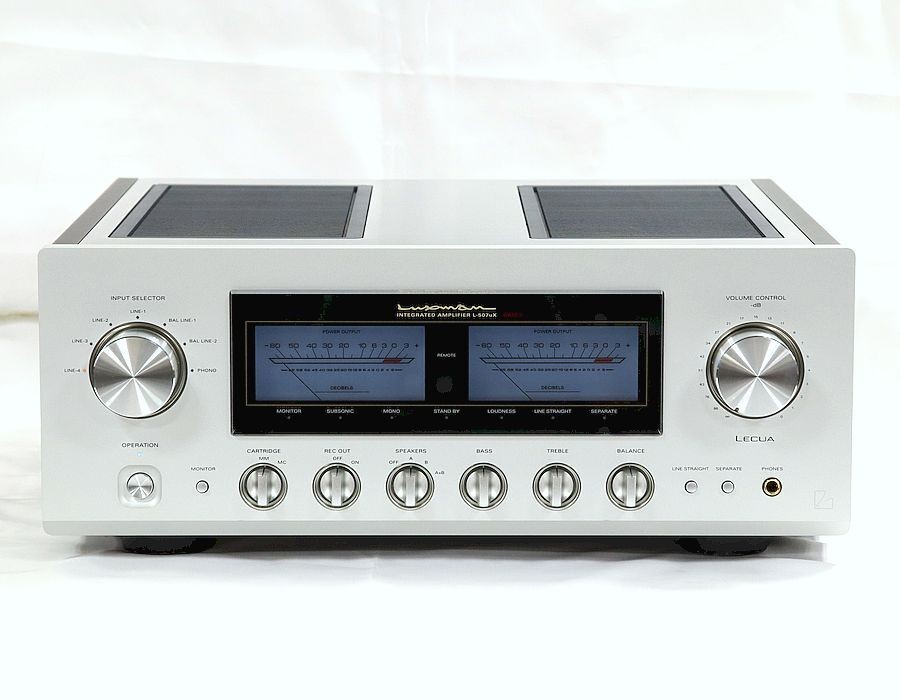
The front panel is minimalist: a large volume knob flanked by input and function selectors, with a small Luxman logo at the center. The brushed aluminum faceplate and smooth mechanical action of the switches convey a sense of solidity and longevity.
Common Issues and Maintenance
Like all vintage electronics from this era, the L-508 benefits from proper servicing after 40+ years. Common issues include:
- Capacitor Aging: Electrolytic capacitors in the power supply and signal path may dry out, leading to hum, reduced bass, or channel imbalance. Replacing these (recapping) is highly recommended.
- Oxidized Switches and Pots: The Alps volume pot and selector switches can develop crackling or channel dropouts. Cleaning with contact cleaner can help, but replacement may be necessary if worn.
- DC Offset Drift: While the L-508 has protection, aging transistors can cause slight DC offset. A technician should check and adjust bias if needed.
- Dust and Oxidation: Internal dust can attract moisture and cause corrosion. A thorough cleaning and inspection are advisable.
Finding replacement parts can be challenging, but the L-508’s popularity among collectors means that service manuals and community knowledge are available through vintage audio forums and specialist technicians.
Current Market Value and Collectibility
The Luxman L-508 is increasingly sought after by vintage audio enthusiasts, particularly those building Luxman-centric systems. While not as rare as the L-550 or L-590, its reputation for reliability and musicality has driven prices upward in recent years.
- Unserviced Units: $300–$500 USD
- Fully Serviced and Tested: $600–$900 USD
- Original Box and Manuals: Can add 10–20% to value
Collectors value the L-508 not just for its performance, but as a representative of Luxman’s analog philosophy—a time when audio gear was built to last decades, not become obsolete in five years. Its understated design also appeals to those who prefer timeless aesthetics over retro-futurism.
Conclusion: A Hidden Gem of the Golden Age
The Luxman L-508 may not have the name recognition of a Marantz 2270 or a Sansui AU-9900, but for those in the know, it represents the quiet excellence that defined Japanese high-fidelity at its peak. It’s a preamplifier that doesn’t shout—it whispers, with clarity and grace.
In an age of digital streaming and compressed audio, the L-508 reminds us of the beauty of analog circuitry, thoughtful design, and the pursuit of musical truth. Whether you're restoring a classic system or discovering vintage audio for the first time, the L-508 is more than a component—it's a bridge to a golden era of listening pleasure.
For the discerning audiophile, the Luxman L-508 isn’t just a preamp. It’s a statement.
eBay Listings



As an eBay Partner, we earn from qualifying purchases. This helps support our independent vintage technology research.
Related Models
- Luxman L-530 (1975)
- Luxman R-404 (1975)
- Luxman RV-371 (1975)
- Luxman SQ-38U (1975)
- Luxman T-14 (1972)
- Luxman T-530 (1975)
- Luxman TX-101 (1975)
- Denon DRA-800 (1985)
- Denon PMA-350Z (1980)
- Denon POA-1500 (1979)